AI companies want your next phone to run a 100-billion-parameter model, all day, every day, by 2028. That is what Qualcomm CEO Cristiano Amon said in an October 8 interview: multiple leading AI labs are telling the world's biggest mobile chipmaker they need smartphones that can keep at least a 100B-parameter model resident in memory and running continuously. He would not name the companies, but noted some are building their own phones. We ran the memory math on what that actually demands, and the gap between the ask and the hardware is brutal.
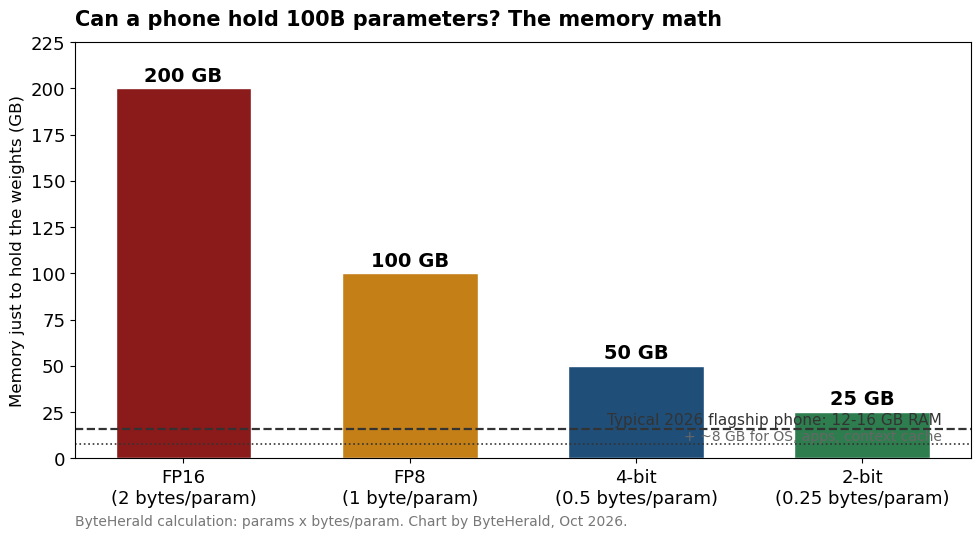
The math
A parameter is just a number the model learned. The memory it costs depends on how many bytes each number gets:
| Precision | Bytes per parameter | Memory for 100B params | + OS, apps, context (~8 GB) |
|---|---|---|---|
| FP16 | 2 | 200 GB | ~208 GB |
| FP8 | 1 | 100 GB | ~100 GB |
| 4-bit | 0.5 | 50 GB | ~58 GB |
| 2-bit | 0.25 | 25 GB | ~33 GB |
Now compare: a typical 2026 flagship ships with 12 to 16 GB of RAM, and even the 24 GB Android flagships of last year are disappearing as manufacturers avoid high-RAM variants during a memory price crunch. At 4-bit quantization, the practical floor before quality degrades, a 100B model needs roughly 58 GB, or about three and a half times the RAM of a 16 GB phone. At 2-bit it technically fits, but model quality falls off a cliff below 4-bit, especially for reasoning tasks. Amon himself admits memory prices are soaring while the industry is being asked to triple the RAM.
What Qualcomm can do today
The current ceiling is Qualcomm's Snapdragon 8 Elite Extreme Gen 6, built on a 2-nanometer process, whose NPU can run mixture-of-experts models above 30 billion parameters on-device with around 32, 000 tokens of context. Amon's target is more than three times that scale, and, crucially, running continuously rather than loaded for one task and shut down. The new platforms are rated for roughly a million tokens of local processing per day, which sounds large until you realize an always-on agent never stops.
There are escape hatches. Mixture-of-experts models keep most parameters dormant, only a fraction are active per token, so clever systems can stream weights from flash storage instead of holding everything in RAM. Aggressive quantization keeps improving. And unified memory architectures, like the packaging shifts in Apple's A20 Pro and Qualcomm's own Extreme chip, squeeze more usable bandwidth from the same silicon. But none of these change the fundamental equation by 3.5x in two years without a memory technology surprise.
Why the labs want it anyway
Amon's framing is the "battle of the agents": software that watches, reasons, and acts on your behalf instead of waiting for you to open an app. That kind of system has to stay resident, keep inferring in the background, and, the privacy pitch, keep your personal context, app data, and sensor history on the device instead of in someone's cloud. "We now have to design chips to allow the phone to be working, even when you're not operating it, " he said, "with an all day battery life and a lot of AI at the edge."
It is also a supercycle bet. Amon compares this moment to the early iPhone, the applications that will define the platform mostly haven't been invented yet, and he expects agents to drive upgrades the way third-party apps once did. The irony: the memory crunch he describes is the same force making buyers delay upgrades now. Whether 2028 delivers 100B-parameter phones or a humbler compromise, the direction is set, the phone is being redesigned around an agent that never sleeps.
What to watch next
Watch DRAM pricing and phone RAM configurations through 2027: if 24 GB flagships return, the industry believes the math closes; if 12 GB stays the ceiling, expect the 2028 "100B phone" to be a sparse mixture-of-experts model that technically qualifies while behaving like something much smaller. And watch which AI company ships its own phone first, Amon says some already are.
No provider paid for or reviewed this analysis. ByteHerald's original contribution is the memory-requirement table and the original chart above, our own calculation of parameters-times-precision against current phone hardware, October 11, 2026.
Comments
Post a Comment