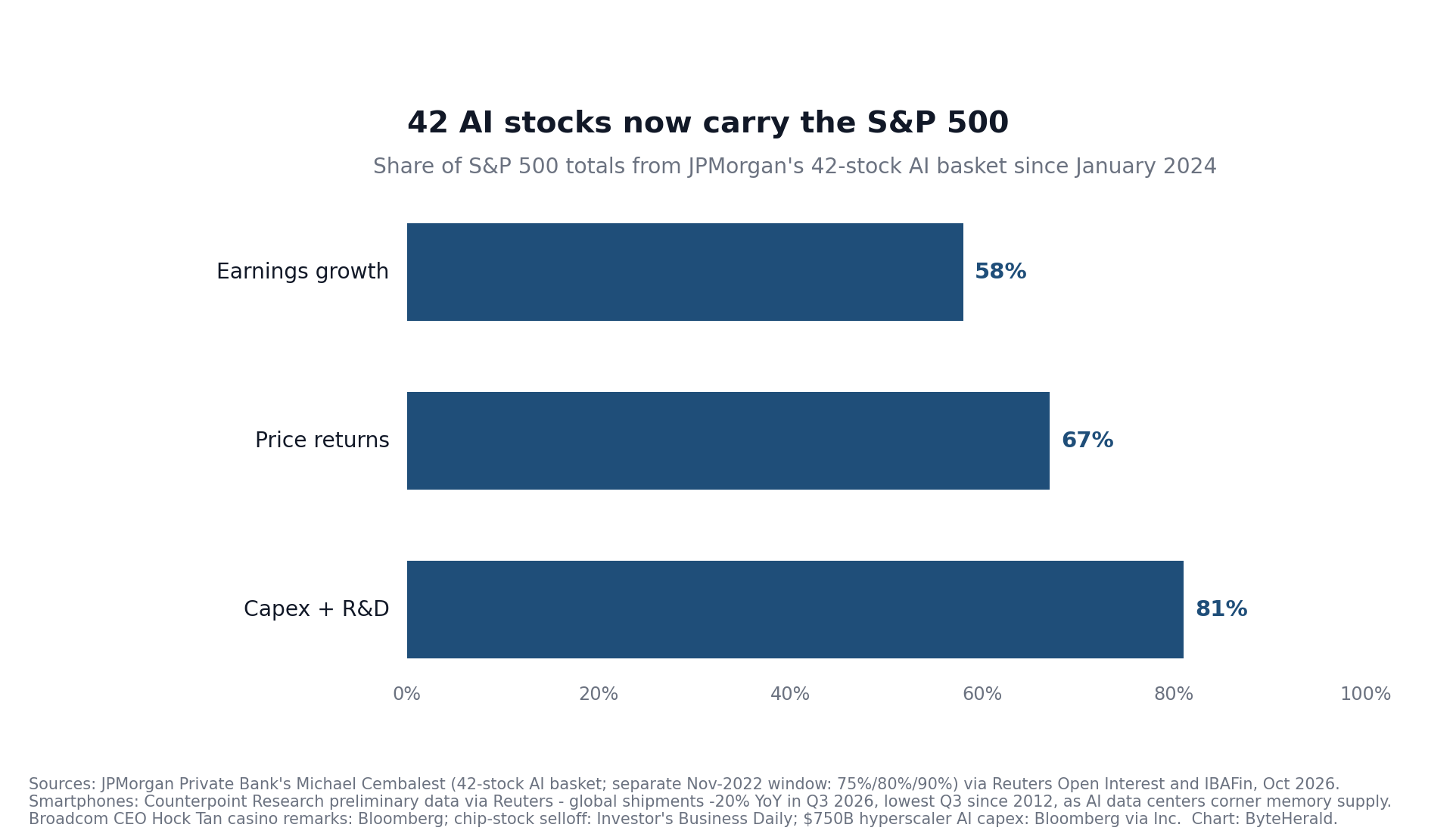
The most concentrated market in history just got a warning from inside the house. On Monday, Broadcom CEO Hock Tan likened many AI investors to casino gamblers, hours after JPMorgan's Michael Cembalest quantified just how concentrated the trade has become: a 42-stock AI basket accounts for 58% of the S&P 500's earnings growth, 67% of its price returns, and 81% of its capex and R&D since January 2024. Here is the concentration story in five numbers, and what each one does and does not prove.
1. 81%: the spending is the concentration
What it is: of all the growth in S&P 500 capital expenditure and R&D since January 2024, 81 cents of every dollar came from 42 AI-related stocks, per Cembalest's basket (reported via IBAFin; Reuters' Open Interest column cites a similar 41-name basket with 90% since ChatGPT's launch). Why it matters: the buildout is not broad business investment. It is a small cohort of companies building data centers, buying accelerators, and funding frontier labs. What it does not prove: that the spending is wasted. Capex is only a problem if the returns never arrive, which brings us to number five.
2. 67%: the AI basket is the market
What it is: the same 42 stocks delivered 67% of the S&P 500's price returns over the same window, and 58% of its earnings growth. Why it matters: passive index investors are AI investors whether they chose to be or not. A shock to the AI trade is now, mechanically, a shock to the index. What it does not prove: that valuations are wrong. Concentration can persist for years when the underlying businesses keep growing. The risk is fragility, not certainty of a crash.
3. -20%: AI ate the smartphone quarter
What it is: global smartphone shipments fell 20% year-on-year in Q3 2026, their lowest third-quarter level since 2012, per preliminary Counterpoint Research data reported by Reuters on Monday. Memory prices soared because AI infrastructure projects are cornering supply, pushing global smartphone retail prices up 20% so far in 2026; Samsung kept the top spot at 23% share while Xiaomi's shipments collapsed more than 30%. Why it matters: this is the concentration trade leaking into the real economy. Chips are finite, and every wafer AI data centers absorb is one phones and PCs do not get. What it does not prove: that the shortage is permanent. Hock Tan himself said the memory squeeze could ease within a year as capacity grows.
4. -1.5% and -3%: what a warning costs
What it is: on Monday, Broadcom (AVGO) fell about 1.5% and Intel (INTC) about 3% after their CEOs warned that access to financing, not chip shortages, is now the biggest constraint on the AI buildout. The headline was Investor's Business Daily's "Chip Stocks Fall On AI Funding Concerns." Why it matters: Tan told the DBS Asia Future Forward Conference in Singapore that raising money for AI infrastructure could prove harder than solving shortages of semiconductors, memory, or electricity. Intel's Lip-Bu Tan pointed to borrowing costs and demanded measurable returns. What it does not prove: that AI demand is weakening. Both CEOs still described strong near-term demand, with Tan saying compute demand could exceed supply through 2029 or 2030.
5. $750B: the bill the warnings are about
What it is: Meta, Amazon, Microsoft, and Alphabet are expected to spend roughly $750 billion in capital expenditures on AI this year alone, per Bloomberg reporting cited by Inc. on Monday. Why it matters: this is the number the casino quote is aimed at. Hock Tan likened AI investors to casino gamblers "who have no clue what they are investing in" (per Bloomberg), and separately rejected the idea that OpenAI is overvalued, blaming investors for setting extreme expectations without understanding the technology. His target was the funding, not the tech. With money this big flowing into AI bets, from DeepSeek raising billions while deploying millions of robots to hyperscalers tripling down on custom silicon, capital discipline is the question every CFO now has to answer. What it does not prove: that the returns will not come. The buildout is only three years old. Tan's warning is a demand for customers who generate real returns, not a verdict that they do not exist.
ByteHerald's reading
The concentration is real, and the warnings are about funding discipline, not technology failure. That is the honest version of this story. Cembalest's numbers describe where returns have come from, not where they are going. Counterpoint's shipments show who pays the supply bill when data centers win, not that phones are doomed. And Tan's casino remark is a funder warning his industry's own backers: the technology can work while the financing does not. If AI workloads keep paying for themselves at today's inference economics, the 42-stock burden is just math. If they stop, the same math becomes the crash. That is why Tan wants customers with real returns, not cheaper chips.
By ByteHerald Staff. Figures verified Oct 12, 2026 against Reuters (Open Interest column and smartphone reporting), IBAFin, Counterpoint Research preliminary data via Reuters, Investor's Business Daily, Bloomberg via Financial News and Inc., and TradingView consolidated price data. Concentration figures are JPMorgan Private Bank's 42-stock basket methodology, not a ByteHerald estimate. Market moves are intraday Monday readings. This is a research synthesis, not investment advice.
Comments
Post a Comment