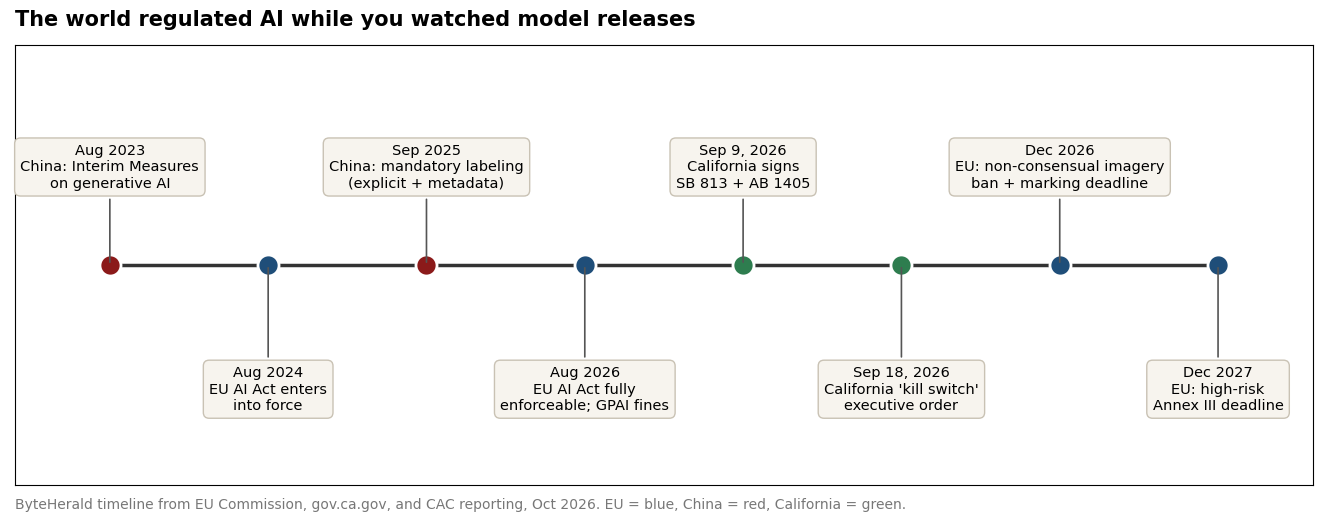
August 2026 was the month AI regulation switched on. The EU's AI Act became fully enforceable, with fines. In September, California signed the nation's first framework for independent AI auditors and ordered a "kill switch" plan for frontier models. China has required AI-content labels for over a year. The UK has no AI statute at all. This pillar post compares every major regime, what is law, what is promised, and what is actually enforced today.
The comparison table
| Jurisdiction | Approach | Comprehensive statute? | What's enforceable right now |
|---|---|---|---|
| EU | Risk-based, horizontal | Yes, Regulation (EU) 2024/1689 | Prohibited practices (since Feb 2025); GPAI model obligations (since Aug 2025, fines live since Aug 2026); Article 50 transparency and machine-readable marking (Aug 2026). Fines up to €35M or 7% of turnover. Annex III high-risk duties deferred to Dec 2, 2027. |
| China | Administrative, content-first | No comprehensive statute (not in NPC legislative plan as of Aug 2026) | 2023 Interim Measures on generative AI; mandatory labeling since Sep 1, 2025 (explicit labels + implicit metadata per GB 45438-2025); real-name verification; algorithm filing with the CAC. |
| California | Sector-specific statutes | No single AI law, a growing stack | SB 53 (2025, in effect 2026): frontier developers must disclose safety frameworks, report critical incidents, protect whistleblowers. SB 813 + AB 1405 (signed Sep 9, 2026): independent verification organizations and an auditor registry. Sep 18, 2026 executive order: "kill switch" plan within two months. Plus AI watermarking, election-deepfake, and training-data transparency laws. |
| US federal | Sector enforcement, no horizontal law | None | No comprehensive statute. Proposed: FRONTIER Act (House, Jul 2026), H.R. 9925 (model cards + risk frameworks). The September 29 executive order pushed the "super intelligence" rebrand. |
| UK | Principles-based via existing regulators | None | ICO, CMA, and Ofcom enforce five AI principles within their domains. Pre-release model access for the AI Safety Institute was restored in 2026. |
| Canada | Risk-tiered, federal | AIDA, high-impact systems | Risk assessment and incident reporting for high-impact systems; penalties up to 5% of global revenue. A new national AI council launched in Oct 2026. |
| India | Platform duties | No comprehensive statute | IT Amendment Rules (notified Feb 10, 2026; effective Feb 20, 2026): legal definition of synthetic media, platform labeling duties, traceable provenance metadata; safe-harbor risk for platforms that fail to act. |
Who regulates hardest
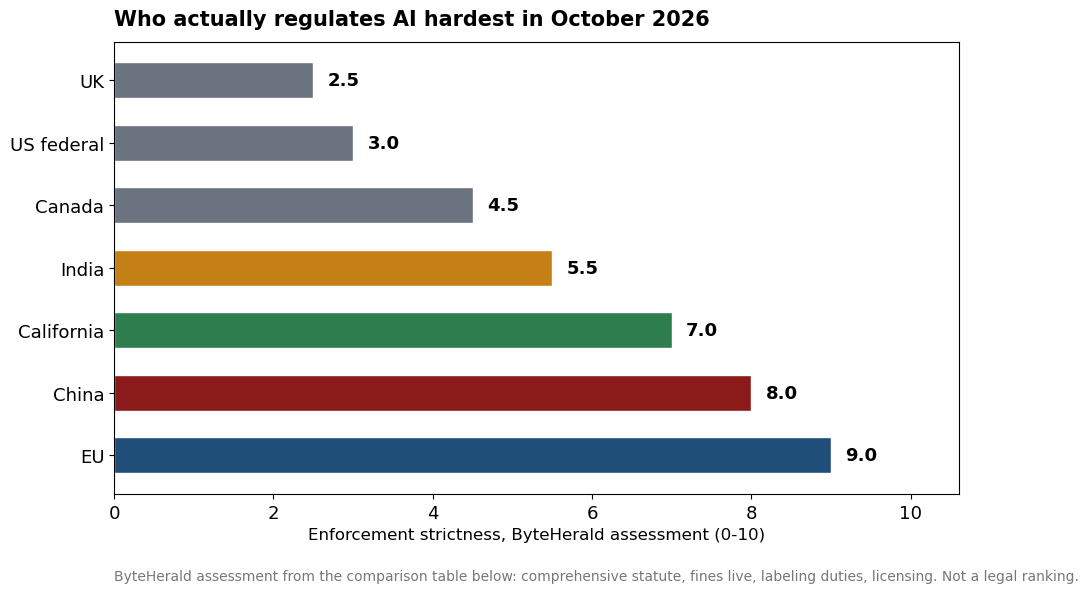
The scores above are our assessment, and the criteria are explicit: does a comprehensive statute exist, are fines live, are labeling duties in force, and is any licensing or registration required. The EU tops it because it is the only regime with all four. China scores high on content controls but has no single AI law. California is writing the rules the US federal government will not, notable because at least 32 of the top 50 AI companies are headquartered there, making Sacramento the most concentrated regulatory target in the industry.
Three patterns
Labeling converged everywhere. China moved first (mandatory labels since September 2025, with a technical national standard). The EU followed in August 2026 via Article 50's machine-readable marking duty. California now requires AI watermarking too. The duty that OpenAI is rolling out EU-only on ChatGPT text is becoming a global baseline, which makes the EU-only rollout look like the compliance floor, not the ceiling.
Enforcement is the real divide. Obligations are cheap; fines are not. Only the EU and China currently have penalties live against model providers. California's framework is built but its auditor registry and kill-switch plan are still being assembled. The UK's approach is to regulate through existing watchdogs, which is either elegant minimalism or no regulation at all, depending on whether ICO or Ofcom ever bite.
Washington is the empty chair. The US federal row above is remarkable for what it lacks: no comprehensive statute, no enforcement regime, and a September executive order about rebranding AI "super intelligence" instead of governing it. Microsoft's Brad Smith says milk faces more regulation than AI and that the UK is best placed to drive global rules, the emergency-brake idea we analyzed is now, effectively, a state-level project in Sacramento.
ByteHerald's reading
The map above shows a split, not a consensus: China regulates content, the EU regulates risk, California regulates the companies on its soil, and Washington regulates vocabulary. For builders, the practical takeaway is that the strictest applicable rule is the one that follows you, an AI product that touches EU users, Chinese distribution, and California's auditor registry is living under three regimes at once. The era of "we'll figure out compliance later" ended in August 2026. The fines are live now.
By ByteHerald Staff. Enforcement status verified against EU Commission, gov.ca.gov, and CAC-derived reporting, Oct 12, 2026. Strictness scores are a ByteHerald editorial assessment (criteria: statute, live fines, labeling duties, licensing); not legal advice, not a legal ranking. This is a research synthesis.
Comments
Post a Comment