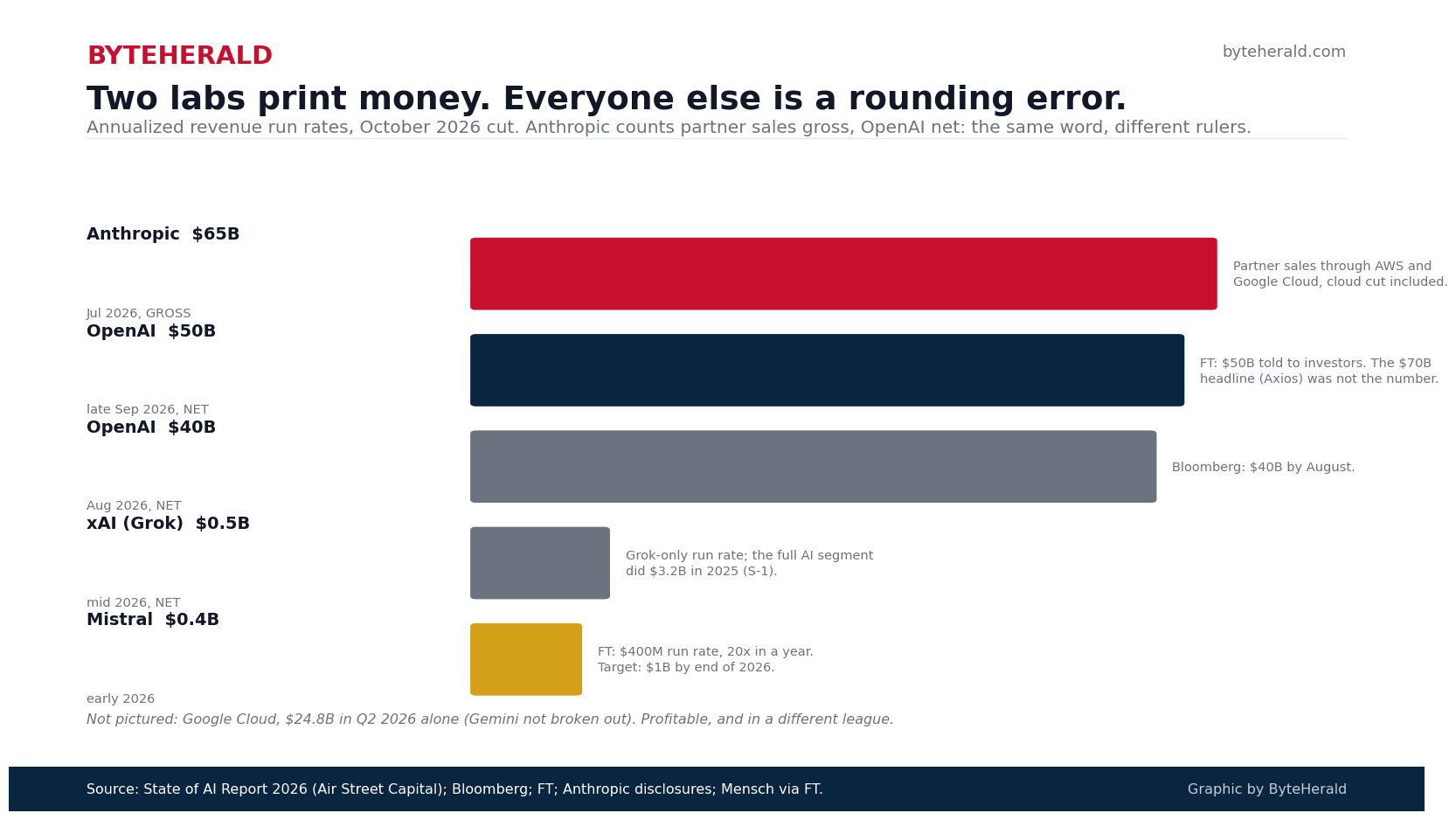
In October 2026, two AI labs print real money. Anthropic is running at roughly $65 billion in annualized revenue as of July, and OpenAI at about $40 billion by August and roughly $50 billion by late September, according to the State of AI Report 2026 and subsequent financial-press reporting. Everyone else in the lab business is at least an order of magnitude smaller. Those are the verified numbers. The fight is over what they mean: the two companies count revenue by different rules, one internal memo accuses the other of an $8 billion inflation, and only one of them can point to an actual profitable quarter.
The ledger, as of October 2026
Every figure below survived a claims audit. Anything that could not be traced to a named source was dropped, and the basis column matters more than the number: gross and net run rates are not the same thing, a point the next section takes apart.
| Lab | Annualized figure | As of | Basis | Source |
|---|---|---|---|---|
| Anthropic | $65B | July 2026 | Gross: partner sales through AWS and Google Cloud include the cloud cut | Bloomberg; State of AI Report 2026 |
| OpenAI | ~$50B | Late Sep 2026 | Net: Microsoft revenue share deducted | FT, from financial documents shared with investors |
| OpenAI | $40B | Aug 2026 | Net | Bloomberg |
| Anthropic | $47B | May 2026 | Gross | Company Series H disclosures |
| Claude Code (Anthropic product) | $2.5B | Feb 2026 | Net | Anthropic disclosure during Series G, via Reuters |
| xAI (Grok only) | ~$0.5B | Mid 2026 | Net | Industry tracking; full AI segment did $3.2B in 2025 per the SpaceX S-1 |
| Mistral | $0.4B | Early 2026 | Net | CEO Arthur Mensch via FT; target $1B+ by end of 2026 |
| Google Cloud (proxy) | $24.8B in one quarter | Q2 2026 | Segment revenue; Gemini not broken out | Alphabet earnings |
The $8 billion accounting fight
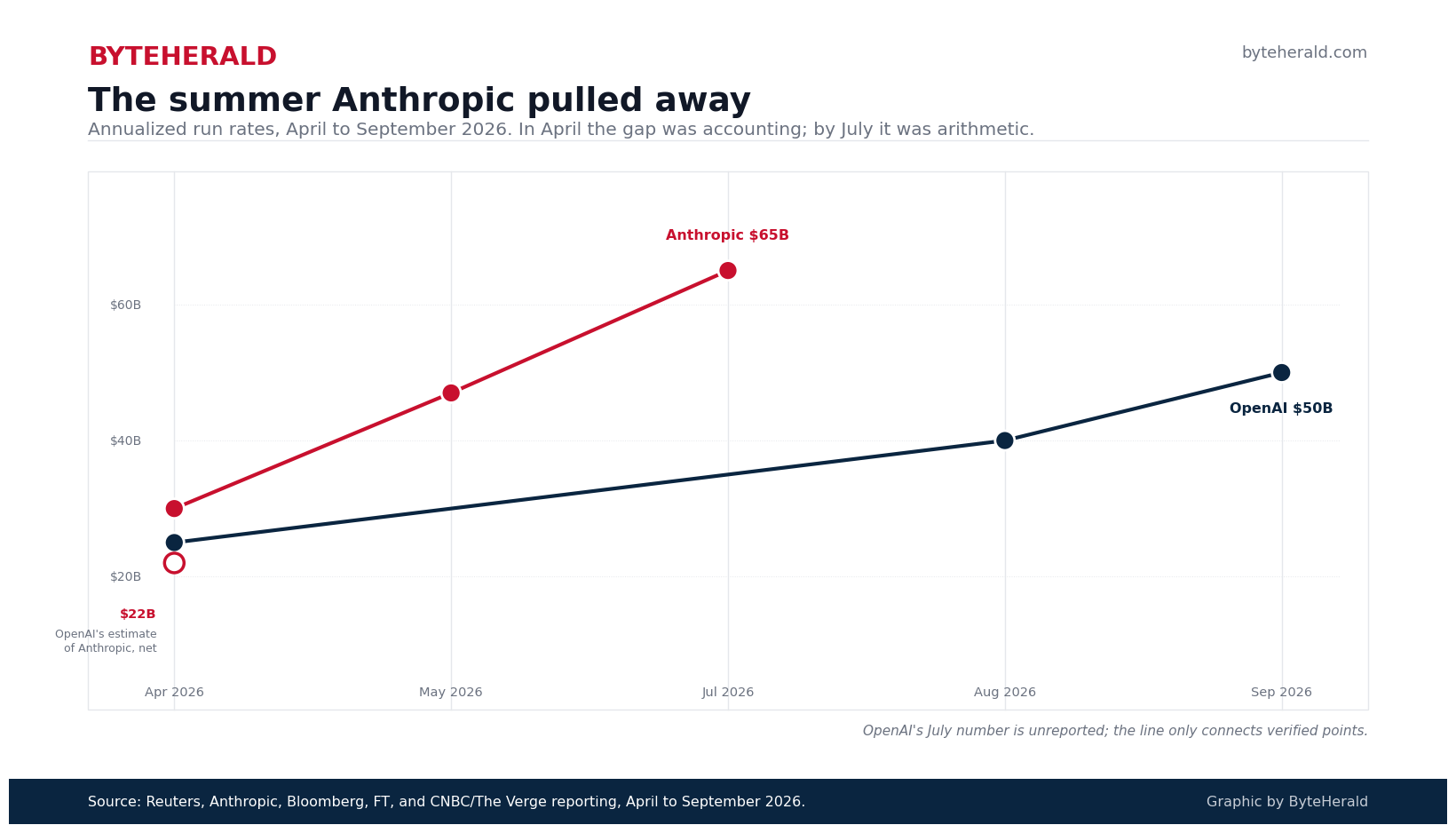
This is the honesty core of the whole revenue conversation. In mid-April 2026, OpenAI chief revenue officer Denise Dresser sent a four-page internal memo to staff, first reported by CNBC and The Verge, accusing Anthropic of overstating its revenue run rate by roughly $8 billion. The mechanism: Anthropic books sales made through cloud distribution partners on a gross basis, recording the full amount billed through AWS and Google Cloud, including the cloud providers' cut, as top-line revenue. OpenAI books its Microsoft revenue share net, deducting Microsoft's portion before recognizing it. On OpenAI's math, Anthropic's widely cited $30 billion run rate was closer to $22 billion on a comparable basis, slightly below OpenAI's own roughly $24 to $25 billion at the time.
Both treatments are permissible under US GAAP. The dispute is the classic principal-versus-agent judgment: Anthropic's position is that it is the principal in the transaction and the cloud vendors are distribution; OpenAI treats Microsoft as the agent and books only what it keeps. Dresser's memo argued the net treatment is "more in line with standards we would be held to as a public company." Anthropic has not publicly responded to the allegations, and no independent verification of either company's accounting exists. What will settle it is the S-1: Anthropic confidentially filed on June 1, 2026, ahead of an expected fall IPO, and auditors will rule on the revenue-recognition standard in public.
The $70 billion saga
September gave the accounting fight a public sequel. On September 29, Axios reported OpenAI's run rate was nearing $70 billion, up more than 70% since the quarter began. On October 8, the Financial Times, citing financial documents, reported OpenAI had told investors roughly $50 billion. A source told CNN the $70 billion "did not come from OpenAI": investors had simply added 70% growth to the $40 billion August estimate. CNBC confirmed the earlier figure included gross partner revenue and that no sales were lost. Markets reacted first and asked questions later: the Nasdaq fell 1.25% on October 8, its worst day since mid-August. A day later, Bloomberg reported OpenAI expects $70 billion or more by the end of 2026, led by enterprise sales.
The information gain here is the sequence itself. The $70 billion was never a company number; it was investor arithmetic applied to a stale estimate, laundered through a headline, then corrected by documents. Anyone comparing lab revenues without checking the date and the basis is comparing fiction to accounting.
Who is actually profitable
Revenue is not profit, and here the ledger gets honest. Anthropic reported preliminary second-quarter 2026 revenue above $11.5 billion, per documents seen by Bloomberg, and with it the company's first quarter of positive adjusted operating income. The third quarter came in at $16.8 billion, up 46%, per the FT. One profitable quarter on an adjusted basis does not make a profitable company, but it is the only such quarter any frontier lab can claim.
OpenAI's audited 2025 financials tell the other side: $13.07 billion in revenue against a $38.5 billion net loss. Anthropic's own S-1 paperwork, reviewed by Reuters, showed 2025 revenue topping $4.6 billion with net losses climbing to $42 billion. Both companies are spending far beyond what their revenue supports, on the bet that the growth curve keeps bending upward long enough to catch the spending.
The profitable incumbent is not a lab at all. Google Cloud did $24.8 billion in Q2 2026, up 82% year over year, with $8.8 billion in operating income and margins around 35%, on a $514 billion contracted backlog. Nearly 90% of the Fortune 100 now use Gemini Enterprise. But even Google is straining: Alphabet raised 2026 capex guidance twice to $195-205 billion, and free cash flow was negative $5.9 billion in the quarter. The cloud prints money and then immediately spends it on concrete.
Below the giants, the picture is niche economics. Mistral's $400 million run rate, up 20-fold in a year on European sovereignty demand, is real money at roughly a fortieth of Anthropic's scale; the company is targeting $1 billion by year end. xAI's Grok runs at roughly a $500 million annualized pace against $13 billion burned in 2025, though the full SpaceX AI segment did $3.2 billion last year and now holds a $1.25 billion-per-month compute lease from Anthropic through May 2029, which transforms the unit's economics from product revenue to infrastructure rent. And Claude Code deserves its own line: $2.5 billion in annualized revenue by February 2026, per Anthropic's own disclosure, up from $500 million five months earlier, with enterprise customers accounting for more than half. A coding tool is now a multi-billion-dollar revenue line inside the revenue leader.
The margin pressure underneath all of this is the price collapse: we tracked in October how AI got 75% cheaper in a year, with token prices falling while compute costs did not. Revenue growth has to outrun price erosion, which is why the run-rate race and the accounting fight are the same story.
Revenue per dollar of capex
Now the ratio that connects this pillar to the industry's biggest question. OpenAI has signed roughly $1.4 trillion in infrastructure commitments plus another $1.15 trillion in hardware and cloud agreements running through 2035; its own compute-spending guidance swung from about $600 billion (February) to $750 billion (July) through 2030. Anthropic carries a $518 billion compute commitment against its S-1. Set $40 to $65 billion in annualized revenue against commitments in the hundreds of billions to trillions, and the ledger does not balance; it bets that revenue roughly doubles annually for years while new funding arrives whenever the gap gets uncomfortable.
That is the company-level version of Gartner's industry-wide arithmetic from October 14: $8.5 trillion in revenue needed through 2030 for a 12% return on the infrastructure plan, $3.6 trillion forecast at most. Our October 14 pillar mapped the cost side of that equation; this is the revenue side. The two posts together are the full picture, and neither side currently covers the other.
The verdict
Two labs make real money, one accounting standard apart. One of them has a single profitable quarter. One incumbent cloud is genuinely profitable and spending like it is not. Everyone else is a rounding error or a niche. The numbers to watch into the IPOs: whether Anthropic's S-1 keeps the gross treatment, whether OpenAI's enterprise mix closes the gap by year end, and whether either company's revenue growth can outrun the token-price erosion that is eating the whole industry's margins.
By ByteHerald Staff. Run-rate figures from State of AI Report 2026, Bloomberg, the FT, and company disclosures as cited; memo details via CNBC and The Verge's April reporting. Charts are ByteHerald's original compilations; figures that could not be verified were dropped per our claims audit.
Comments
Post a Comment