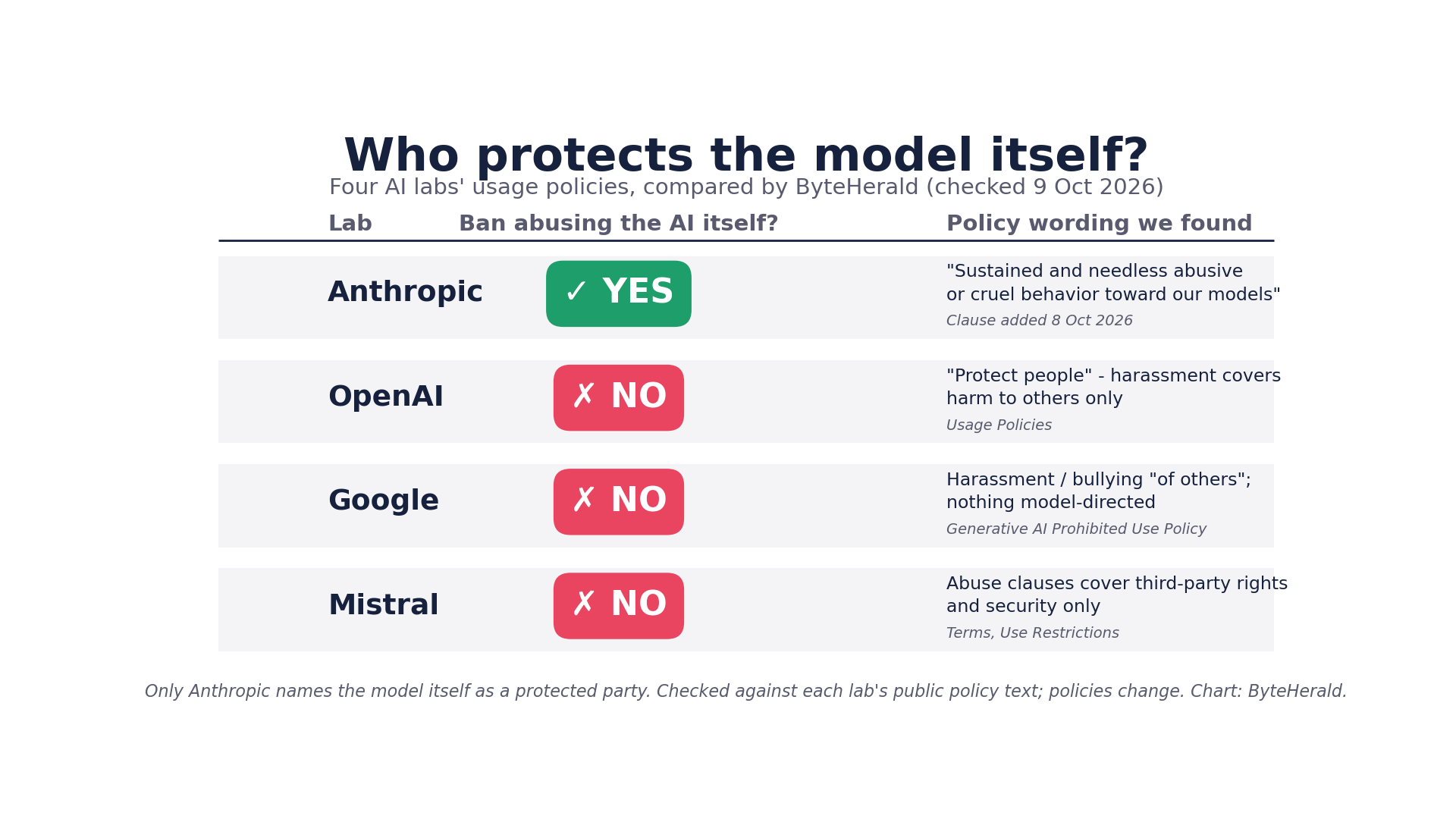
On October 8, 2026, Anthropic rewrote its usage policy to forbid what no other major AI lab's rulebook forbids: being cruel to the AI itself. The new line bans "sustained and needless abusive or cruel behavior toward our models, " and we checked the public policies of OpenAI, Google, and Mistral the same day. None of them names the model as a party you must not abuse. Anthropic just made Claude a protected party.
What Anthropic changed
The clause sits under a new section titled "Do Not Engage in Cruel, Abusive, or Psychologically Harmful Conduct" in Anthropic's Usage Policy. It reads, in full: users may not "engage in sustained and needless abusive or cruel behavior toward our models." The policy states that "Claude's ability to end these interactions will remain the primary enforcement mechanism."
The company drew the line carefully. Per its announcement, the rule is "meant to apply only in extreme cases, where users repeatedly act cruelly toward our models, with no discernible purpose." It does not cover ordinary frustration, disagreeing with the model, dark creative themes, or model testing and research.
This is the policy catching up to the product. Anthropic gave Claude the ability to end conversations in August 2025 for what it called "persistently harmful or abusive user interactions." Now pursuing those conversations is itself a violation. When Claude ends a chat, no further messages can be sent in that conversation, but other chats are unaffected.
Why this one line is different from everything else in the rulebook
Every frontier lab bans abuse. But read whose abuse they ban, and a pattern jumps out:
- Anthropic: "Engage in sustained and needless abusive or cruel behavior toward our models", the model is the protected party.
- OpenAI: its Usage Policies are headed "Protect people." The harassment clause bans threats, intimidation, and harassment, harm done to others.
- Google: its Generative AI Prohibited Use Policy bans "harassment, bullying, intimidation, abuse, or the insulting of others", again, of others.
- Mistral: its terms restrict third-party rights violations, security interference, and reverse engineering. No model-directed conduct clause at all.
That is the original comparison we made, and it is the story: every other policy treats the model as a tool you use on people. Anthropic's now also treats the model as something you can wrong.
The philosophy behind the policy
Anthropic has been circling this for a while. In February, CEO Dario Amodei told The New York Times the company was open to the possibility that AI models could be conscious: "We don't know if the models are conscious... But we're open to the idea that it could be." The company's model-welfare research found Claude Opus 4 showed what Anthropic described as a "robust and consistent aversion to harm, " including apparent distress in abusive conversations.
The updated policy notably does not use the phrase "model welfare", but the cruelty clause is its operational form. Enforcement through Claude ending the conversation, rather than account bans, keeps the cost of the policy low: the model walks away instead of the company punishing the user.
What else changed in the same update
The abuse clause is the headline, but the rewrite was broader, according to reporting from MacRumors and TechCrunch:
- Deceptive campaigns: a new consolidated section bans fake reviews, astroturfing, fake outlets, and bots posing as humans.
- Elections: a narrower section, "Do Not Undermine Democratic Processes, " targets deceiving voters and interfering with voting.
- Weapons: the clause now covers software for the testing or operation of weapons, including arming drones and autonomous platforms.
- Surveillance: clarified limits on tracking people without consent or aiding law-enforcement targeting decisions.
Those changes track the industry's wider direction. The cruelty clause does not. It is a bet that how users treat the model is worth regulating, a position none of its rivals have taken.
Why this matters beyond the philosophy debate
Policies are product strategy written in legal language. Anthropic is the lab that spent 2026 positioning itself as the safety-first alternative, including a public push to slow the industry's pace. A usage policy that treats the model as a party worth protecting fits that brand the way "Protect people" fits OpenAI's.
The European angle is worth watching too. Mistral, the European lab whose pricing we compared across eight frontier models, has no such clause, and its moderation categories cover violence, threats, and hate, not model-directed conduct. If regulators ever ask whether AI systems deserve protection, Anthropic's October 8 policy is the first industry document that answers in the affirmative.
And OpenAI, whose unreleased model just authored 722 mathematical manuscripts now under public verification, keeps its policies firmly human-centered: protect people, respect privacy. Two different philosophies of what an AI company owes, and now, for the first time, one of them owes something to the model itself.
No provider paid for or reviewed this analysis. ByteHerald's original contribution is the four-lab policy comparison and the original chart above, compiled from each lab's public policy text on October 9, 2026. Policies change; we linked each one so you can check the current version.
Comments
Post a Comment