Apollo Global Management published a short note on October 24, 2026, with a blunt headline: there are no signs of an AI payoff outside the tech sector. The note's own description puts it plainly, that despite massive investment and widespread hype, artificial intelligence has delivered zero financial payoff to corporate America outside of tech.
The direct answer: Apollo chief economist Torsten Slok said on October 24, 2026, that AI has delivered no measurable financial payoff outside the tech sector, because revenue per employee and profit margins are rising for the Magnificent Seven and flat for the other 493 companies in the S&P 500.
What Apollo actually measured
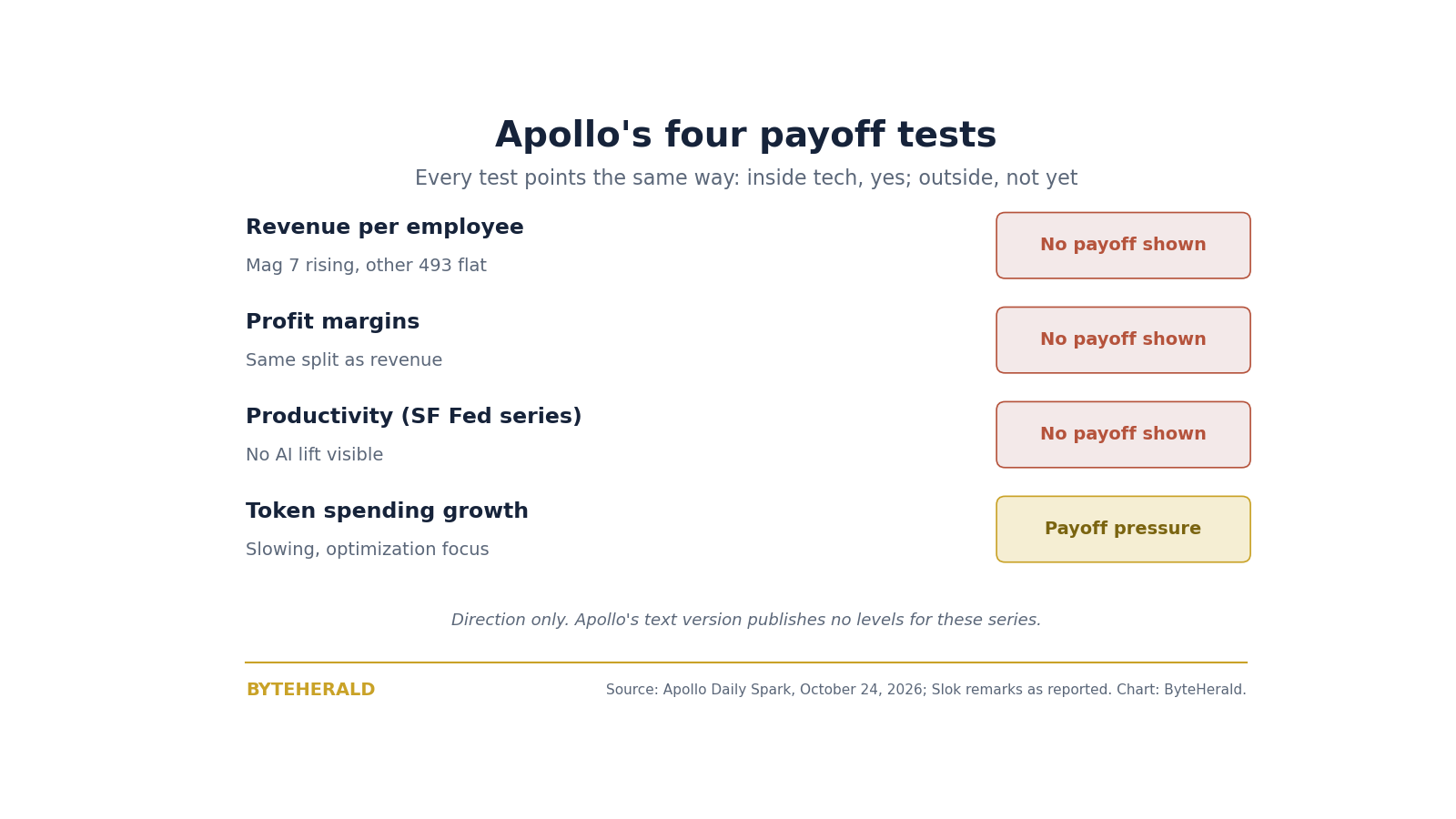
Apollo's note rests on four tests, as summarized in coverage of the note. First, revenue per employee: rising for the seven largest tech companies, flat for the other 493. Second, profit margins: the same split, rising inside tech and flat outside it. Third, productivity: the San Francisco Federal Reserve's productivity series shows no sign of AI lifting growth. Fourth, the market's own behavior: token spending growth is slowing, and labs and buyers are turning to token optimization, model routing, and token marketplaces, which Slok reads as an early warning that adoption is proving slower and more complex than markets priced in.
That fourth point is the one with teeth. If AI were paying off broadly, buyers would be spending more, not optimizing harder to spend less. Slok's warning, as reported, is that valuations could face a painful repricing if the productivity payoff takes five years rather than five months, because equity markets have priced instant earnings growth against a much slower cash flow reality. He has also argued, in the same week's remarks, that the marginal cost of producing compute exceeds the marginal benefit it delivers to users so far, which raises questions about claims of unlimited demand for data centers.
The other reading of the same data
Apollo's verdict is not uncontested, and the honest way to report it is to show where the other side reads the same chart differently. A separate reading of public Federal Reserve productivity data by vinay krishna on Medium, published the same weekend, finds that United States productivity growth roughly doubled after 2022, but that the component which would show machines making work smarter has gone flat over the last four quarters. On that reading, both sides are looking at different lines on the same chart: the headline growth number rose, the smarter-work component did not.
The distinction matters because it decides what would settle the argument. If Apollo is right, the next few quarters should show margins outside tech staying flat even as AI spending continues. If the other reading is right, the smarter-work component should turn up as deployed systems mature, and the lag is a measurement problem, not a payoff problem. Economists have seen this pattern before with earlier general purpose technologies: the productivity paradox, where a transformative technology shows up everywhere except in the productivity statistics, until workflows are redesigned around it.
Why the payoff would lag outside tech
Slok's own explanation for the lag is structural, not mysterious. Software companies can integrate AI into their products relatively quickly. Healthcare, banking, manufacturing, energy, and transportation face far longer implementation timelines because of regulatory hurdles, data governance requirements, and the need for extensive process changes. A hospital cannot deploy an AI system the way a software company ships a feature, and a bank cannot let a model touch customer money without controls that take quarters to build.
That is also why the enterprise spending data cuts both ways. Our ledger of what AI agents actually spend at scale found enterprises capping agent spend, with heavy users reaching hundreds of dollars per engineer per month and banks imposing strict gatekeeping on model usage, which is exactly what a payoff lag looks like from the buyer's side: the bill arrives monthly, the return arrives eventually. The question is not whether companies are spending, it is whether the spending is buying productivity or buying the option on future productivity.
The payoff test: what would change the verdict
Apollo's note is a claim about the present, not a prophecy, so it should be held to a test. Here is the test, in the open, so readers can check it against the next round of data.
| Apollo test | What Apollo shows now | What would change the verdict |
|---|---|---|
| Revenue per employee, Mag 7 vs other 493 | Rising inside tech, flat outside | Other-493 revenue per employee rising for two consecutive quarters |
| Profit margins, same split | Expanding inside tech, flat outside | Other-493 margins expanding while AI spending holds steady |
| Productivity, SF Fed series | No AI lift visible | The smarter-work component turning up over four quarters |
| Token spending behavior | Growth slowing, optimization rising | Token spending growth re-accelerating without discounting |
Two of those four tests are already moving in ways worth watching. Token prices have collapsed, with our price tracker showing cuts of up to 75 percent on some models, which should, in theory, make the payoff math easier for buyers. And Gartner's October analysis put the gap between AI spending and AI revenue in the trillions, which is the same warning from the seller's side of the market: up to 3.5 trillion dollars of AI spending may never pay off if revenue does not arrive. Apollo, Gartner, and the enterprise spending caps all point at the same gap from three different directions.
What this means for buyers
For a company deciding its 2027 AI budget, Apollo's note argues for a narrower test than the one vendors sell. Do not ask whether AI works in a demo. Ask whether revenue per employee or margins moved in the unit that deployed it, over at least two quarters, against a unit that did not. If neither moved, the deployment is a cost center with a good story, and the honest budget response is a cap, not an expansion. If one moved, the deployment is the template, and the budget follows the template, not the vendor.
For investors, the note reframes the AI trade. The Magnificent Seven are not a proxy for the AI economy; they are the AI economy's sellers, and their rising revenue per employee is, in part, the other 493 companies' AI spending. When the sellers' growth depends on buyers who show no payoff, the trade is circular until the buyers' numbers turn. That circularity is the same warning Slok sounded about token spending: AI companies financing or guaranteeing the purchases of their own customers. A payoff that only exists inside tech is not a broad economic boom. It is a transfer.
By ByteHerald Staff. Apollo Global Management published its Daily Spark note titled No Signs of AI Payoff Outside the Tech Sector on October 24, 2026, with the description that despite massive investment and widespread hype, AI has delivered zero financial payoff to corporate America outside of tech. Coverage of the note reports Slok's four tests: revenue per employee and profit margins rising for the Magnificent Seven and flat for the other 493 S&P 500 companies, and no AI lift visible in the San Francisco Federal Reserve productivity series. Slok warned in remarks reported the same week by MENAFN via AsiaNet News that AI valuations could face a painful repricing if the productivity payoff takes five years rather than five months, and that token spending growth is slowing as buyers turn to token optimization. A separate reading of Federal Reserve productivity data by vinay krishna on Medium, published October 24, 2026, found United States productivity growth roughly doubled after 2022 while the smarter-work component stayed flat over the last four quarters. Gartner reported in October 2026 that up to 3.5 trillion dollars of AI spending may never pay off against forecast revenue.
Comments
Post a Comment