CERN and Mistral AI have formed a long-term strategic partnership to build "Flare", what CERN calls the first foundation model for collider physics, trained on billions of simulated particle collisions. The French AI company gets access to one of the world's largest scientific datasets: roughly one exabyte of Large Hadron Collider data. Here is what the deal is, what Flare would replace, and where it sits in AI's conquest of science.
What was announced
Reuters reported on October 15 that CERN and Mistral signed a statement of intent for a long-term strategic partnership to develop a foundation model for scientific discovery. The goal: a "Large Physics Model" named Flare, which CERN says would be the first foundation model for collider physics. It uses the same idea as the large language models behind generative AI, the transformer pattern we walked through in our visual explainer, but trained on collision data instead of text. A CERN spokesperson told Reuters it is meant to replace some of the specialized algorithms now used to reconstruct and identify particles, noting CERN has used AI to turn raw experiment data into event pictures for a decade, with multiple separate tools per step. CERN chief information officer Enrica Porcari said the partnership would advance AI capabilities "that can serve the whole physics community and be shared." No timeline or budget was disclosed; both sides said the models could later serve other sciences.
The politics inside the physics
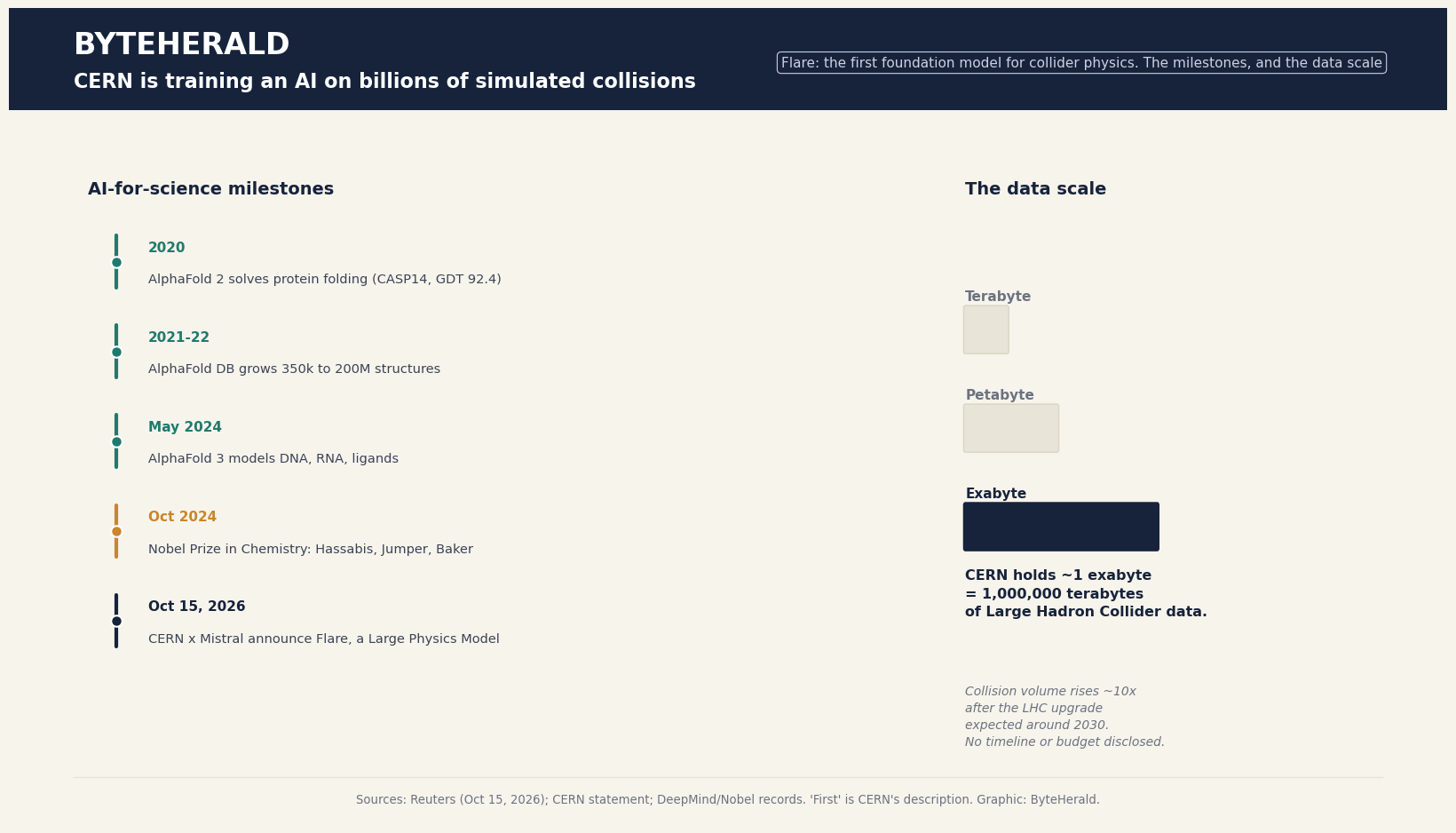
Mistral chief executive Arthur Mensch used a Le Monde article published the same day to argue that frontier models are "now indispensable to scientific progress", and to criticize companies that keep their advantages to themselves. The jab lands in context: Mistral, the French lab whose frontier-model pricing we charted last week, is positioning open scientific models against closed frontier labs. For CERN, the logic is data gravity: it holds about one exabyte, a million terabytes, of experimental data, and expects collision volume to rise tenfold after the LHC's ongoing upgrade, expected around 2030. Nobody else has this dataset. A foundation model trained on it is a moat made of physics.
Where Flare sits in the timeline
The milestones graphic above is our original compilation. AlphaFold 2's 2020 CASP14 win (GDT score 92.4) solved the 50-year protein-folding problem; its database grew from 350, 000 structures in 2021 to over 200 million in 2022; AlphaFold 3 arrived in May 2024 extending to DNA, RNA, and ligands; the 2024 Nobel Prize in Chemistry went to Hassabis, Jumper, and Baker. Flare is the first attempt to do for collider physics what AlphaFold did for structural biology: replace a patchwork of specialized tools with one foundation model. The honest caveats: "first foundation model for collider physics" is CERN's description, not an independent verdict; there is no timeline, no budget, and no published architecture. What is real is the dataset and the intent, and in AI, those two have been enough to start every previous revolution.
ByteHerald's reading
The pattern to watch is AlphaFold's: a domain with a uniquely large, uniquely clean dataset meets the transformer, and a decade of specialized tooling collapses into one model. Particle physics has the cleanest data in science, every collision is labeled by the laws of physics themselves, and CERN has an exabyte of it. If Flare works, the next decade of "foundation models for X" will be built on whoever holds the best domain datasets, not whoever holds the most GPUs. That is a very different AI race than the one Silicon Valley is running.
By ByteHerald Staff. Based on Reuters reporting (Leo Marchandon, Oct 15, 2026) and the CERN statement. The single Mensch quotation is brief; all else paraphrased. Milestone graphic is ByteHerald's original compilation.
Comments
Post a Comment