OpenAI added monthly API credits to ChatGPT Pro and Business subscriptions on October 28, 2026, turning a chat subscription into a small developer budget. The direct answer for anyone holding one of these plans is this: Pro tiers get a credit equal to their monthly price, $100, $200, or $500, and Business workspaces pool $20 per Standard seat or $100 per Premium seat up to a $500 monthly cap, but the credit must be claimed, it expires at the end of each billing cycle, and it does not cover Codex. Unclaimed credit is not a discount deferred. It is money that vanishes.
What each plan actually gets
OpenAI announced the benefit through its developer community on October 28, 2026, with the amounts in its developer documentation page titled "API credits for ChatGPT subscribers." The structure is simple on the Pro side and pooled on the Business side. A Pro subscriber's credit matches the tier price. A Business workspace's credit grows seat by seat until it hits the ceiling, and seats added past the ceiling add nothing.
| Plan | Monthly API credit | Cap |
|---|---|---|
| ChatGPT Pro, $100 tier | $100 | $100 per subscriber |
| ChatGPT Pro, $200 tier | $200 | $200 per subscriber |
| ChatGPT Pro, $500 tier | $500 | $500 per subscriber |
| ChatGPT Business, Standard seat | $20 per paid seat | $500 per workspace |
| ChatGPT Business, Premium seat | $100 per paid seat | $500 per workspace |
| ChatGPT Business, annual billing | Full year upfront | $6,000 per workspace |
Free, Go, Plus, and Enterprise plans get nothing, and neither do free trials or legacy Codex seats. The subscription must have been active for at least seven days, the ChatGPT account and the API organization receiving the credit must share an email address, and the subscriber must own both. Pro subscribers claim through ChatGPT billing settings. Business subscribers claim through workspace billing settings or the Admin Console.
The cap arithmetic
The Business cap is where most readers will misjudge the benefit. A workspace reaches $500 with 25 Standard seats or with five Premium seats. A 26th Standard seat adds zero. A sixth Premium seat adds zero. Annual workspaces get the whole year's credit in one grant, capped at $6,000, and that grant expires at the end of the annual billing cycle. The first grant is prorated to the time left in the current billing cycle, so claiming mid-cycle buys a partial month, not a full one. No payment method is required to spend the credit, and free credits are spent before purchased credits. When the balance runs out and nothing else is loaded, API requests fail with HTTP 429 and the error code credit_balance_exhausted.
OpenAI copied Anthropic, then raised the top
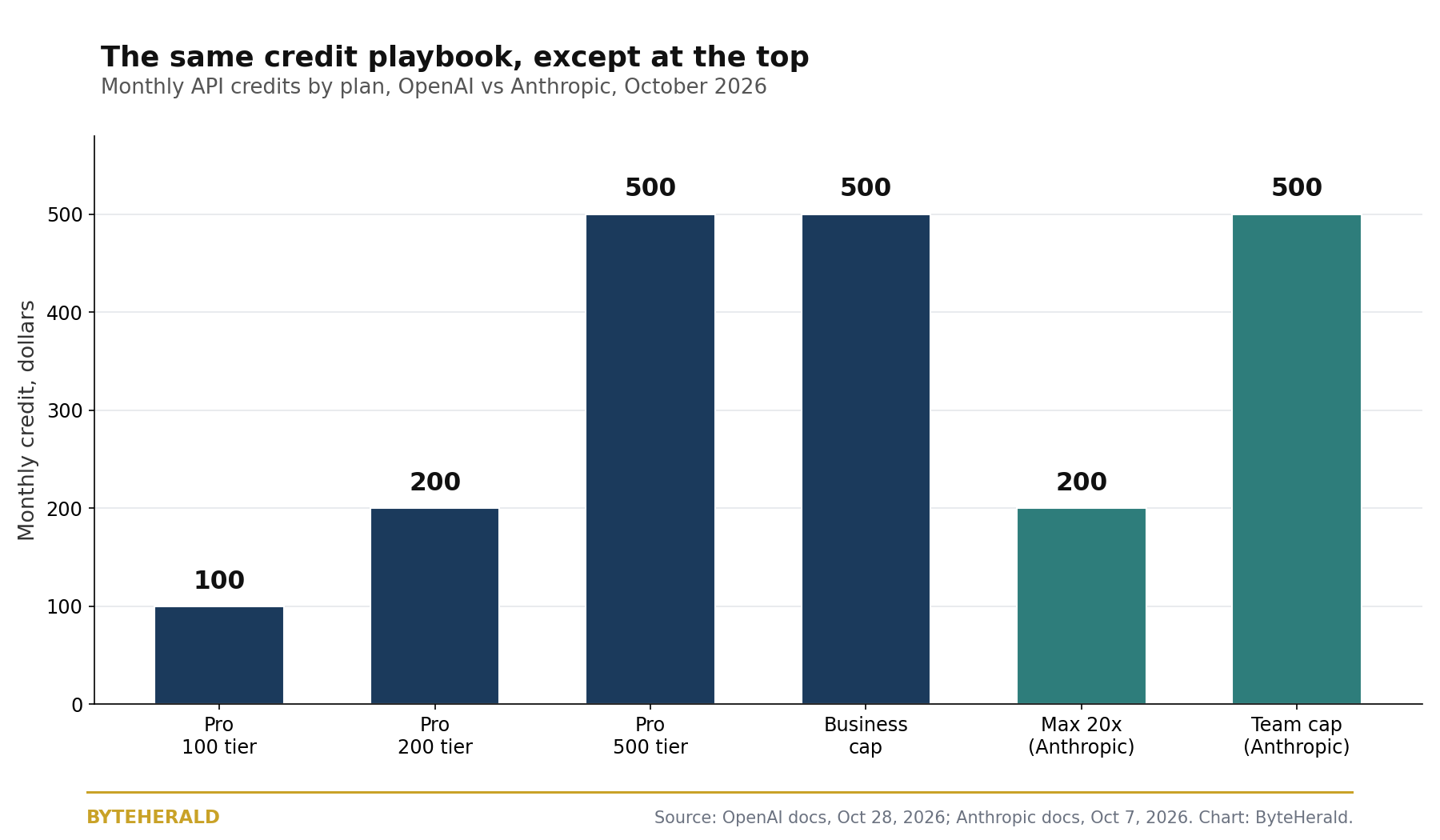
Anthropic announced a near-identical structure on October 7, 2026, alongside Claude Haiku 5.5, and the two programs line up seat for seat: $20 per Standard seat, $100 per Premium seat, a $500 team cap, a seven-day wait, no rollover, no payment method required, and the vendor's coding tool excluded (Claude Code there, Codex through an API key here). Three differences stand out. OpenAI's $500 Pro tier gets $500 in credits, while Anthropic's most expensive Max plan, Max 20x, gets $200. OpenAI hands annual Business workspaces the full year upfront, while Anthropic pays monthly on annual plans. And a seat added mid-cycle brings prorated credit at OpenAI, while Anthropic counts it only from the next billing month. The pattern is familiar from both vendors: bundle a slice of the metered product into the flat subscription so existing customers try the metered side.
What the credit buys, and what it does not
The credit pays for usage on the API platform: the Responses API, Agents API, Decisions API, GPT-Live and the Realtime API, the Images API, and built-in tools such as web search, file search, and Code Interpreter, including their usage and storage fees. It does not raise usage limits inside ChatGPT, and it does not pay for Codex used through an API key. For a sense of scale, take the list prices from our flash-model pricing work: a 10-million-input plus 2-million-output batch costs $2.50 uncached on GLM-5.3-Flash and $2.70 on DeepSeek V4.1 Flash, so a $100 credit covers 40 such batches on the former and about 37 on the latter, before caching or peak pricing changes the math. That is a real experimentation budget for prototypes and agent workflows, not a rounding error, and it is also the reason the expiry matters: a team that claims late or forgets the cycle boundary donates the budget back. Readers who want the full price picture can start from our flash-model price scoreboard, which shows how the cheapest pick changes by workload and by hour.
The catch is the calendar
Three limits decide whether this benefit is worth anything to a given subscriber. First, it must be claimed and linked to an API organization the subscriber owns; nothing arrives automatically into an unlinked account. Second, unused credit expires at the end of the billing cycle, so the budget resets whether it was spent or not. Third, OpenAI gives no numbers on the program's reach, no count of eligible subscribers, no cost figure, and no guaranteed duration: grants continue while the benefits are available, which is the company's wording, not a promise. The evergreen question behind this launch is not whether $500 sounds generous, because for a solo Pro subscriber it matches the subscription price exactly, but whether a chat subscriber becomes an API builder once the first month's credit is sitting in the account. Both OpenAI and Anthropic are betting the answer is yes, and both have set the same trap for the inattentive: the credit that is never claimed costs the vendor nothing. The broader price context matters too: credits are arriving as model prices fall, a trend we tracked in our token-price tracker, which found the big cuts had already happened and the next moves were up, so a credit banked now buys more than the same dollars may buy later.
Who should claim, and who should skip
Claim it if you build anything with the API, even occasionally: prototypes, internal assistants, retrieval workflows, or agent experiments. The claim takes a few clicks in billing settings, and the first grant is prorated, so claiming sooner buys more of the current cycle. Claim it once per Business workspace, not per seat, since the pool is shared and capped. Skip worrying about it if you only chat: the credit does not change ChatGPT limits, it does not apply to Codex, and it cannot be converted into anything inside the chat product. For a Business workspace, the decision worth a meeting is the seat mix: five Premium seats already hit the cap, so adding Standard seats past 25 buys headcount, not credit. And for any subscriber, the discipline is monthly: check the balance before the cycle ends, because the unspent portion does not carry over, and the vendor is counting on exactly that forgetfulness.
By ByteHerald Staff. OpenAI Developer Community announcement, published October 28, 2026, gave the claim steps and the credit amounts: Pro plans get $100, $200, or $500 per month by tier, and Business plans get $20 per paid Standard seat or $100 per paid Premium seat, pooled up to $500 per workspace, with the first grant prorated and monthly grants expiring at the end of the billing cycle. OpenAI developer documentation titled "API credits for ChatGPT subscribers," published October 28, 2026, added the $6,000 annual Business cap, the seven-day active requirement, the same-email and owned-organization conditions, the covered APIs and built-in tools, the Codex exclusion, and the HTTP 429 failure when the balance is empty. Anthropic documentation titled "API credits for Max and Team plans," published October 7, 2026, set the mirror structure: Max 5x $100, Max 20x $200, Team $20 per Standard seat and $100 per Premium seat pooled and capped at $500, with the same seven-day wait, no rollover, and Claude Code excluded.
Comments
Post a Comment