Cisco president Jeetu Patel gave 27-year-old engineer Padmanabhan Krishnamurthy unlimited AI tokens and four weeks to prove a two-person team can rewrite 98% of Cisco legacy code within 24 months, Fortune reported on October 30, 2026. It is the bluntest version yet of a bet every large software company is now making: that AI coding tools can do what hiring alone cannot, which is to clear a legacy backlog faster than it grows.
What Cisco actually announced
Patel told Fortune at a small roundtable dinner that he found Krishnamurthy five levels below him in the organization, doing work Patel called unstrategic. Krishnamurthy cofounded EzDubs, a real-time translation startup founded in 2023 that Cisco acquired in 2025, and joined Cisco with that acquisition. Patel gave him unlimited tokens because, in Patel's words, he is going to refactor code. Patel added: go nuts.
| Item | What Fortune reported |
|---|---|
| Who | Padmanabhan Krishnamurthy, 27, former EzDubs cofounder, now a Cisco engineer |
| Sponsor | Jeetu Patel, Cisco president and chief product officer |
| Budget | Unlimited AI tokens for the refactoring work, with no rationing of usage |
| Target | Refactor 98% of Cisco legacy code within 24 months |
| Proof window | Four weeks for Krishnamurthy to prove the approach works |
| Team claim | Krishnamurthy believes a two-person team could do the job |
Refactoring, for readers outside engineering, means restructuring code without changing what it does. Done well, it makes a codebase cheaper to change and safer to extend. Done carelessly, it breaks things that used to work, which is why legacy rewrites have a reputation for running long and failing quietly. That reputation is the context for the four-week proof window: Cisco is not committing to the 24-month target on a promise, it is asking for evidence first.
The pace problem, in plain arithmetic
Spread evenly, 98% over 24 months is about 4.08 percentage points of legacy code a month. That figure is ByteHerald arithmetic from Fortune's two numbers, not Cisco's plan, and it should not be read as one. Real rewrites are never even. The first code to go is usually the best understood and best tested, and the last code is usually the oldest, least documented, and most entangled with customers who cannot tolerate a breakage. If Cisco reports steady percentage progress without saying which code moved, that progress will flatter the plan.
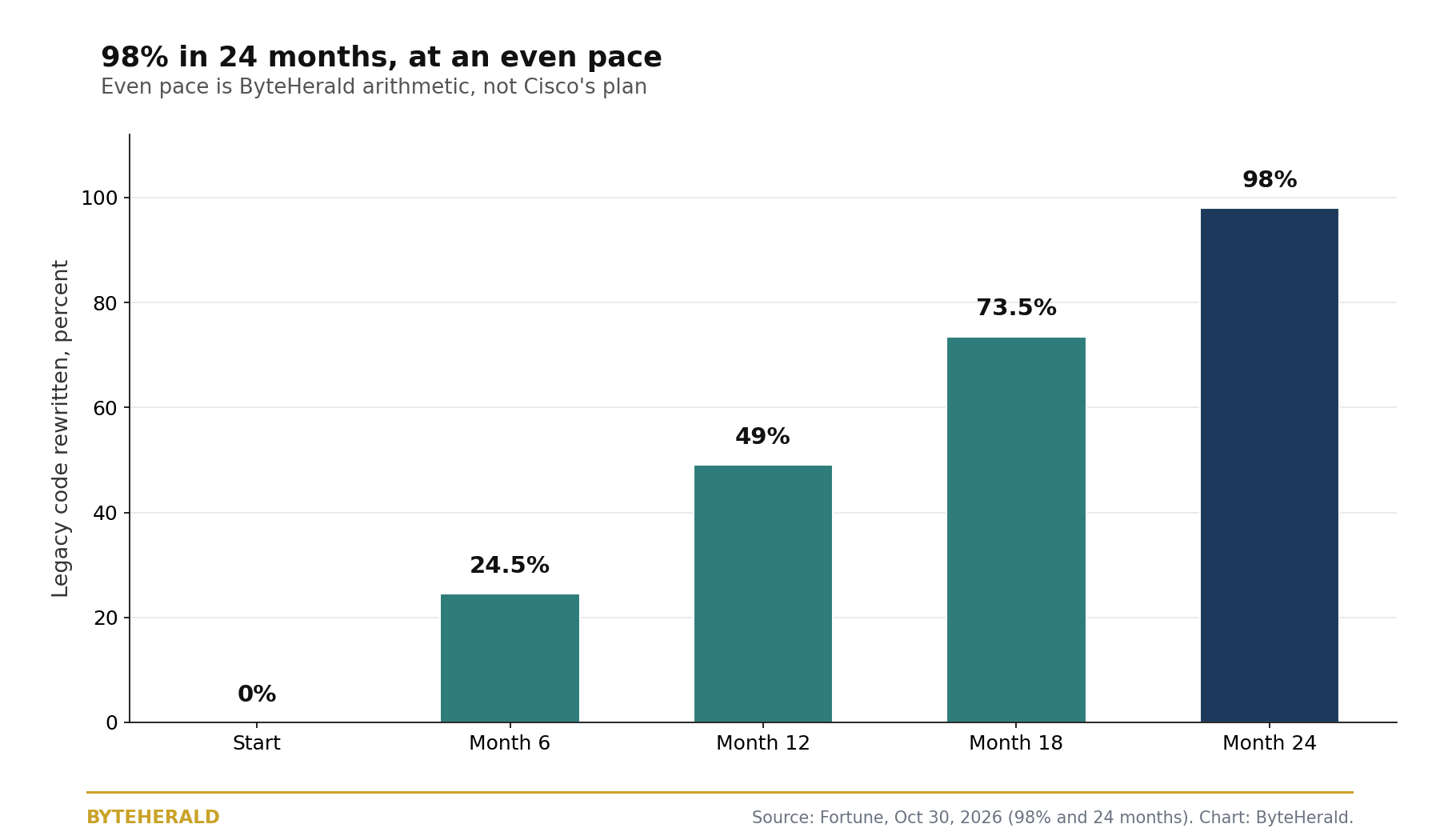
The honest way to read the target is as a direction, not a schedule. A 98% refactor in 24 months would mean Cisco's engineering organization spends two years changing almost everything it already ships, while still shipping new products. That is possible only if the refactoring itself is largely automated, which is exactly what the unlimited token budget is meant to test.
What unlimited tokens do not fix
Tokens are the small chunks of text that AI models read and write, and companies pay for them by usage. Removing the ration means an engineer stops choosing between a thorough pass and a cheap pass. It does not remove the bill, it does not supply judgment about which code is safe to change, it does not write the tests that prove nothing broke, and it does not review the result for security flaws. No token spend, cost figure, method description, or result from the four-week proof has been reported yet, and this article does not fill those gaps with guesses.
The signing-off question matters as much as the writing question. If agents do the rewriting, someone must still verify the agent's work and carry the liability when it ships. ByteHerald compared the emerging agent identity stack, who verifies an agent, what credential it carries, and who is liable when it acts, in AI Agents Need ID: The Agent Identity Stack, Compared. Cisco's two-person team will need an answer to that question before a single refactored module reaches customers, whether the team states it publicly or not.
The four-week proof test
Cisco has not published the criteria for its four-week proof, so here is the test ByteHerald will apply when Cisco reports back, stated plainly as our test, not Cisco's. First, the proof must cover a real module end to end, not a demo file. Second, the existing tests must pass before and after, with any test change explained rather than quietly rewritten. Third, the resulting diff must be reviewable by engineers who did not write it. Fourth, Cisco must publish the token cost of the proof, so readers can judge whether unlimited meant affordable or merely unrationed. A proof that meets all four is a real signal. A proof that meets only the first is a press release.
Why a 27-year-old got the job
The age in this story is not decoration. Patel found the idea inside the company, five levels below the executive suite, and chose to fund the person rather than route the idea through the usual chain of approvals. ET Telecom's report of the Fortune story adds that Patel is seeking more young talent to drive innovation, which fits a hiring market where AI is already the co-pilot in the interview room. The Fortune article itself describes Patel's wider hiring point directly: bringing in more young challengers, treating interns as reverse mentors, and building teams from roughly one-third experienced operators, one-third systems thinkers, and one-third AI-native founders and engineers. ByteHerald covered that shift in Google Changed the Coding Interview: AI Is Now the Co-Pilot. The Cisco bet is the same shift from the other side of the desk: if a junior engineer with unlimited tokens can clear legacy code, the scarce resource is no longer senior hands, it is judgment about what to change and proof that the change held.
That is also why this story is worth watching beyond Cisco. Every company with a legacy codebase faces the same choice: ration AI usage and move slowly, or remove the ration and discover whether the bottleneck was ever the budget. Cisco chose the second option in public, with a named engineer, a number, and a deadline. The four weeks will tell us whether the bottleneck was tokens, or everything tokens cannot buy.
ByteHerald will update this article when Cisco reports the four-week result, publishes a cost figure, or names the criteria for the proof, rather than publishing a competing post.
By ByteHerald Staff. Fortune reported on October 30, 2026, that Cisco president Jeetu Patel gave 27-year-old Padmanabhan Krishnamurthy unlimited AI tokens to refactor 98% of Cisco legacy code within 24 months, with a four-week proof window and a two-person team claim, and that Krishnamurthy cofounded EzDubs in 2023 before Cisco acquired it in 2025. ET Telecom reported on October 31, 2026, the same Fortune account, including Patel's remark that Krishnamurthy sat five levels below him and that Patel is seeking more young talent. FourWeekMBA reported on October 30, 2026, that no token spend or cost figure and no result from the four-week effort has been reported yet, and that the even pace of about 4 percentage points a month is its own arithmetic, not Cisco's plan.
Comments
Post a Comment