Anthropic said on October 27, 2026, that Claude helped generate roughly 35,000 antibody designs in about a month for a potential food allergy treatment, and that three of those designs appeared to dislodge the allergy molecule IgE from immune cells better than the standard medication in early lab tests. That is a real result from a real lab program, and it is also not a drug. No candidate in Anthropic's update has been tested in humans, most of the work is preclinical, and the company's own post says so in plain terms. The honest way to read this announcement is as a pipeline report: six partners, six different stages of drug development, and measurable time savings at each stage, with the hardest gates, animal safety, human trials, and regulatory approval, still ahead.
The funnel: 35,000 designs down to three leads
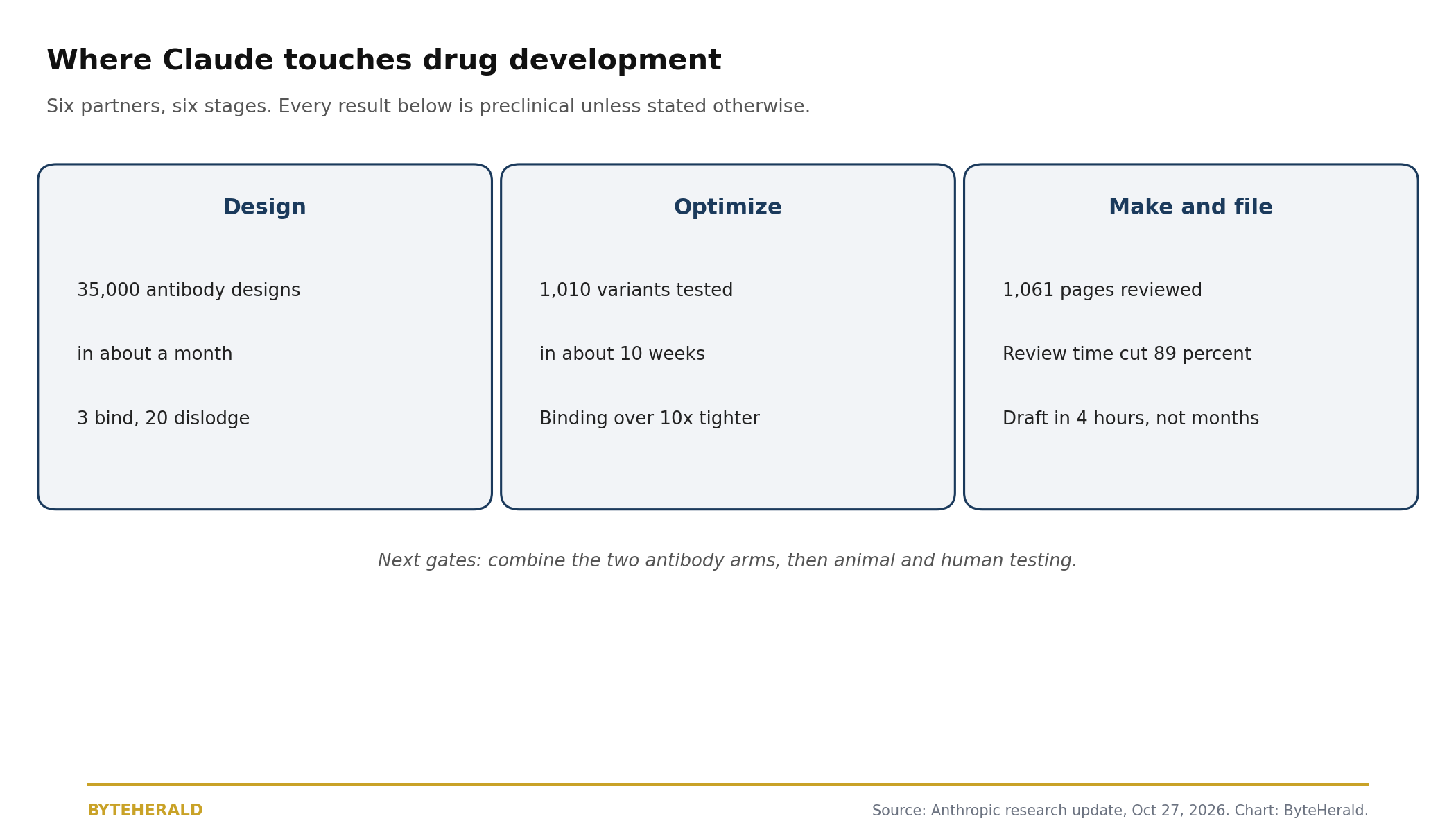
The food allergy program, run with Divergence Labs, is the clearest funnel in the update. Food allergies are driven by IgE, a molecule that sits partly attached to immune cells and partly floating free in blood. Standard medications neutralise the free floating IgE. Divergence is trying to build a drug with two arms: one that binds tightly to IgE, and another that prises IgE off the immune cell entirely. Claude turned Divergence's goals into a detailed design plan and then, largely on its own, generated roughly 35,000 antibody designs in about a month. Early tests found hits for both arms: three designs that could bind to IgE, and 20 that could dislodge it. Three of those 20 appeared to dislodge IgE more than the standard medication. The next step is to combine the two arms into a single drug candidate, which is where most designed molecules fail, because a molecule that binds well and a molecule that dislodges well do not automatically work when joined. The funnel matters because it corrects the headline: 35,000 is the number of tries, 23 is the number of early hits, and three is the number that beat the standard on one measure in early tests. None of those numbers is a cure.
| Partner program | What Claude did | Measured result, as reported | Stage |
|---|---|---|---|
| Divergence Labs, food allergy | Generated antibody designs from a design plan | 35,000 designs in about a month; 3 bind, 20 dislodge, 3 beat standard on dislodging | Preclinical, early lab tests |
| Generate Biomedicines, CAR T-cell therapy | Proposed shorter genetic instructions with Claude Code | One design about 70 percent shorter; roughly 10 times as many receptors in lab tests | Preclinical, lab tests |
| BigHat Biosciences, lead optimisation | Proposed molecule changes, connected to lab data | About 1,010 variants in about 10 weeks; binding over 10 times tighter; 18 degrees Celsius higher stability; clumping over 100 times slower | Preclinical, lab tests |
| Enveda, manufacturing and filings | Reviewed documents and drafted regulatory filings | 1,061 pages; all 11 human found issues plus 7 more; review time cut 89 percent; one draft in 4 hours against about 3 months by hand | Manufacturing documentation, preclinical programs |
| Bristol Myers Squibb, trial planning | Assessed an early stage trial plan and its odds of success | One prompt produced an initial analysis that would otherwise take days, per BMS | Early stage planning, expansion planned for 2027 |
| The Column Group, company creation | Building Pleiades, a company run on Claude workflows | First skill evaluated on 45 target disease pairs | Company formation, tools in development |
Why the boring stages may matter more than the molecule stages
The most transferable results in the update are not the antibody designs but the paperwork. At Enveda, manufacturing chemists spent up to 75 percent of their time on paperwork. Claude reviewed 1,061 pages of manufacturing documentation, caught all 11 issues human reviewers had spotted, and flagged seven they had missed. Human review time fell 89 percent, from more than 25 hours to under three hours. Separately, Claude wrote first drafts of two regulatory documents; one took four hours against about three months by hand, and the other passed Enveda's standard human review with one minor error found. Those numbers are easier to trust than molecule claims, because they are counts of documents, hours, and issues, not predictions about biology. They also explain Anthropic's strategy, which its post states directly: the bottlenecks in drug development are distributed across the whole process, from target identification to manufacturing to trial paperwork, so the company is putting Claude into every stage rather than betting on molecule design alone. A drug program that saves months on filings and catches documentation errors before a regulator does has gained something even if its lead molecule later fails, because the next program inherits the workflow.
How a prediction model designs a molecule, and why labs still test it
Readers sometimes imagine that an AI designs a drug the way a chemist sketches a structure, then the drug exists. The process in these programs is closer to proposal and selection. Claude proposes designs based on patterns in its training and on the partner's data, the lab makes and tests a subset, and the results feed back into the next round. At BigHat, that loop ran about 1,010 variants of two antibody fragments over about 10 weeks, and partway through the team suspected the standard heat stability and clumping metrics were misleading. Claude and an Anthropic researcher reanalysed the raw data, proposed different metrics and a protocol change, and BigHat's scientists refined and ran it, with the main predictions holding. That episode is the most encouraging detail in the update, because it shows the model doing something closer to science than to generation: noticing that the measurement itself may be wrong. It is also the reason the lab step cannot be skipped. How Transformers Actually Work: The Visual Explainer showed that these models predict plausible text and patterns, not verified fact, and a proposed molecule is a prediction until a lab result confirms it. The 10 times tighter binding and 18 degree stability gains at BigHat are lab measurements of specific variants, not guarantees about a finished drug, and they say nothing yet about safety in animals or humans.
What Anthropic bought, and what it still has to prove
Alongside the six partnerships, Anthropic said it has acquired Mithril Medicine, a one person company developing treatments for two rare forms of muscular dystrophy. Its founder, Cody Tranbarger, used Claude to organise contracts, logistics, and experiments across 11 external labs, and took one candidate from an idea to promising results in mice in under 18 months. Anthropic says that if the candidates hold up, a drug could be ready to start human trials as soon as late 2028. That date is a conditional forecast, not a schedule, and the condition is doing all the work: mouse results fail in humans most of the time in drug development generally, and nothing in the update changes that base rate. Anthropic also announced Claude Science, a workbench for researchers, credits for life scientists, a Life Sciences Verification Program for trusted organisations to use its most powerful models with more permissive safeguards, and an open call for guest investigators. The verification program deserves a sceptical note: more permissive safeguards for biology work are exactly the kind of access that needs the strongest oversight, and Anthropic's post does not publish the program's criteria or its rejection rate. The right test for this whole announcement is the one OpenAI's AI Wrote 722 Math Manuscripts, 3 Withdrawn in 24H applied to AI science claims: public proof, or it does not count yet. Anthropic has published technical reports with its partners, which is a better start than a press release alone, but a technical report is not a peer reviewed result, and a lab hit is not a treatment. Watch for three milestones, in order: a combined two arm drug candidate from Divergence, animal safety data from any partner program, and a human trial start date that survives contact with regulators. Until the first of those arrives, 35,000 designs is a productivity story with promising early biology, and that is already a lot, without pretending it is more.
By ByteHerald Staff. Anthropic, October 27, 2026, published early progress on accelerating drug development with Claude, reporting six partner organisations, roughly 35,000 antibody designs in about a month for Divergence Labs, three binding and 20 dislodging hits with three beating the standard medication, Generate Biomedicines designs about 70 percent shorter with roughly 10 times as many receptors in lab tests, BigHat Biosciences testing about 1,010 variants in about 10 weeks, Enveda reviewing 1,061 pages with an 89 percent review time cut, the Mithril Medicine acquisition, and that the work is mostly preclinical. Becker's Hospital Review, October 27, 2026, reported Anthropic's acquisition of Mithril Medicine, a one person startup for two rare forms of muscular dystrophy, and that most drug candidates in the update have not yet been tested in humans, with human trials possible as soon as late 2028 if candidates hold up.
Comments
Post a Comment