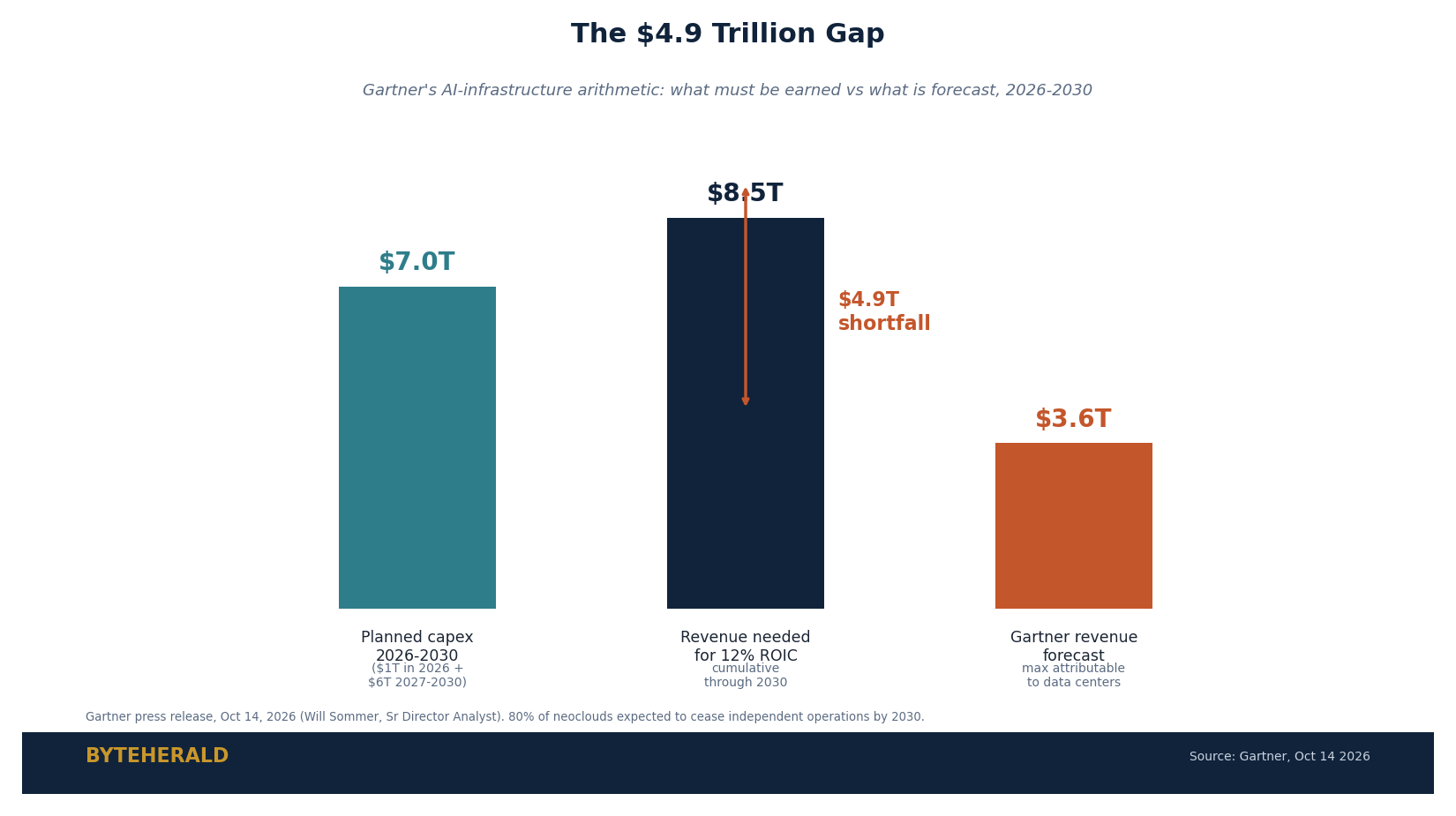
On Wednesday, October 14, CoreWeave's stock fell 15.5% while its 2032 bonds traded below 80 cents on the dollar, deep-distress territory. The same morning, Gartner published the math behind the fear: AI providers will spend about $7 trillion on infrastructure through 2030, but need $8.5 trillion in revenue to earn their cost of capital. Gartner's forecast of actual revenue: $3.6 trillion. And 80% of neoclouds, it says, will not survive the decade as independent companies.
What Gartner actually said
The research firm's press release, published October 14, 2026, is unusually blunt. AI providers are expected to spend nearly $1 trillion on AI infrastructure in 2026 alone, plus another $6 trillion between 2027 and 2030. To cover that announced capital spending, financing costs, and a 12% return on invested capital, Gartner's assumed hurdle rate, data center owners would need cumulative revenue of $8.5 trillion through 2030. Gartner's forecast of enterprise and consumer AI revenue attributable to those data centers: no more than $3.6 trillion. The shortfall, $4.9 trillion, is what the firm means by "exposed to impairment." Push the trajectory to 2032 and more than $4 trillion in asset value is exposed to write-down risk, with the 12% ROIC target not expected before the end of 2032 at the earliest.
"Enterprise and consumer AI revenue will be insufficient to support profitable returns on all planned AI capital expenditures during this period, " said Will Sommer, senior director analyst at Gartner, in the release. The neocloud tier, GPU-as-a-service specialists like CoreWeave and Nebius, takes the hit first: "cost pressure and a lack of a differentiating business model will force over 80% of neocloud providers to cease independent operations" by 2030. Hyperscalers, Gartner notes, are cushioned by diversified revenue. One more number from the release: AI-optimized infrastructure-as-a-service spending grows from $66 billion in 2027 to $174 billion in 2030, "too low, " Sommer says, for most compute providers to recover their investments before the current generation of AI chips is replaced.
Wednesday in the market
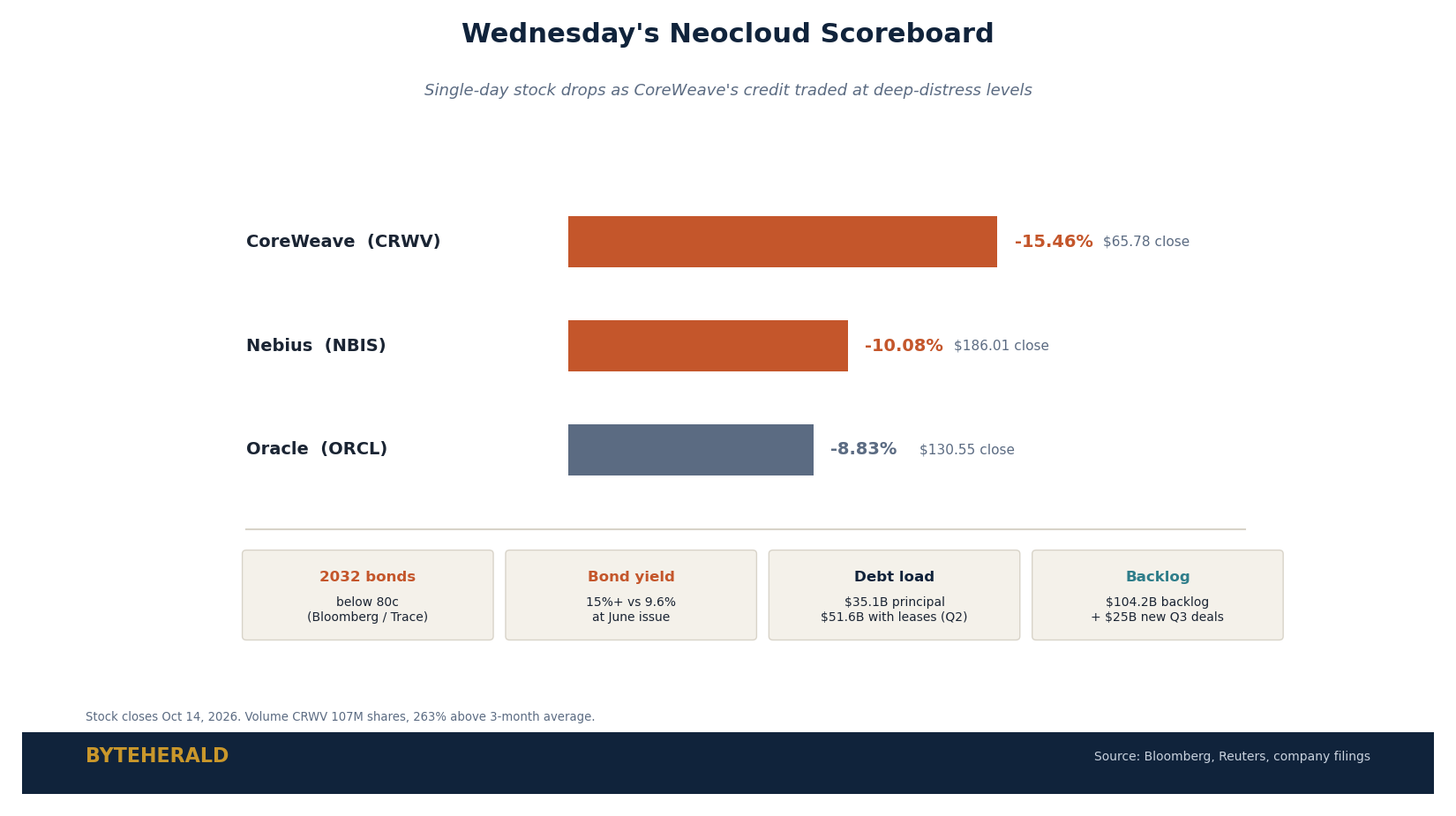
CoreWeave (CRWV) closed at $65.78, down 15.46%, on volume of 107 million shares, 263% above its three-month average. Nebius (NBIS) fell 10.08% to $186.01; Oracle dropped 8.83% as investors reassessed capacity spending across the sector. The credit side moved first: CoreWeave's unsecured 2032 bonds, a $1.25 billion tranche issued in June at a 9.6% coupon, traded below 80 cents on the dollar on Wednesday, Bloomberg reported via Trace pricing data, with yields topping 15%. Below 80 cents is the market's conventional threshold for deep distress.
The bond chart went viral when venture capitalist Chamath Palihapitiya shared it as a warning about a private-credit bubble forming around AI. Elon Musk replied "Yikes." Musk added, in a longer response, that supercomputer data centers are clearly in demand, but "getting money to build complex hardware systems with massive power, cooling and networking is not the same as doing it." CoreWeave CEO Michael Intrator told staff in an internal memo, reported by Reuters, that the market was acting "irrationally" and that the company's $104.2 billion backlog (up from $99.4 billion in Q1, plus $25 billion-plus in net new Q3 commitments) more than covers its debt obligations. The fundamentals he points to are real: Q2 revenue of $2.6 billion, up 112% year over year, and a 2026 sales forecast of at least $12.4 billion against $5.1 billion in 2025. The counterweight: about $35.1 billion in debt principal on the Q2 balance sheet, roughly $51.6 billion including operating and financial leases, and the day's hotter-than-expected CPI data raising the odds of further rate hikes, which punishes exactly this kind of leveraged buildout.
The split screen: Modal's $750M day
The same day the neocloud trade sold off, capital was still rushing into AI infrastructure, just a different kind of it. We mapped where AI money actually flows earlier today, and Wednesday gave the thesis a live demonstration. Modal, the serverless AI-compute platform, announced a $750 million Series D at a $15.75 billion post-money valuation, led by Accel with Kleiner Perkins joining, five months after its Series C at roughly a $4.65 billion valuation. The company says it crossed $1 billion in annualized run rate, with usage tripled since May and 15x year-over-year growth; its Sandboxes product alone runs at a $300 million run rate. Total funding raised: $1.2 billion. No data-center debt wall. No 80-cent bonds.
The contrast is the story. Investors will still pay up for asset-light compute platforms selling usage by the second, Modal's customers include DoorDash's AI team, Runway, and robotics labs, while the market reprices the debt-financed GPU landlords. One founder-scale signal from Modal's own announcement: TypeSafe AI's Jev served a trillion tokens on Modal in its first three days. Demand for compute is not the question; who captures the margin on it is.
ByteHerald's reading
Gartner's $4.9 trillion gap and CoreWeave's 80-cent bonds are the same fact viewed from two sides: the AI buildout is being financed on revenue assumptions the largest independent research firm in tech no longer believes. The 80% consolidation forecast is the industry's first mainstream obituary for the neocloud as a standalone species, survival means either hyperscaler-scale balance sheets or Modal-style asset-light platforms. Watch the bond market, not the stock: credit has been flagging this for weeks, and it moved first on Wednesday too.
Our October 2026 price tracker documented the other half of the squeeze, token prices collapsing even as capex balloons. The margin is being crushed from both directions.
By ByteHerald Staff. Market data: Gartner press release (Oct 14, 2026), Bloomberg via Trace pricing, Reuters, company announcements. Stock figures are single-day closes, not investment advice.
Comments
Post a Comment