On October 6, 2026, Minneapolis-based HUMXN Research Labs announced it will pay for qualifying plumbing, electrical, HVAC, air-duct cleaning, and carpet-cleaning appointments in Minneapolis, Chicago, and Miami, at no cost to the homeowner, in exchange for recording the technicians at work and turning the footage into licensed training data for AI and robotics. One week later, on October 13, the company said it wants to buy $50 million of skilled-trades, farming, and manufacturing business data for the same purpose. HUMXN's own announcement frames the bet plainly, in founder Thomas Unise's words: "The next generation of AI is going to need more than text and images from the internet. Robots need to understand how skilled people interact with the physical world."
What HUMXN is actually buying
The October 6 program works through partnerships with home-service companies in the three cities. HUMXN subsidizes select appointments; the homeowner pays nothing; participating contractors get paid; the technicians' work is recorded and converted into structured datasets that HUMXN licenses to AI and robotics companies. The October 13 press release widens the aperture from new recordings to existing archives.
| October 6: free-service program | October 13: $50M buy-up | |
|---|---|---|
| What changes hands | New recordings of live service calls | Years of existing business data: service records, repair histories, job-site photos, equipment manuals, training videos, manufacturing records |
| Who gets paid | Homeowners pay nothing; contractors are paid for the job | Businesses, in deals HUMXN says often reach six figures; workers in the wearable-camera program get about $20 per hour of approved footage |
| Scope | Minneapolis, Chicago, Miami; plumbing, electrical, HVAC, duct and carpet cleaning | Nationwide; skilled trades, farming, manufacturing |
| Privacy terms | Not detailed in the launch announcement | Businesses must own the data and have the right to sell it; customer names, addresses, and phone numbers are stripped before any purchase |
The honest caveats
Two facts keep this story grounded. First, as Ground Truth's October 18 coverage notes, there is no published evidence yet that any of this footage has trained robots to perform repairs. Second, Unise himself says the company has no robots. HUMXN is a data-acquisition business, not a robotics company: it acquires real-world work data, prepares it, and licenses finished datasets to the labs that do build robots. The free plumbing is the customer-acquisition cost of a dataset business. That distinction matters because the history of AI data plays is full of impressive collection operations whose datasets never found buyers at the promised prices.
Why watching a plumber matters more than reading about plumbing
Here is the durable idea, and why this story will outlive the October news cycle. Web text teaches models what to say. It does not teach a robot how to diagnose a leak under a sink, trace a fault through a live panel, or decide which wrench to reach for. That knowledge lives in sequences of perception, decision, tool use, and physical problem-solving, and the field calls learning from such sequences imitation learning. The bottleneck for physical AI has never been model architecture; it is demonstration data from the real world.
The alternatives are all worse. Teleoperation, where a human drives a robot arm to collect demonstrations, is precise and ruinously expensive per hour. Lab mockups are cheap and do not generalize to real homes. Simulation is improving but still struggles with the messiness of the physical world: water, rust, undocumented wiring. A service call is the opposite of a mockup. It is an unstructured environment, a skilled human, and a real task, and HUMXN's insight is that millions of such calls happen every day already. The free repair is a loss leader for access to environments that money usually cannot buy at scale.
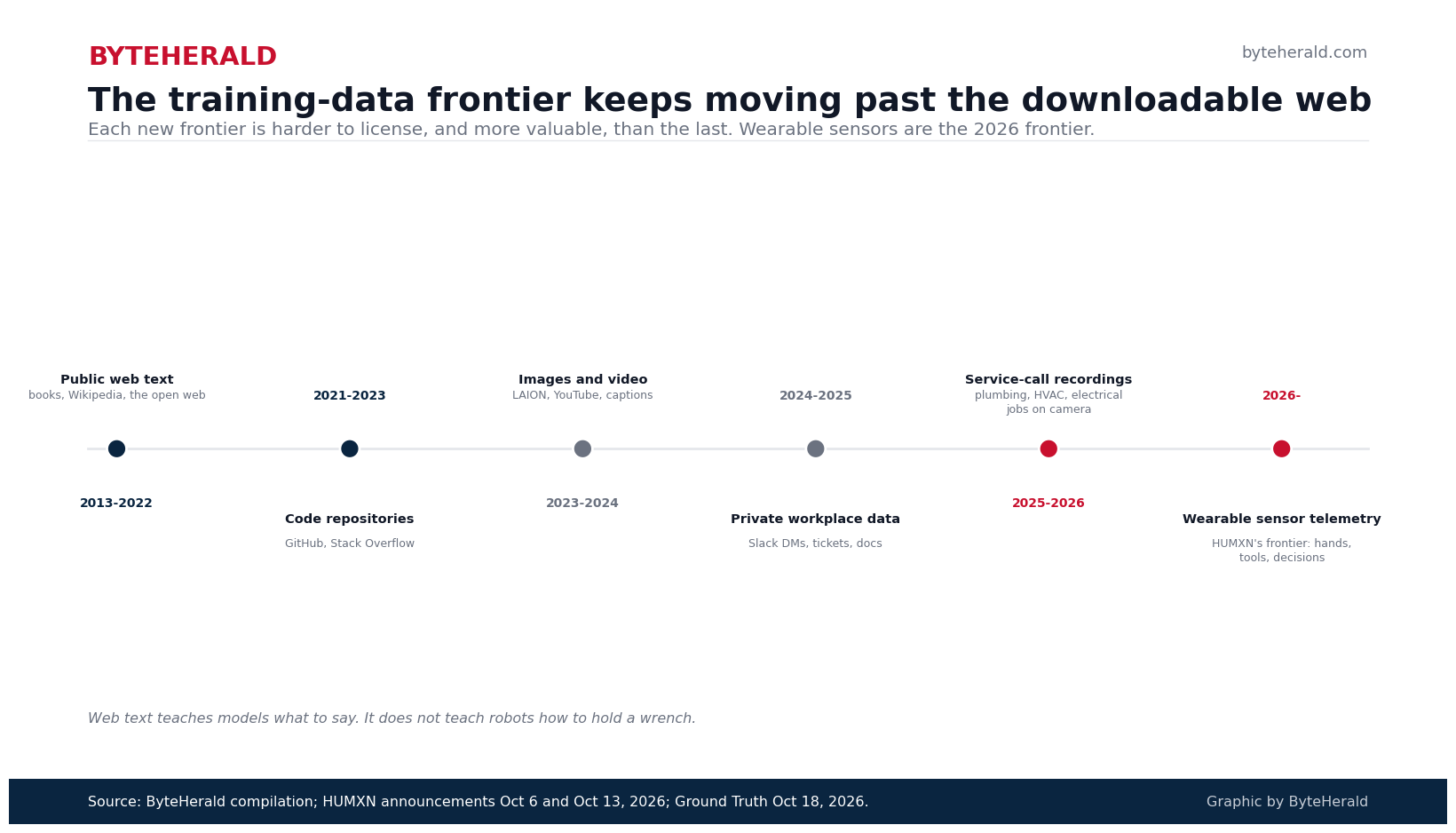
This is the next step in a frontier that keeps moving. The previous step was private workplace data: we covered in October how AI labs started pricing Slack DMs and internal tickets once the public web was exhausted. HUMXN is applying the same logic one rung further out, to physical work. And it is exactly the missing input our October 17 pillar on why robotics has had no ChatGPT moment identified: deployment hours and real-world manipulation data do not exist at the scale the models need, and whoever assembles that data first owns a chokepoint.
The real question
Strip away the free-service hook and HUMXN is asking a question the whole industry will soon have to answer: who gets paid when human expertise becomes training data. The technicians get paid work, the homeowners get free repairs, and HUMXN gets the recordings. What stays unsettled is what the workers whose know-how fills these datasets are owed once the footage is licensed, and whether home recordings described as anonymized stay that way. Independent audits, named licensees, and the first public data deals will settle it.
By ByteHerald Staff. Program details from HUMXN's October 6 announcement and its October 13 press release via Newsfile; caveats via Ground Truth's October 18 coverage. Frontier graphic is ByteHerald's original taxonomy.
Comments
Post a Comment