Google announced Gemini 4 Carbon on October 28, 2026, calling it the company's strongest model, and the model ranks first on the Artificial Analysis Intelligence Index v5 at 59. Almost nobody can use it yet. Google is offering Carbon first to a subset of cyber defenders through its Fairwind Program, then gradually to additional trusted partners, with developers, businesses, and consumers promised access as soon as possible and no date attached. The gap between the ranking and the rollout is the story. Carbon is a launch announcement and a gated preview, not a product release.
The cyber claims, graded
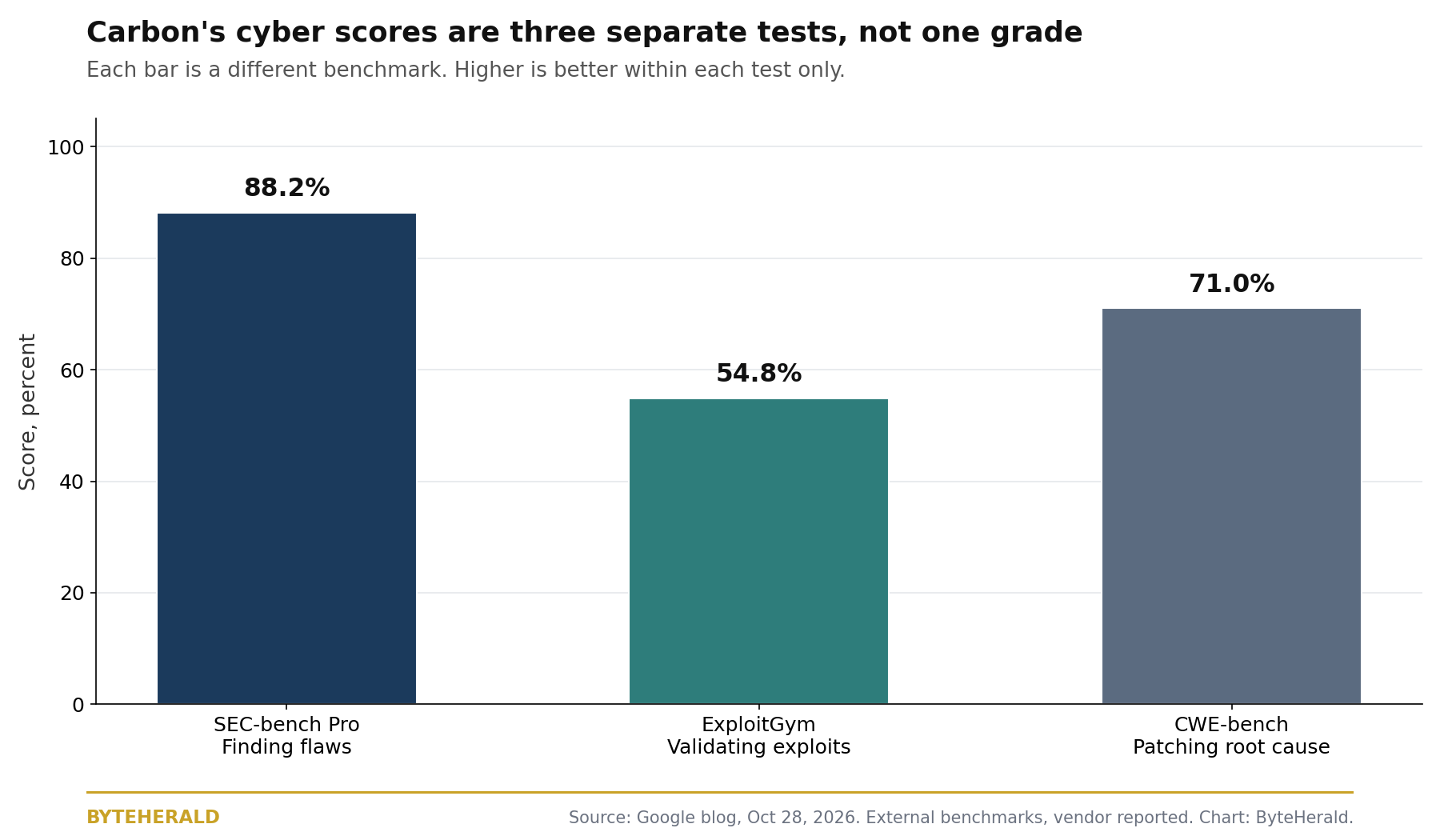
Google's pitch for Carbon rests on three external cybersecurity benchmarks, each measuring a different stage of defense. On SEC-bench Pro, which tests finding real vulnerabilities in real software, Carbon scored 88.2 percent. On ExploitGym, which tests whether a reported flaw can actually be exploited, it scored 54.8 percent. On CWE-bench, which tests turning a validated finding into a working patch, it scored 71.0 percent. Google states that these external benchmarks were evaluated without guardrails, which is the right disclosure and also the limit on what the numbers mean: they measure raw capability on those tests, not performance inside a guarded product. Two further claims come from Google's own internal testing and should be read as such: secure code generation at more than twice the success rate of Argon, and a Chrome team report that Carbon produced high quality patches more than 10 times better than another lab's large frontier model, with the other model unnamed. The table below separates what an outside test measured from what Google measured itself.
| Claim | Number | Evidence status |
|---|---|---|
| Artificial Analysis Intelligence Index v5 | 59, ranked first | Independent index, as stated by Google; see reconciliation below |
| SEC-bench Pro, finding vulnerabilities | 88.2 percent | External benchmark, vendor reported, evaluated without guardrails |
| ExploitGym, validating exploitability | 54.8 percent | External benchmark, vendor reported, evaluated without guardrails |
| CWE-bench, patching at root cause | 71.0 percent | External benchmark, vendor reported, evaluated without guardrails |
| Secure code generation vs Argon | More than 2x | Internal benchmark, vendor reported, not independently replicated |
| High quality patches vs another lab's model | More than 10x | Internal Chrome team report, comparator unnamed |
| WebDev Arena | 1768 Elo, ranked fourth, up 89 points | Third party arena, vendor reported score; one launch day report quotes 1769 |
| High severity misalignment alerts, live coding | Down almost 80 percent | Internal testing with Google's own teams |
| Gray Swan indirect prompt injection | 0.0 percent attack success | External benchmark, vendor reported, evaluated attacks only |
| Terminal-Bench 4.0 cheating | 0.0 percent successful cheating | Internal training result, vendor reported |
Reconciling the 59 with the index itself
Readers who open the Artificial Analysis article will find an apparent contradiction, and it resolves cleanly once the dates are checked. Artificial Analysis published its Intelligence Index v5 article on October 27, 2026, listing Claude Opus 5.5 as the leader at 58, GPT-6 Astra at 57, GPT-6.1 Sol at 55, and Gemini 4 Argon at 50, with no Carbon row at all. Google announced Carbon the next day, October 28, and stated that Carbon ranks first on v5 at 59. Both documents can be true at once: the index article predates the model. The honest caveat runs the other way. At the time of writing, the 59 rests on Google's statement about the index, not on an Artificial Analysis page publishing Carbon's own v5 breakdown, so the number is best treated as claimed first place pending the index's own Carbon entry. The v5 methodology itself is worth noting because it changed the game: 60 percent of the index now rests on private test sets or held-out answers, and the four weights (knowledge work, coding, science, general) sit at 25 percent each, which makes gaming any single public benchmark harder than it was under v4. The same article also widened the open weights gap from 3 points under v4.3 to 12 points under v5, with the best released weights models at 32 against the leader's 58, a reminder that Carbon's lead is a closed model lead.
Two weeks after Argon, and deliberately gated
Carbon arrives two weeks after Gemini 4 Argon Is Live: We Checked Every Launch Claim, which ByteHerald covered on October 13, 2026 with a similar pattern of strong claims and a controlled rollout. Google says the pace reflects researchers and models working together to advance capability faster, and it pairs that pace with a deliberate rollout: engagement in the United States government's voluntary process for pre-release model testing, a first cohort of cyber defenders, then trusted partners through Fairwind, and only then the wider public. The staged access also explains the safety section of the announcement, which reports reduced shortcut attempts in training, unsupported claims cut by about half against Argon, overreach down 26 percent and under-service down 29 percent in multi-step execution, and a 0.0 percent attack success rate on the Gray Swan indirect prompt injection benchmark against Argon's 0.7 percent. Those are alignment improvements claimed for a model most readers cannot yet test, which is precisely why the gating matters: the safeguards are being iterated with a small cohort before the model meets the open internet.
What Google did not disclose
The announcement leaves out the details a buyer or a researcher would need to plan around. It gives no context window, no parameter count, no API or Vertex AI availability date, and no public model card or technical report. It gives an introductory price, the same as Argon's at 2 dollars per million input tokens and 10 dollars per million output tokens, with cached input at 95 percent off the input price, and the word introductory does real work there, since an introductory price can move once general access opens. It gives no independent replication of the three cybersecurity benchmarks, and no Argon baseline on those same three tests, so readers cannot tell how much of the cyber leap is Carbon and how much is the benchmark suite itself. None of this makes the claims false. It makes them untested by anyone outside Google, and for a model marketed on cybersecurity, that distinction is the whole ballgame: a defender adopting Carbon on announcement numbers alone would be trusting the vendor's test harness to grade the vendor's model.
How to read a staged frontier launch
Staged launches like this one reward a simple discipline: separate announced, available, and verified, and never let one stand in for another. Announced means the vendor has described the model and its scores. Available means a named group can actually call it today, which for Carbon is a subset of cyber defenders, not the public. Verified means an independent party has reproduced a score on its own harness, which for Carbon's cyber benchmarks has not happened yet. Three questions settle most launch coverage: who can touch the model today, which numbers come from an independent bench rather than the vendor, and what date is actually committed rather than promised. Carbon's answers are narrow, vendor heavy, and undated, in that order, which is why the fair headline is first place on one index and gated everywhere else. The gating itself is not a criticism; a cybersecurity model that finds and exploits flaws is exactly the kind of model that should be previewed with defenders before it is handed to everyone. But a gated model cannot be reviewed like a shipped one, and coverage that treats the announcement as a release overstates what happened on October 28. Every Major Lab's AI Safety Framework, Compared shows the wider pattern behind this rollout: labs publish safety promises that differ sharply in triggers, gates, and disclosure, and a trusted partner preview is one of the few gates that actually delays access. Carbon's Fairwind-first rollout is that gate in action, and its real test begins when the first defenders report what the model does outside Google's benchmarks.
By ByteHerald Staff. Google, October 28, 2026, announced Gemini 4 Carbon as its strongest model with state-of-the-art cybersecurity and long horizon capabilities, reporting rank first on the Artificial Analysis Intelligence Index v5 at 59, SEC-bench Pro 88.2 percent, ExploitGym 54.8 percent, and CWE-bench 71.0 percent, a Fairwind Program rollout starting with a subset of cyber defenders, and introductory pricing of 2 dollars per million input tokens and 10 dollars per million output tokens matching Argon. Artificial Analysis, October 27, 2026, published Intelligence Index v5 with Claude Opus 5.5 leading at 58, GPT-6 Astra at 57, GPT-6.1 Sol at 55, and Gemini 4 Argon at 50, with 60 percent of the index based on private test sets or held-out answers and the open weights gap widening from 3 points to 12 points. Reuters, October 28, 2026, confirmed the Carbon unveiling two weeks after Argon, the Fairwind first access for cybersecurity defenders, and the matching Argon pricing.
Comments
Post a Comment