TechCrunch reported on October 27, 2026, that General Compute raised 100 million dollars in a Series A led by Blackbird Ventures and Abstract Ventures, valuing the inference-focused neocloud at 800 million dollars after a seed round in May valued it at 60 million dollars. What the raise does not settle is whether the collapse story is wrong, because the company's first major deployments do not go live until the first quarter of 2027 and the 100 million dollar customer deal behind the raise is unnamed. Investors have placed a bet on inference demand outrunning that story. They have not yet collected the evidence that would prove it.
What the money stack actually is
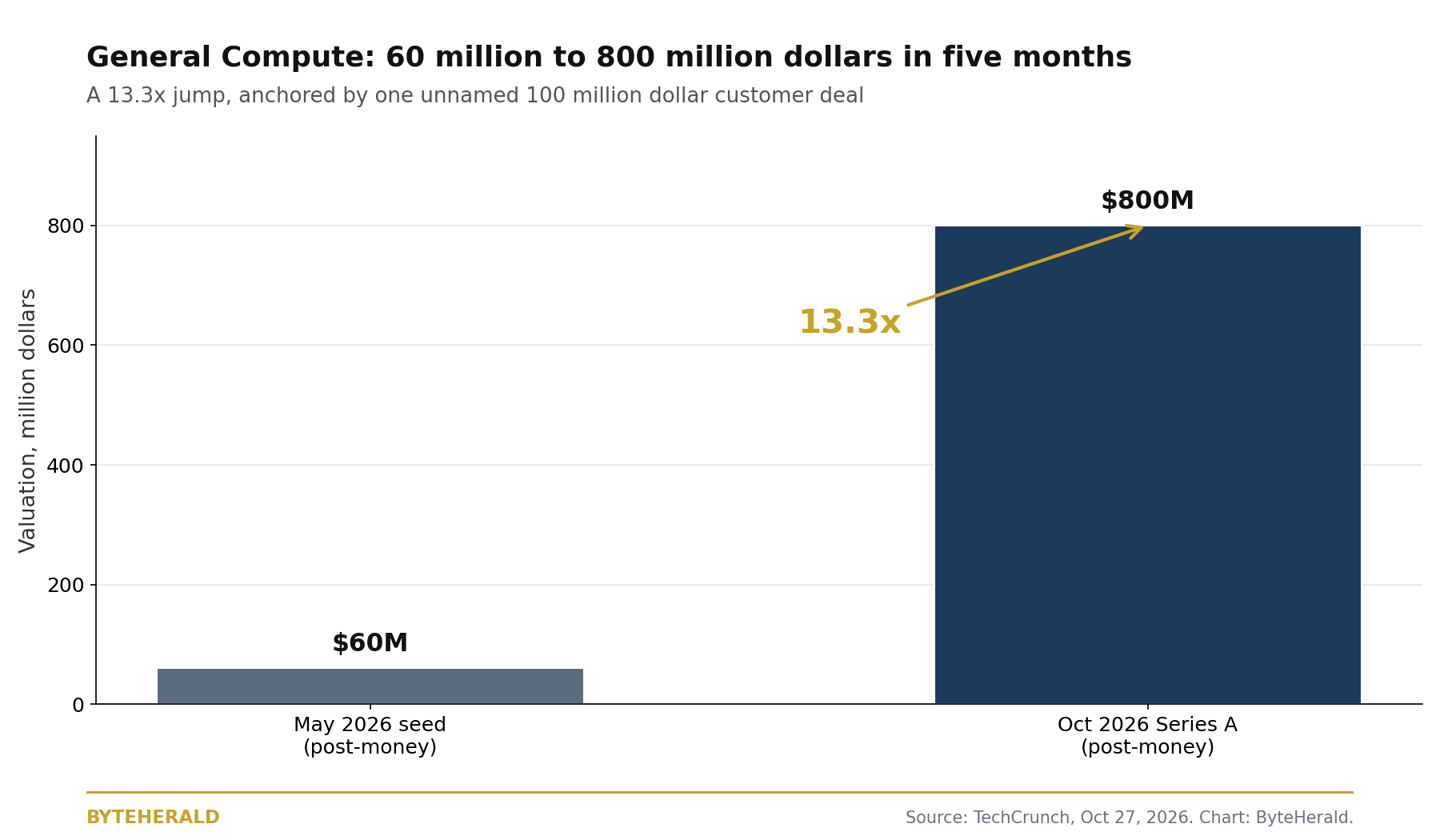
Read the deal as four separate pieces, not one 100 million dollar headline. The equity piece is the Series A itself: 100 million dollars at an 800 million dollar post-money valuation, up from 60 million dollars after the May seed round. The revenue piece is a deal with a large customer worth 100 million dollars in annual recurring revenue, which TechCrunch says paved the way for the raise. The hardware piece is a 400 million dollar purchase agreement for SambaNova chips, which TechCrunch describes as the first debt financing of inference chips. Secondary reporting of the deal names Upper90 as the debt provider behind that facility. The capacity piece is the company's plan to deploy 75 megawatts of compute in 2027, against access to 200 megawatts of power that chief executive Finn Puklowski says is more than the company can probably fund and equip.
| Piece | Figure | Status |
|---|---|---|
| May seed valuation | 60 million dollars | Reported, post-money |
| October Series A | 100 million dollars | Closed, Blackbird and Abstract led |
| October post-money valuation | 800 million dollars | Reported, 13.3 times the seed mark |
| Anchor customer deal | 100 million dollars a year | Reported, customer unnamed |
| SambaNova chip purchase | 400 million dollars | Debt-financed, per TechCrunch |
| 2027 deployment plan | 75 megawatts | Planned, not yet live |
The arithmetic matters because it shows how much of the story is still a promise. Eight hundred divided by 60 is 13.3, so investors repriced the company by more than thirteen times in about five months. The anchor deal equals the entire Series A in size, which means one customer, not a broad book of business, is carrying the valuation case. Seventy-five megawatts against 200 megawatts of access is 37.5 percent, so even the company's own power access is mostly unbuilt capacity. None of that makes the raise fake. It makes it early, and early raises should be judged on what ships next, not on the size of the announcement.
Why the timing is the story
TechCrunch frames the timing bluntly: this is not an ideal week to announce a neocloud Series A. CoreWeave, the publicly traded neocloud that rents out computing power for AI, has fallen to a 12-month low, and Elon Musk has predicted that more than 200 neoclouds face death and consolidation. Puklowski is unfazed, and his counterargument has two parts. First, he calls fears of a chip-led collapse massively overstated, saying people call him every week asking for TPUs, GPUs, and any chip that gets them more compute. Second, he says Anthropic's bullish S-1 filing is settling fears for today. That second point is worth pausing on, because it cuts both ways: a single filing can calm a market for a day, and a single filing can also be read as a company asking public investors to trust numbers that have never been tested in public markets. ByteHerald covered that filing, and its 94 pages of risk warnings, in Anthropic Filed Its IPO. The 94-Page Risk Warning Is Real, and the contrast is the point: Anthropic's disclosure is long and public, while General Compute's anchor customer is unnamed and its deployments are future-dated.
The zig: inference chips, leased space, old mining sites
General Compute's strategy is to zig where the rest of the neocloud market zagged. While competitors chased GPUs for training, it built for inference, the work of running finished models, using specialized chips from Nvidia rivals SambaNova, Positron, and Cerebras. While competitors built huge data centers, it rents space inside other companies' facilities, taps smaller power sources, and converts former bitcoin-mining sites into places that run AI models. The pitch to customers is bare metal hardware or a guaranteed tokens-per-second service agreement, without the customer procuring or managing infrastructure. That is a real differentiation, and it is also a real concentration risk: the whole model depends on non-Nvidia silicon holding its price and performance edge, on landlords and power suppliers staying cheap, and on inference prices staying high enough to service chip debt. If any one of those legs weakens, the 800 million dollar mark has no broad revenue base to fall back on, because the disclosed base is one anchor deal.
Three tests that will settle the debate
Do not judge this raise by the next funding headline. Judge it by three observable tests. First, do the first major deployments go live in the first quarter of 2027 at the promised scale, with more than 50 megawatts in the pipeline turning into running capacity? Second, does a second customer of similar size appear, or does the company stay a one-anchor business? Third, does the debt-financed chip model survive a price drop in inference, when the collateral behind the loan is specialized hardware rather than the Nvidia GPUs lenders know best? If all three pass, General Compute will have earned the right to call the collapse narrative overstated. If deployments slip, or the anchor stays anonymous while the valuation is quoted as proof, the raise will look like what it is today: a well-timed bet placed at the exact moment the market was most afraid. That distinction is why ByteHerald's earlier neocloud coverage matters here: Gartner warned that 3.5 trillion dollars of AI spending may never pay off, and a single Series A does not answer a warning about the whole sector's revenue gap.
How to read any neocloud raise
The durable lesson in this story is a reading method, not a verdict on one startup. Separate equity from debt, because a 400 million dollar chip purchase financed with debt is not the same as 400 million dollars of cash in the bank. Separate annual recurring revenue from a named customer list, because an unnamed anchor can be a real contract and still be uncheckable by readers. Separate megawatts of access from megawatts deployed, because access is an option and deployment is a fact. And separate a valuation from a business, because a 13.3 times repricing in five months tells you what investors hope, not what customers have already paid for at scale. General Compute may yet prove the optimists right. Today, the honest summary is that investors paid 100 million dollars for a company whose best evidence is one large deal, three chip suppliers, and a deployment calendar that starts next quarter.
By ByteHerald Staff. TechCrunch, October 27, 2026, reported that General Compute raised 100 million dollars in a Series A led by Blackbird Ventures and Abstract Ventures at an 800 million dollar post-money valuation, up from 60 million dollars after a May seed round, following a customer deal worth 100 million dollars in annual recurring revenue, with a 400 million dollar SambaNova chip purchase described as the first debt financing of inference chips. Silicon Report, October 27, 2026, reported that chief executive Finn Puklowski expects to deploy 75 megawatts of capacity in 2027 and anticipates access to 200 megawatts of power, and that the company rents space in third-party data centers and converts former bitcoin-mining facilities. Dealroom, October 27, 2026, reported that the SambaNova purchase was financed with a debt facility from Upper90 and that the company's first major deployments go live in the first quarter of 2027.
Comments
Post a Comment