Google DeepMind announced Genie 4 on October 27, 2026, as a research preview that generates interactive worlds with native audio and lets users steer scenes in real time with natural language, holding a coherent scene for up to two minutes. In short: Genie 4 doubles the coherent runtime of Genie 3, adds sound generated alongside the picture, and puts a Gemini agent inside the loop to plan steps and check frames while the world runs.
What is new, in one table
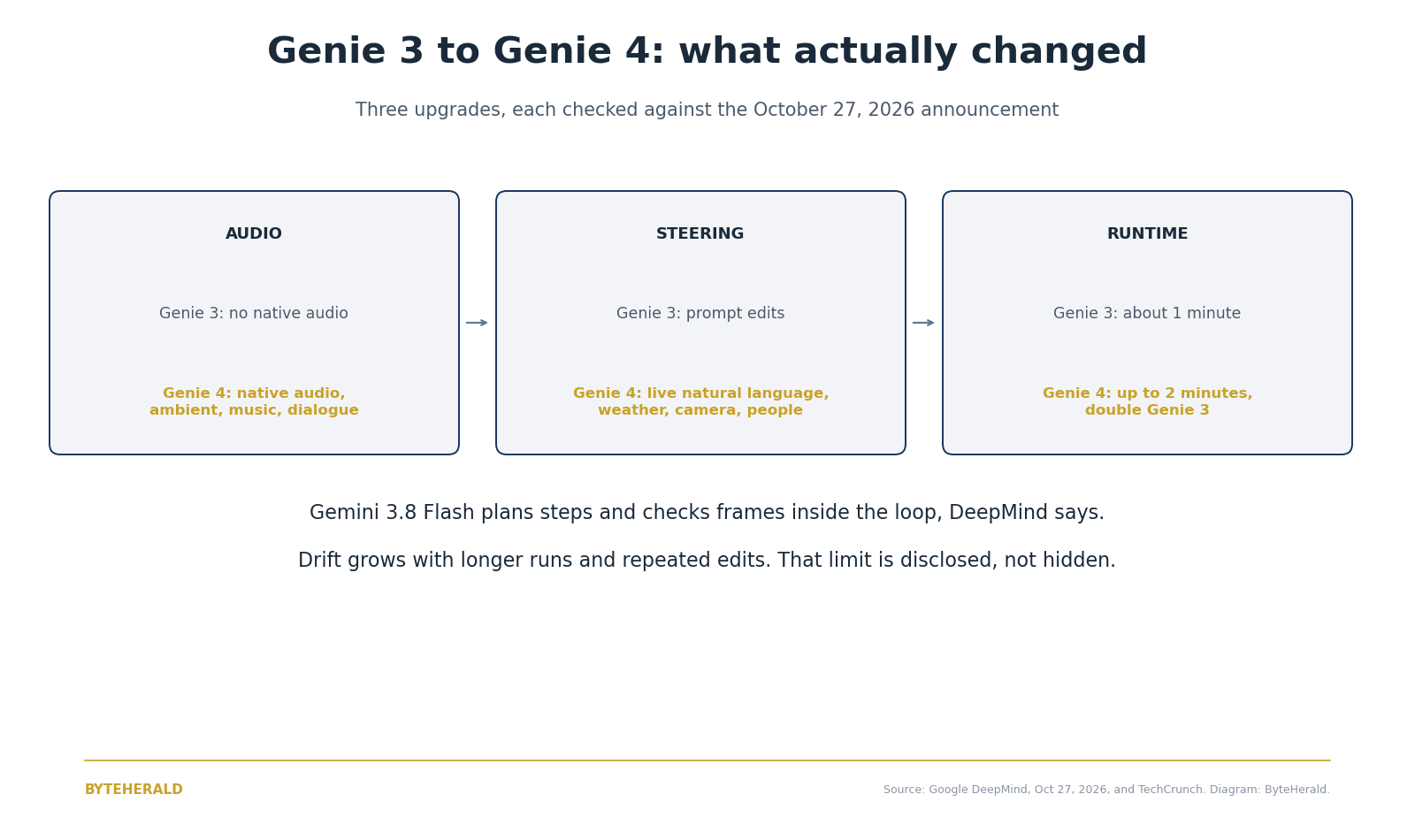
DeepMind's announcement is specific about three upgrades, and the table below stays inside what the announcement and its first coverage actually say. Audio is the headline: Genie 4 is the lab's first real-time world model to generate audio natively, with ambient sound, music and interactive dialogue produced together with the scene, not dubbed on afterwards. Steering is the second: users type natural language while the simulation runs, changing the weather, moving the camera, or introducing a new person or object, and the model adapts the prompt to what is already on screen. Runtime is the third, and the only one with a clean number: up to two minutes of coherent scene, double the limit of Genie 3.
| Capability | Genie 4, October 27, 2026 | Change from Genie 3 |
|---|---|---|
| Audio | Native, generated with the scene: ambient sound, music, dialogue | First real-time world model from the lab with native audio, per DeepMind |
| Steering | Live natural-language edits during the run | Extends Genie 3 midstream changes into freeform live edits |
| Coherent runtime | Up to 2 minutes | Double the Genie 3 limit of about 1 minute |
| Guiding agent | Gemini 3.8 Flash inside the loop | Gemini wired into the loop as planner and frame checker |
The Gemini loop inside the world
Genie 4 is not a standalone graphics engine. DeepMind describes three Gemini roles working together. Gemini Omni anchors simulations in real-world appearance and behavior. Other Gemini reasoning models maintain the coherence and continuity of the scene, so events unfold with cause and effect rather than as disconnected clips. Gemini 3.8 Flash serves as the guiding agent in the loop: as Genie 4 generates the world in real time, Gemini continuously observes the scene, breaks a high-level instruction into steps, and checks whether each step succeeded, adapting the plan when the user intervenes. That division of labor is the technical claim worth watching. A world model that only renders will drift. A world model with an agent checking its own frames has a chance to notice the drift before the viewer does, and Genie 4 is DeepMind's test of whether that checking loop scales.
What it is for, and what it is not yet
DeepMind lists filmmaking, journalism, gaming and manufacturing as creative and industrial uses, and adds a more consequential one: safe training environments for robots and agents. In a research experiment tied to Gemini Robotics, a Gemini model broke tasks into steps that Genie 4 simulated in real time, which points to testing robot scenarios in simulation before they happen in the real world. That is where simulation economics bite hardest, because a failed robot in a warehouse costs money and a failed robot in a simulation costs compute, and the same logic drives the physical AI bets we have tracked, including DeepSeek's $400 million robot bet on taking AI into the physical world. Access, however, is gated: trusted testers have Genie 4 now, with Google AI Ultra subscribers in Project Genie and early access partners in the Gemini API and AI Studio to follow. Every output carries SynthID, DeepMind's imperceptible watermark. And the limits are disclosed in the announcement itself: visual details and object permanence can still shift or drift over time, especially as a simulation runs longer, after multiple complex prompt edits, or when navigating through the scene. No resolution, frame rate, inference cost or maximum session length appears in the announcement, so no reviewer can yet price a minute of Genie 4 or compare its fidelity to a rendered clip on equal terms.
The field around Genie 4
Genie 4 does not arrive into an empty field. Runway released its second world model, GWM Worlds 2, a couple of months earlier, a playable model that responds to user inputs and includes audio generation. At the same time, the world model industry is consolidating: Fei-Fei Li's World Labs is being acquired by AMD, Amazon is in talks to buy Decart, and Rivian acquired Third Dimension to bring simulation capability in-house for self-driving testing. Read together, that pattern says simulation is becoming infrastructure, not a demo category. Labs are being bought for their simulation stacks, carmakers are buying simulation to train driving, and Google is answering with a model that ties simulation directly to its Gemini reasoning stack. The race is no longer who can generate the prettiest clip. It is who can hold a world together for minutes, under edits, with sound, without the scene quietly changing its mind about what is in it.
What to judge before the hype settles
Three checks separate a real world model from a good video demo. First, the persistence check: move the camera away and back after a minute, and see whether the same objects are still there. Second, the edit check: change the weather and add a person, and see whether the rest of the scene still obeys its own rules. Third, the duration check: run the full two minutes, not a ten-second highlight, because drift is a function of time and edits, and highlights hide both. Genie 4 passes the announcement test on all three in principle, with Gemini checking frames and a doubled runtime. Whether it passes them in independent hands, at a disclosed cost, is the review that matters, and it cannot be written from a launch post. That review is also the subject of our companion pillar on how world models work and how to judge them, which sets out the same three tests in full.
By ByteHerald Staff. Google DeepMind, October 27, 2026, announced Genie 4 as a research preview with native audio, real-time natural-language steering, Gemini Omni anchoring, Gemini reasoning for coherence, and Gemini 3.8 Flash as the guiding agent in the loop, rolling out first to trusted testers and then to Google AI Ultra subscribers in Project Genie and early access partners in the Gemini API and AI Studio. TechCrunch, October 27, 2026, reported that Genie 4 holds a coherent scene for up to two minutes, double the Genie 3 limit, described the Gemini Robotics simulation experiment, and reported Runway's GWM Worlds 2 release and the World Labs, Decart and Third Dimension deals.
Comments
Post a Comment