OpenAI released GPT-6.1 Terra on October 26, 2026, at $1 per million input tokens and $5 per million output tokens, half the list price of GPT-6.1 Sol, for computer-use work in ChatGPT Work and Codex. The headline number is the token price, but the number that decides whether Terra matters is the cost of a finished task, and on that measure OpenAI's own chart puts Terra just over three points behind Claude Opus 5.5 at about one-ninth of the cost per task.
The price, in one table
Terra replaces GPT-5.6 Terra as OpenAI's mid-tier work model. The table below keeps vendor claims and independent figures apart, because the two do not measure the same thing.
| Model | Input per million tokens | Output per million tokens | Cached input |
|---|---|---|---|
| GPT-6.1 Terra | $1 | $5 | $0.05 |
| GPT-6.1 Sol | $2 (derived: Terra is half of Sol) | $10 (derived) | Not stated in sources reviewed |
| GPT-5.6 Terra (July 2026 rates) | $2 | $12 | Not stated in sources reviewed |
OpenAI describes the new rates as 50 percent lower than GPT-5.6 Terra. Against the July rates reported by Techstrong, the input cut is exactly half and the output cut is about 58 percent, from $12 to $5. The distinction matters for budgeting: the headline 50 percent is OpenAI's framing, the $12 to $5 move is the arithmetic.
What OpenAI claims it can do
| Test (vendor reported unless noted) | GPT-6.1 Terra | Predecessor or rival |
|---|---|---|
| Agents Last Exam, medium effort | 15 points higher than GPT-5.6 Terra, about one-third the cost per task | GPT-5.6 Terra |
| Agents Last Exam, max effort (OpenAI chart) | 60.0 percent, $1.01 per task | Claude Opus 5.5: 63.2 percent, $8.82 per task |
| Terminal-Bench 4.0, max effort | 50.3 percent | GPT-5.6 Terra: 21.5 percent |
| Internal difficult-prompt error rate, low effort | 16.7 percent | GPT-5.6 Terra: 53.6 percent |
| Internal difficult-prompt error rate, max effort | 4.3 percent | Near GPT-6.1 Sol and GPT-6 Astra, OpenAI says |
| Task speed | More than 3 times faster than Astra and Sol | OpenAI own timing runs, not independent timing |
Two caveats belong beside that table, not in a footnote. First, every figure above is OpenAI's unless a source says otherwise, and the speed claim rests on OpenAI's own timing runs. Second, the Opus 5.5 comparison uses a previous-generation rival model, as independent coverage noted, so the one-ninth cost figure is a price comparison against an older flagship, not against Anthropic's current best.
The cost per task is the real launch
Token prices fall every few months, and we have tracked that slide since our October 2026 price tracker. What changed with Terra is the unit buyers should watch. A model that charges $1 per million input tokens can still be expensive if it needs three attempts, a long reasoning effort, and a human review for every finished form.
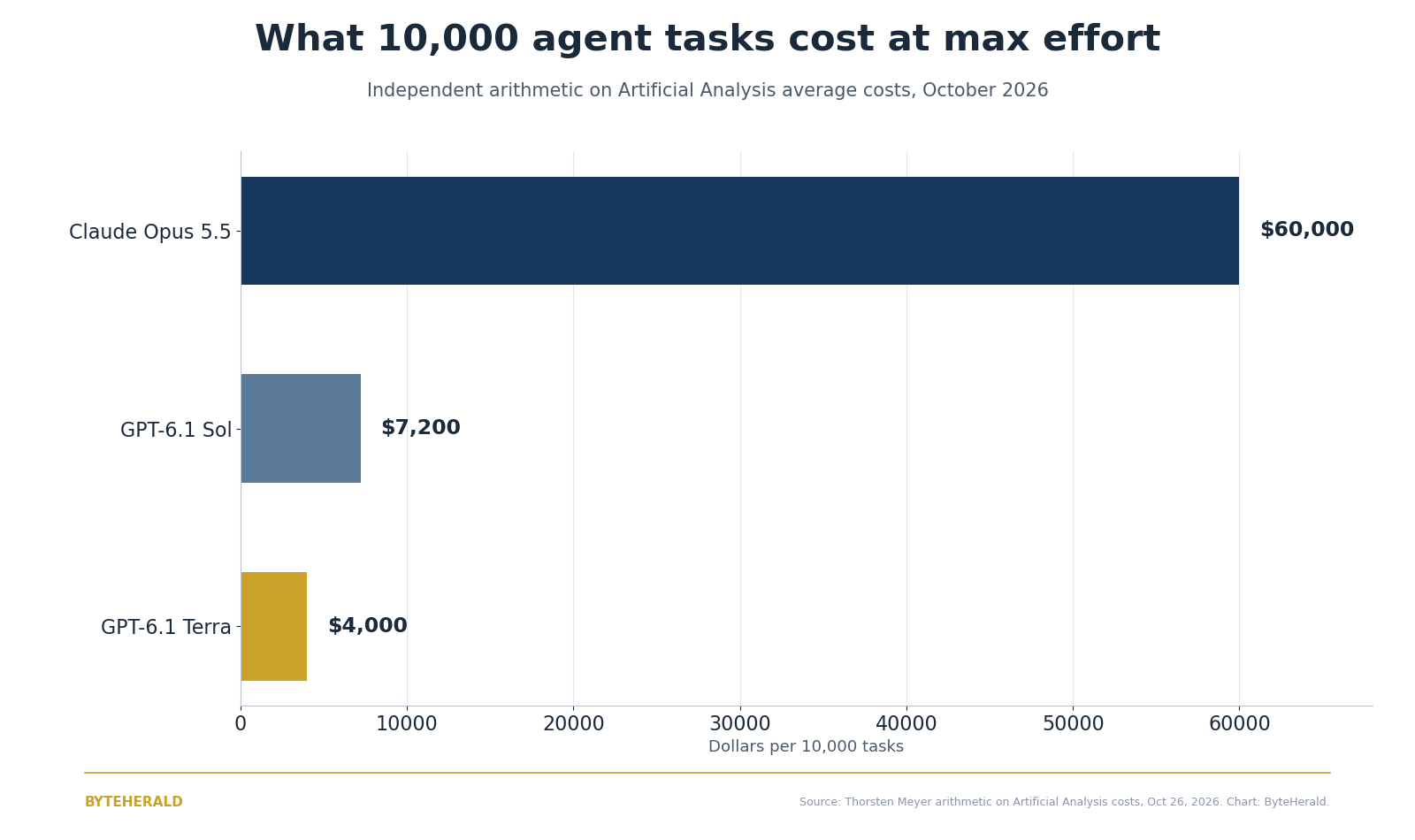
The chart above is independent arithmetic, not OpenAI's chart. Thorsten Meyer applied Artificial Analysis average costs to 10,000 tasks at max effort and got $4,000 for Terra, $7,200 for Sol, and $60,000 for Opus 5.5. At medium effort, the same independent arithmetic puts 10,000 Terra tasks at $950. Artificial Analysis tasks are not your tasks, and effort level is a dial, not a fixed property: low effort is cheapest, max effort is dearest, and the highest setting did worse than medium in Meyer's own test. Measure cost per finished task on your own samples before switching, and keep a rival in the test.
Where Terra fits, and where it does not
| Workload | Start with | Why, in one line |
|---|---|---|
| Forms, invoices, proposals, document work | Terra, low or medium effort | OpenAI built it for the repetitive workday, and medium effort carries its computer-use claims |
| Routine computer-use runs at scale | Terra, medium effort | Cheapest per task in the independent arithmetic, with the speed claim attached |
| Hard coding, research, costly errors | Sol or Astra | OpenAI itself says Sol and Astra remain the better choice for the most complex coding |
Availability is narrower than the launch headline suggests. Terra is rolling out in ChatGPT Work and Codex for Plus, Pro, Business, Enterprise, and Edu plans, and through the API as gpt-6.1-terra. It is not available in Chat, and access varies by plan, region, and workspace settings during rollout. Developer documentation summarized in launch coverage puts the context window at 1.05 million tokens, maximum output at 128,000 tokens, and the knowledge cutoff at June 1, 2026, with prompts above 272,000 input tokens charged at higher rates. OpenAI also classifies Terra at the Critical threshold for cybersecurity under its Preparedness Framework, a disclosure that says more about capability than about safety in deployment.
The evergreen rule: price per token is not price per task
Every model generation gets cheaper per token, and every generation tempts buyers to compare the wrong number. A finished task costs tokens times attempts times review time, and a cheap model that still guesses on 38 percent of questions it cannot answer, as Meyer's test found for Terra, can cost more than a dear model that gets it right once. The durable discipline is boring: a fixed test set, cost per finished task, and a routing layer that lets one model swap for another without a rewrite. Terra is the first model in this family where that discipline pays for itself at scale, because the gap between tiers is now large enough to measure in a monthly bill rather than a rounding error.
What to watch
Three questions decide whether Terra is a price war or a capability shift. First, do independent benchmarks confirm the medium-effort cost per task, or does the advantage shrink outside OpenAI's chart? Second, does the 3x speed claim survive independent timing, since speed is what turns a cheap model into a usable agent? Third, does the bottleneck move from model quality to permission? Agents that can click still need sites to let them in, and the sites blocking AI agents are the other half of this story. A $1 model that cannot reach the checkout page is not a $1 solution.
By ByteHerald Staff. OpenAI, October 26, 2026, announced GPT-6.1 Terra at $1 per million input tokens and $5 per million output tokens, with Agents Last Exam, Terminal-Bench 4.0, and speed claims as reported in the launch post. AI Weekly, October 26, 2026, reported the Terminal-Bench 4.0 result of 50.3 percent at max effort, the internal error-rate fall from 53.6 percent to 16.7 percent at low effort, and the $0.29 versus $0.84 medium-effort cost per task against GPT-5.6 Terra. Thorsten Meyer, October 26, 2026, published independent arithmetic on Artificial Analysis costs putting 10,000 tasks at max effort at $4,000 for Terra, $7,200 for Sol, and $60,000 for Claude Opus 5.5. Techstrong, October 26, 2026, reported GPT-5.6 Terra July rates of $2 input and $12 output, against which the new output rate is about 58 percent lower.
Comments
Post a Comment