Meta released the weights for an 816-billion-parameter AI model on Thursday, and for the first time the headline is not the parameter count. It is the hardware: Meta says Muse Spark Open can run on two Apple Mac Studios sitting on a desk, no data center required. The catch, as always with open models, is what "can run" actually costs.
The quotable answer
Meta released Muse Spark Open on October 15, 2026, an 816-billion-parameter open-weight model that needs roughly 1 terabyte of RAM to run locally. In practice that means two 512 GB M5 Ultra Mac Studios linked over Thunderbolt 5, hardware costing well over $40,000 as a pair that was not yet shipping at launch. A four-machine 256 GB setup works today and hit 36 tokens per second in Apple's tests, at roughly $38,000 in hardware.
What actually launched
Muse Spark Open is the open-weight sibling of Meta's Muse Spark line: 816 billion total parameters with 42 billion active per token (a mixture-of-experts design with 256 experts, 8 active per token), a 1-million-token context window, natively multimodal input, and a build target of coding and long-horizon agentic work (Reuters). The unusual part is the partnership: Meta worked directly with Apple to optimize the model for the MLX framework on Apple silicon, with Apple publishing its own ML research post on running it locally (MacRumors). Meta's demos ran the model through its Muse Code agent to patch an open-source Mastodon client and to drive DaVinci Resolve through video footage, all on local hardware. The weights are free to download under the Muse Model License, which allows limited commercial use; community analysis notes attribution is required and larger companies need a commercial agreement.
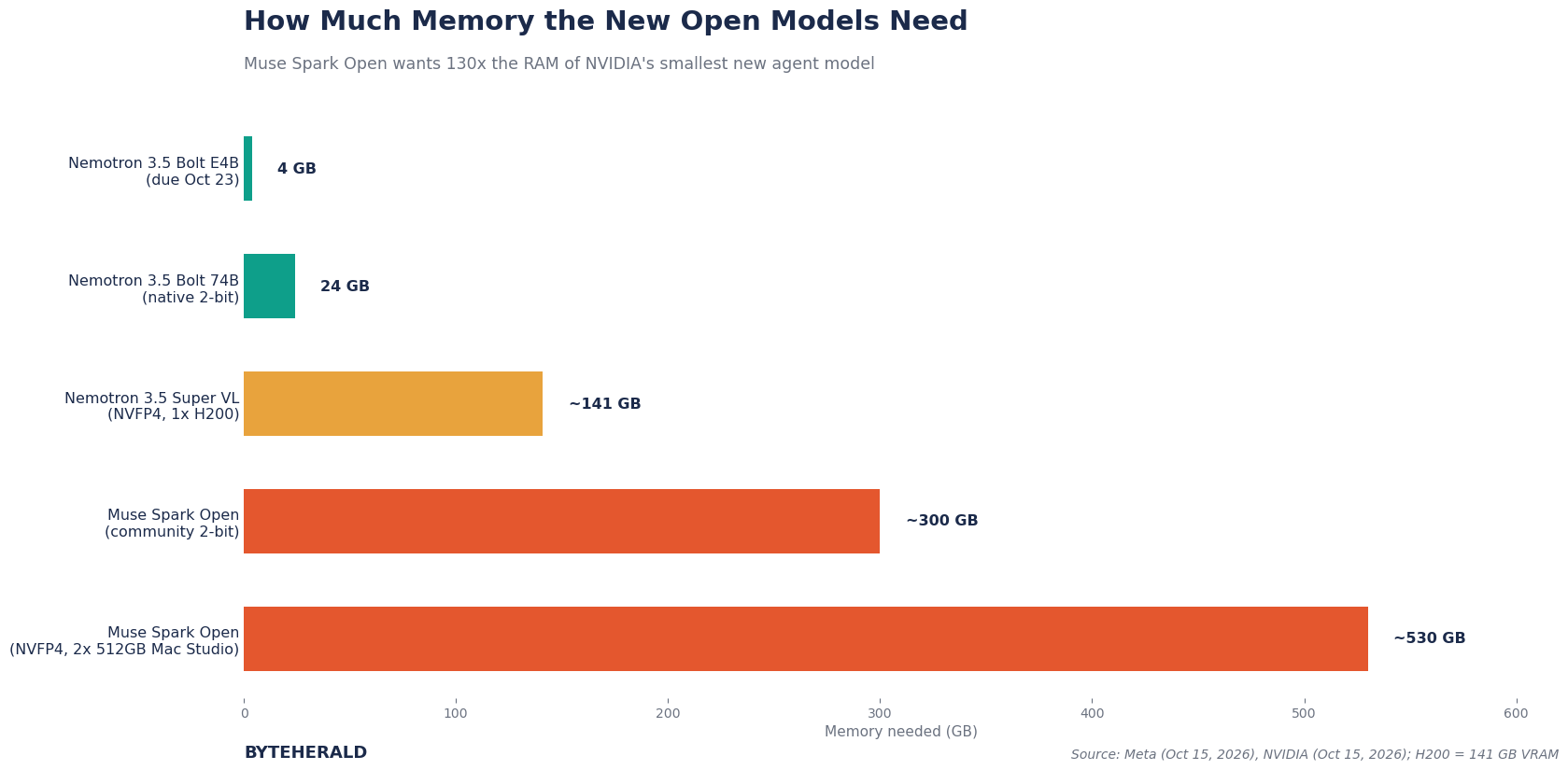
The same day, NVIDIA shipped its own open-model trio for the opposite end of the ladder. Nemotron 3.5 Super VL is a 120-billion-parameter multimodal model (12 billion active per token) aimed at always-on enterprise agents that read documents, images and video, running on a single H200, two H100s or one GB200 in its NVFP4 build (NVIDIA's technical blog). Below it sit two Bolt models for local hardware: Bolt 74B-A9B fits in 24 GB of memory with native 2-bit quantization, and Bolt E4B fits in 4 GB for device agents, due October 23. NVIDIA also published open datasets, training recipes and RL environments alongside the weights, which is the genuinely open part of the release.
The hardware map, side by side
| Model | Parameters (total / active) | Memory needed | Minimum hardware |
|---|---|---|---|
| Nemotron 3.5 Bolt E4B | Not disclosed | 4 GB | Device or laptop (due Oct 23) |
| Nemotron 3.5 Bolt 74B-A9B | 74B / 9B | 24 GB | Single 24 GB consumer GPU |
| Nemotron 3.5 Super VL | 120B / 12B | About 141 GB (NVFP4) | 1x H200, 2x H100, or 1x GB200 |
| Muse Spark Open (community 2-bit) | 816B / 42B | About 300 GB | High-memory workstation (reported) |
| Muse Spark Open (NVFP4) | 816B / 42B | About 530 GB | 2x 512 GB M5 Ultra Mac Studio |
The memory math, explained
Here is the evergreen part: you can estimate any open model's appetite with one multiplication. Parameters times bytes-per-parameter equals memory. At full BF16 precision (2 bytes per parameter), Muse Spark Open's 816 billion parameters need about 1.6 terabytes. NVIDIA's NVFP4 quantization compresses that to roughly half a byte per parameter, about 530 GB, which is why two 512 GB Mac Studios can hold it. Community 2-bit builds push it near 300 GB at the cost of quality. Mixture-of-experts helps speed, not memory: only 42 billion parameters are active per token, so the chip's 1.2 TB/s of bandwidth only has to read a small slice each step, but every parameter still has to live in memory somewhere. This is why Apple's unified memory architecture matters more than raw GPU speed here: a Mac Studio pools up to 512 GB that the GPU can actually use, while a typical gaming GPU tops out at 24 GB. The rule of thumb for 2026: if the model is bigger than your unified memory, you are renting API calls, not running locally.
ByteHerald's reading
Three honesties before you download anything. First, every capability number in this story comes from Meta or NVIDIA; there are no independent benchmarks yet, and Meta's own comparison table shows the model trailing Chinese open models on some coding tests. Second, "runs on a desktop" is doing heavy lifting: the 512 GB Mac Studio configuration was not shipping at launch, and the setup that works today costs roughly $38,000. Third, the practical route for almost everyone is a hosted API through partners like Together AI, Fireworks or Groq, where you pay per token and skip the hardware entirely. That is also where the price war we tracked this week is pushing costs down. The real significance of this week is strategic, not practical: the US finally has an open-weights answer to the Chinese labs, and open models keep winning the value game even as the closed models hold the capability crown.
By ByteHerald Staff. Hardware figures from Meta and NVIDIA announcements of October 15, 2026, and community quantization reporting; prices and availability change frequently. All benchmark claims are vendor-reported unless noted.
Comments
Post a Comment