Michael Burry, the investor known for betting against the housing market before 2008, read Anthropic's IPO filing and came back with one number: about 537 billion dollars in compute and infrastructure commitments. His argument, published on Substack on October 27, 2026, and reported by Stocktwits and Business Insider, is that the commitments are about 12 times Anthropic's current revenue run rate and more than 20 times its trailing twelve month sales, and that the structure behind them is circular, because the same companies selling Anthropic its compute are also its investors, its lenders, and its sales channel. The number checks out as a tally of separate contract items. It does not check out as a single clean total, because the filing itself leaves its grand total blank and warns, through its separate disclosures, that the pieces overlap. Both facts matter, and the difference between them is the story.
The tally, item by item
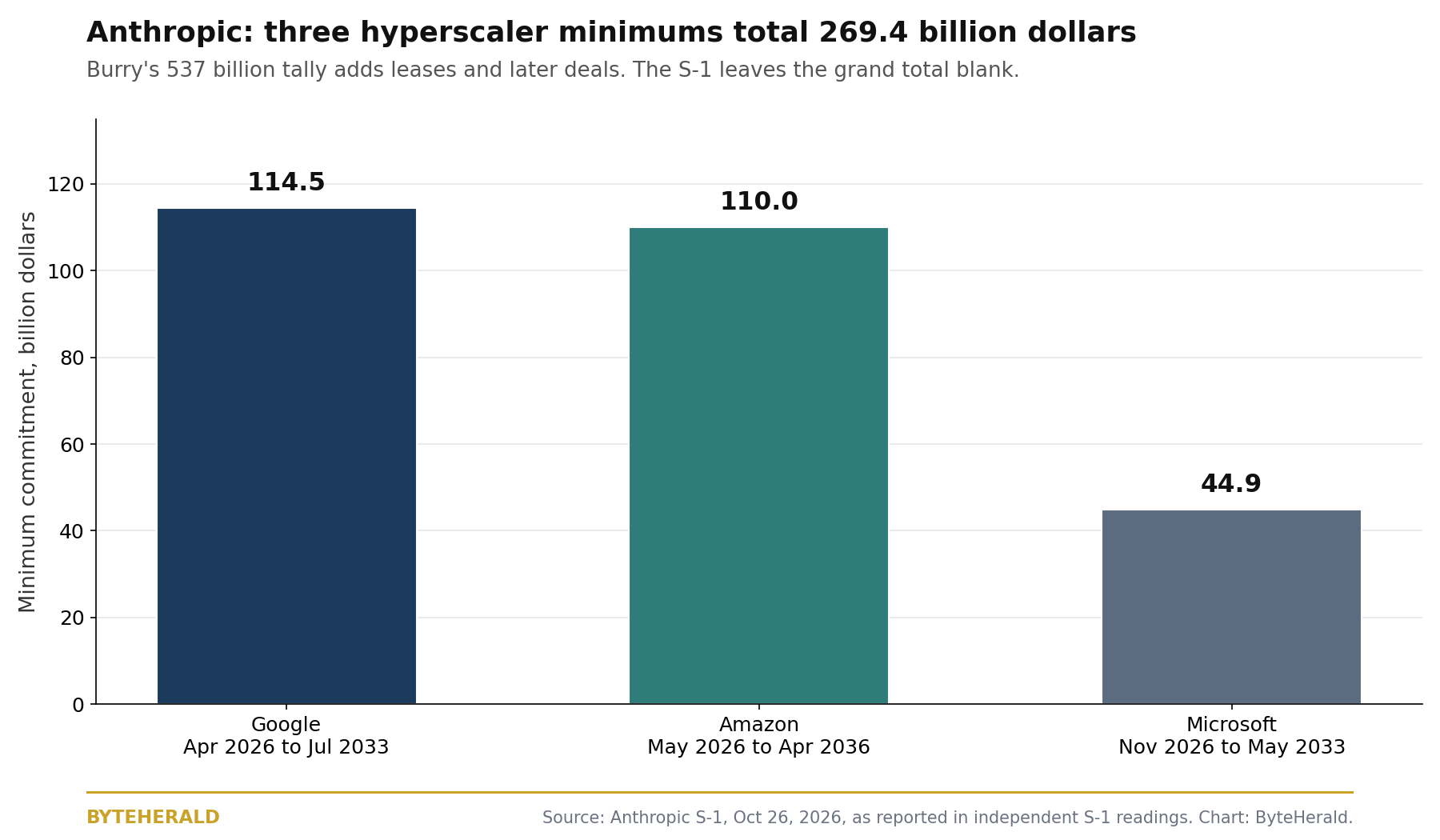
Burry's total is built from items the filing discloses in different places. The three hyperscaler minimums are the firmest part: at least about 114.5 billion dollars with Google from April 2026 to July 2033, at least 110 billion dollars with Amazon from May 2026 to April 2036, and at least 44.9 billion dollars with Microsoft from November 2026 to May 2033. Added together they come to 269.4 billion dollars, and for Google and Amazon the filing says the minimum is owed whether or not the capacity is used. Around that core, Burry adds Broadcom rack leases of about 161.2 billion dollars and agreements with specialist cloud providers such as Lambda and Nscale, plus pending Google TPU capacity and potential SpaceXAI arrangements, to reach roughly 537 billion dollars. Anthropic Filed Its IPO. The 94-Page Risk Warning Is Real laid out the filing's headline numbers when the S-1 went public on October 26, 2026: first half revenue of 16.3 billion dollars against 1.2 billion dollars a year earlier, and an operating loss of 693 million dollars. Burry is arguing about the other side of that same document, the spending the revenue has to grow into.
| Item in Burry's tally | Amount, billion dollars | What the filing actually says |
|---|---|---|
| Google minimum | 114.5 | April 2026 to July 2033, minimum owed regardless of use |
| Amazon minimum | 110.0 | May 2026 to April 2036, minimum owed regardless of use |
| Microsoft minimum | 44.9 | November 2026 to May 2033 |
| Three hyperscalers combined | 269.4 | Sum of the three minimums above, the firmest part of the tally |
| Broadcom rack leases | 161.2 | Five year equipment leases, reported in S-1 coverage |
| Burry's full tally | About 537 | Adds specialist providers, pending TPU capacity, and SpaceXAI |
Why the filing will not confirm 537 billion dollars
The filing's own anchors sit on different bases, and independent readers of the S-1 have said so plainly. As of June 30, 2026, Anthropic disclosed about 265.6 billion dollars of fixed or minimum guaranteed commitments, plus about 321.4 billion dollars of leases signed but not yet commenced. After June 30, it signed or amended agreements carrying about 245 billion dollars in minimum payments, some conditional, plus about 21 billion dollars in shorter term commitments that cannot be cancelled. Add those three figures and you get roughly 853 billion dollars, which is higher than Burry's number and higher than the Financial Times count of more than 800 billion dollars stretching to 2045. The reason none of these sums is the answer is that the pieces overlap: part of the post June agreements amend contracts already counted in the June totals, and an estimated 125 billion to 150 billion dollars of TPU capacity for 2028 to 2031, whose terms have not been finalised, sits outside the totals entirely. The S-1 leaves the aggregate committed spend figure blank, with its year by year obligations table also blank. A reader who adds every disclosed number together is double counting. A reader who picks only one number is understating the exposure. The honest statement is a range with named bases: 265.6 billion dollars of fixed or minimum commitments at June 30, hundreds of billions more in leases and later deals, and a grand total the filing does not yet state.
The circular financing claim, and where it bites
Burry's second claim is about who sits on both sides of these contracts. Out of about 141 billion dollars Anthropic has raised, roughly 41 billion dollars came directly from Amazon and Google through equity and convertible notes, with an additional 35 billion dollars in notes remaining undrawn. Nearly half of Anthropic's revenue, 48 percent in the first half of 2026, is billed and collected directly through hyperscaler marketplaces, and the same companies account for 58 percent of Anthropic's receivables. That is the loop Burry is pointing at: a supplier funds the customer, sells the customer its product, and collects the customer's revenue. The loop is not, on its own, proof of wrongdoing, and it is common in infrastructure buildouts where the supplier is also the deepest pocketed investor. It becomes a risk when demand pauses, because the same downturn hits the revenue, the funding, and the supplier's willingness to extend terms at the same time. Burry's historical parallel is the telecom buildout of 1998 to 2002 and the computer leasing era of the 1960s, when vendor backed, debt heavy expansion was mistaken for organic demand. The parallel is an argument, not a measurement, and it should be read that way: the filing proves the contracts exist, it does not prove they end the same way.
The growth slowdown inside Burry's case
The part of Burry's case that deserves the most attention is also the part easiest to overstate. Anthropic's revenue grew 132 percent in the first quarter of 2026 and 144 percent in the second quarter, on a sequential basis, then monthly growth slowed to between 3 and 7 percent in August and September, according to Burry's reading. He also cites Anthropic's claim that third quarter revenue was 86 times the 197 million dollars recorded in the fourth quarter of 2024, or about 16.9 billion dollars, while noting that the filing itself covers information only through June 30, so the third quarter figures sit outside the audited filing period. On efficiency, the filing shows compute costs falling from 251 percent of revenue in the first quarter of 2025 to 48 percent in the second quarter of 2026, or 2.08 dollars of revenue per dollar of compute, up from 0.40 dollars in the first quarter of 2025. Burry puts the later figure at 1.70 dollars, a slip he reads as early friction. The slip is Burry's calculation, not a filing line, and the two numbers come from different periods and methods. What the filing does establish is the mechanism that makes a slowdown dangerous: Anthropic typically contracts for compute 12 to 18 months before it arrives and recognises the expense when capacity comes online, whether or not it is fully used. Revenue can grow into that cost base, but a demand slowdown does not remove capacity already delivered. One exception matters: the SpaceXAI deals, worth up to 120.5 billion dollars through 2029, can be cancelled on 90 days notice after non-cancellable periods ending in early 2027, which gives Anthropic one exit hatch that most of its other commitments lack. Gartner's $3.5 trillion AI spending forecast is the wider context for this bet: the whole industry is committing to capacity ahead of proven returns, and Anthropic's filing is simply the first one to show the arithmetic in public.
What would settle the argument
Three disclosures would turn this debate from duelling tallies into a checkable total. First, the amended S-1 should fill in the blank aggregate committed spend figure and its year by year table, so readers stop adding overlapping items. Second, Anthropic should state, contract by contract, which minimums are genuinely incremental and which amend earlier deals, because that single distinction moves the total by hundreds of billions of dollars. Third, the company should publish the third quarter revenue and compute figures on the same basis as the first half, so Burry's slowdown claim and his 1.70 dollar efficiency figure can be tested rather than repeated. Until then, the fair summary is narrow: Burry's 537 billion dollar tally is a reasonable addition of disclosed items, not a filing total; the filing's own anchors support a commitment base in the hundreds of billions of dollars with an unstated grand total; and the circular structure he describes is real, documented in the filing's investor, supplier, and marketplace roles, even though its consequences are a forecast, not a fact. Investors who treat 537 billion dollars as the filing's number will overstate what is proven. Readers who dismiss it as invented will understate what is committed.
By ByteHerald Staff. Stocktwits, October 27, 2026, reported Michael Burry's Substack analysis of Anthropic's S-1 filing, including the roughly 537 billion dollar compute commitment tally, the 12 times revenue run rate and 20 times trailing sales ratios, the 114.5 billion dollar Google, 110 billion dollar Amazon, and 44.9 billion dollar Microsoft minimums, the 161.2 billion dollar Broadcom rack leases, the 48 percent of first half revenue billed through hyperscaler marketplaces, and the August and September monthly growth slowdown to 3 to 7 percent. Anthropic, October 26, 2026, filed its S-1 with the SEC, reporting first half 2026 revenue of 16.286 billion dollars, an operating loss of 693 million dollars, and about 265.6 billion dollars of fixed or minimum compute commitments at June 30, 2026, with the aggregate committed spend total left blank. Independent S-1 readings published October 26 to 27, 2026, by Atrani Capital and Decoding Discontinuity, reported the 321.4 billion dollars of leases not yet commenced at June 30, the roughly 245 billion dollars of post June minimum payments, the 125 billion to 150 billion dollar TPU estimate outside the commitments table, and the warning that the disclosed pieces overlap and should not simply be added together.
Comments
Post a Comment