Microsoft reported 92.3 billion dollars in revenue for the quarter ended September 30, 2026, its tenth straight quarterly record, and for the first time it put dollar figures on the two lines that matter most to the AI story. Strip away the record-streak framing and the quarter says this: Azure revenue was 33.2 billion dollars, up 48 percent from a year earlier, and revenue from OpenAI reached 10 billion dollars for a quarter, about 11 percent of Microsoft's total, while capital spending hit a record 45.2 billion dollars to deliver on 677 billion dollars of contracted future work.
Two firsts in one quarter
Microsoft's fiscal first quarter of 2027 covers July through September 2026, the same calendar window as other companies' third quarters, under a different label. The quarter's importance is not just the record total. It is the disclosure change. Microsoft disclosed Azure revenue in dollars for the first time, after years of reporting only a growth percentage, and it gave a quarterly OpenAI figure for the first time, after reporting OpenAI business only as a full-year total in July. TechCrunch's report on the filing and GeekWire's report on the OpenAI figure agree on the headline numbers, and the earnings-call transcript carries the same quarter bridge. Microsoft had announced on October 7, 2026, that results would be published after market close on October 28, 2026, on its Investor Relations site, which is the provenance for the timing, not for the figures themselves.
| What Microsoft disclosed | Figure | Why it is new |
|---|---|---|
| Azure revenue, in dollars | 33.2 billion dollars, up 48 percent | First quarterly dollar disclosure; previously a growth rate only |
| OpenAI-related revenue, for a quarter | 10 billion dollars | First quarterly figure; previously a full-year total only |
| Reporting structure | Agents and Infra plus Devices and Consumer | First quarter under the reorganized segments |
| Microsoft Cloud revenue | 63.9 billion dollars, up 30 percent | Context for the Azure figure inside the cloud total |
The quarter bridge
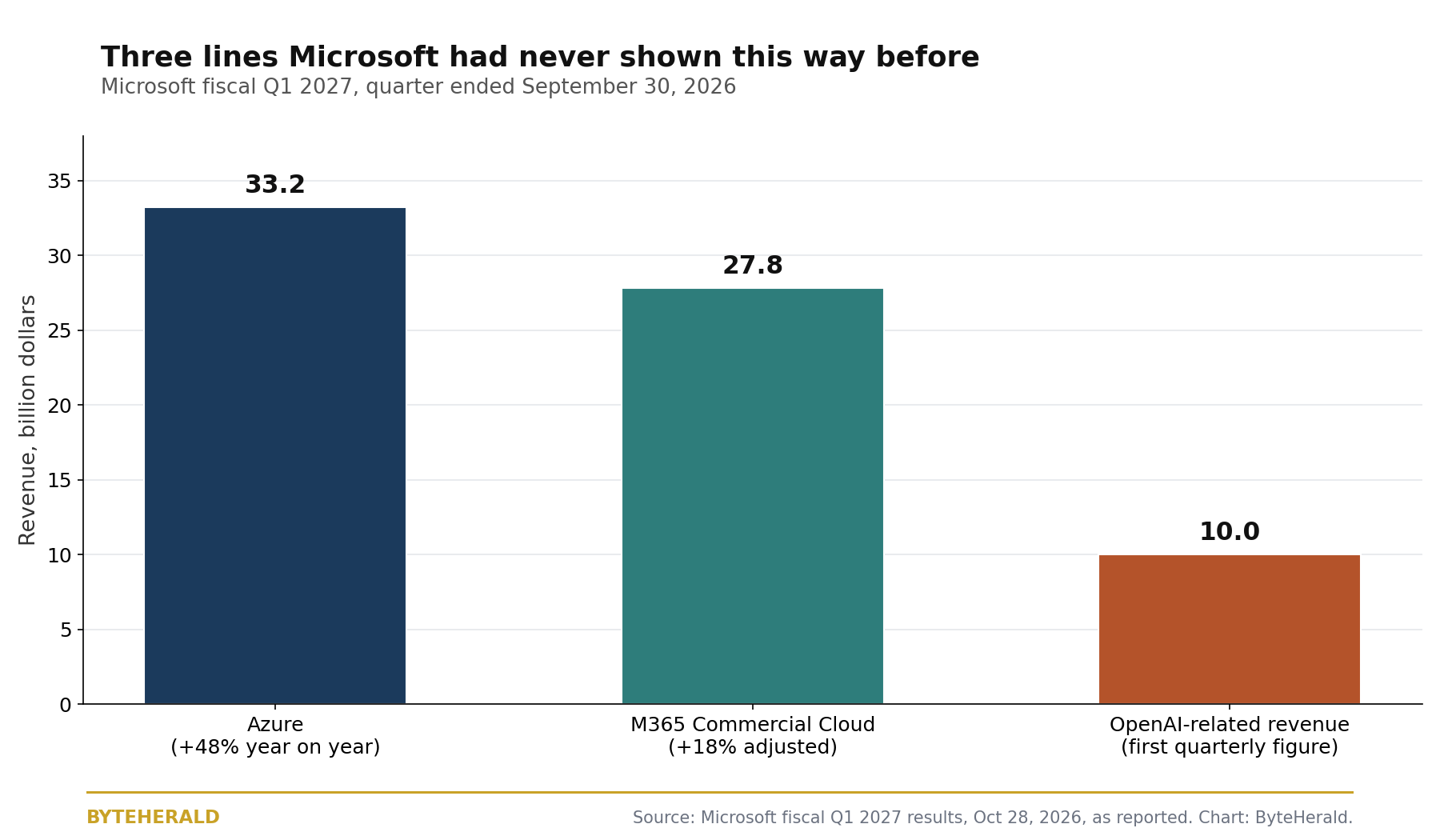
Total revenue of 92.3 billion dollars rose 19 percent from a year earlier. Net income reached 36.6 billion dollars on a GAAP basis, up 32 percent, and operating income rose 21 percent to 45.9 billion dollars. Non-GAAP earnings per share were 4.89 dollars, up 18 percent. The new Agents and Infra segment generated 76.8 billion dollars, up 25 percent and representing 83 percent of total revenue, while Devices and Consumer generated 15.5 billion dollars, down 3 percent. Inside the cloud total, Microsoft 365 Commercial Cloud revenue was 27.8 billion dollars. Windows OEM revenue declined 27 percent in the call transcript's framing, a scope to keep separate from any combined Windows-and-devices figure. Azure's 48 percent growth beat both analyst expectations of about 32.3 billion dollars and the company's own forecast of 44 to 45 percent growth.
The 10 billion dollar OpenAI line, read carefully
Ten billion dollars in one quarter from OpenAI is larger than two of Microsoft's longest-running businesses in the same quarter: Xbox at 5.4 billion dollars and search and advertising, including Bing, at 6.6 billion dollars. It is also a sharp step up from the prior fiscal year's average of about 6 billion dollars per quarter, since full-year fiscal 2026 OpenAI-related revenue was 24.1 billion dollars. The figure covers revenue-sharing payments from OpenAI plus other business between the companies, including OpenAI's use of Azure to train and run models. Microsoft did not say how much came from each part, and it did not say how much of Azure's growth came from OpenAI. Microsoft discloses the OpenAI business because its stake of about 24 percent makes OpenAI a related party under accounting rules, which require reporting business done with a related party. That rule, not a marketing choice, is why readers now get a quarterly OpenAI number at all.
Two limits keep the figure honest. First, the OpenAI revenue line overlaps with Azure in an undisclosed way, since part of it is payment for Azure computing, so it must not be added to Azure revenue as if it were a separate, non-overlapping business. Second, OpenAI continues to expand to other cloud providers, including AWS and Oracle, while still running much of its work on Azure, and Anthropic also runs on Azure, so the OpenAI line measures one relationship inside a larger cloud business, not the whole AI demand story. Azure at 33.2 billion dollars is now slightly ahead of Alphabet's Google Cloud at 30.7 billion dollars for the same quarter, though the two totals are not perfectly comparable, since Google Cloud includes Workspace subscriptions and grew about twice as fast from a smaller base.
What 45.2 billion in capex and 677 billion in backlog mean
Capital spending of 45.2 billion dollars set another quarterly record, and commercial remaining performance obligation, the contracted revenue not yet recognized, rose 73 percent to 677 billion dollars, with a weighted average duration of 2.3 years in the call transcript's framing. About 75 percent of the capital spending went to short-lived assets such as CPUs and GPUs for AI infrastructure. Read together, the two numbers describe a company spending heavily now to deliver work customers have already contracted for, rather than building on speculation alone. That distinction matters for the spending-payoff question we tracked in our Gartner spending-gap analysis, which asked how much announced AI spending would ever earn its return: Microsoft's backlog is contracted revenue, not a forecast, but contracts still have to be delivered profitably, and the delivery cost is visible in the same quarter's capex line.
What the Azure figure does not prove
Azure revenue of 33.2 billion dollars does not, by itself, separate AI demand from conventional cloud use. Enterprises run traditional software and SaaS applications on Azure alongside AI workloads, and Microsoft 365 Commercial Cloud revenue was 27.8 billion dollars. The honest reading is that AI is a significant contributor inside a large, growing cloud business, not that the whole 33.2 billion dollars is AI revenue. The same discipline applies to the record streak: ten straight quarterly records is a fact about Microsoft's total revenue, not a guarantee about any single product line, and nothing in this quarter's disclosure promises that Azure growth, OpenAI revenue, or capital spending will hold at these rates. For readers, the durable skill is the one this quarter rewards: when a company discloses a line for the first time, compare the new dollar figure against the old growth-rate-only history, check what scope the figure includes, and ask what split the company chose not to disclose, because the undisclosed split is often where the next quarter's surprise lives.
By ByteHerald Staff. TechCrunch report, published October 28, 2026, on Microsoft's filing gave total revenue of 92.3 billion dollars up 19 percent, net income of 36.6 billion dollars up 32 percent, operating income of 45.9 billion dollars up 21 percent, Microsoft Cloud revenue of 63.9 billion dollars up 30 percent, Azure revenue of 33.2 billion dollars, OpenAI revenue of 10 billion dollars, commercial remaining performance obligation of 677 billion dollars up 73 percent, capital spending of 45.2 billion dollars, Agents and Infra revenue of 76.8 billion dollars up 25 percent, and Devices and Consumer revenue of 15.5 billion dollars down 3 percent. GeekWire report, published October 28, 2026, gave the OpenAI comparison figures of Xbox at 5.4 billion dollars, search and advertising at 6.6 billion dollars, Windows plus devices at 3.6 billion dollars, full-year fiscal 2026 OpenAI revenue of 24.1 billion dollars, a stake of about 24 percent, and the undisclosed split of the OpenAI figure between revenue sharing and Azure usage. Motley Fool earnings-call transcript takeaways, published October 29, 2026, added non-GAAP earnings per share of 4.89 dollars up 18 percent, Microsoft 365 Commercial Cloud revenue of 27.8 billion dollars, a remaining performance obligation duration of 2.3 years, capital spending of 75 percent short-lived assets, and Windows OEM revenue down 27 percent.
Comments
Post a Comment