On October 19, 2026, MiniMax officially launched M3.1 Flash, a 428-billion-parameter mixture-of-experts model (23 billion active parameters) priced at $0.15 per million input tokens and $0.60 per million output tokens. The launch confirmed that the anonymous "Space Bunny," which topped global leaderboards while running in stealth and processed more than 200 trillion tokens, was an early build of the new model. Open weights are promised for October 23, and the model is live now on MiniMax's API, the M Plan subscription, and MiniMax Code.
What actually launched
The launch details come from MiniMax's official announcement, published October 19, 2026. M3.1 Flash is a multimodal MoE model with a 1-million-token context window, targeting agentic office work, coding, computer use, and cybersecurity. Reasoning is always on and cannot be disabled; developers pick from five effort levels (low to max, with max as the default), and migration notes warn that integrations sending disabled-reasoning flags will now return errors. The company claims agent-task usage costs fall 70% versus its predecessor M3, with median output speed above 170 tokens per second and cached input at $0.015 per million tokens.
The Space Bunny reveal is the launch's most interesting datum. OpenRouter, which hosted the stealth run, said Space Bunny was its number-one model for 10 straight days and processed 56.7 trillion tokens on its platform alone, the most of any stealth model it has run. During the stealth period, MiniMax used user feedback to cut time-to-first-token 38% (1.95s to 1.22s), raise throughput 45% (70 to 100 tokens per second), and halve the error rate (1.4% to 0.7%). Shipping a model under a false name, letting the market benchmark it blind, then revealing the identity is now an established launch playbook. It worked: the model arrived with third-party credibility already banked.
Half the price, more score
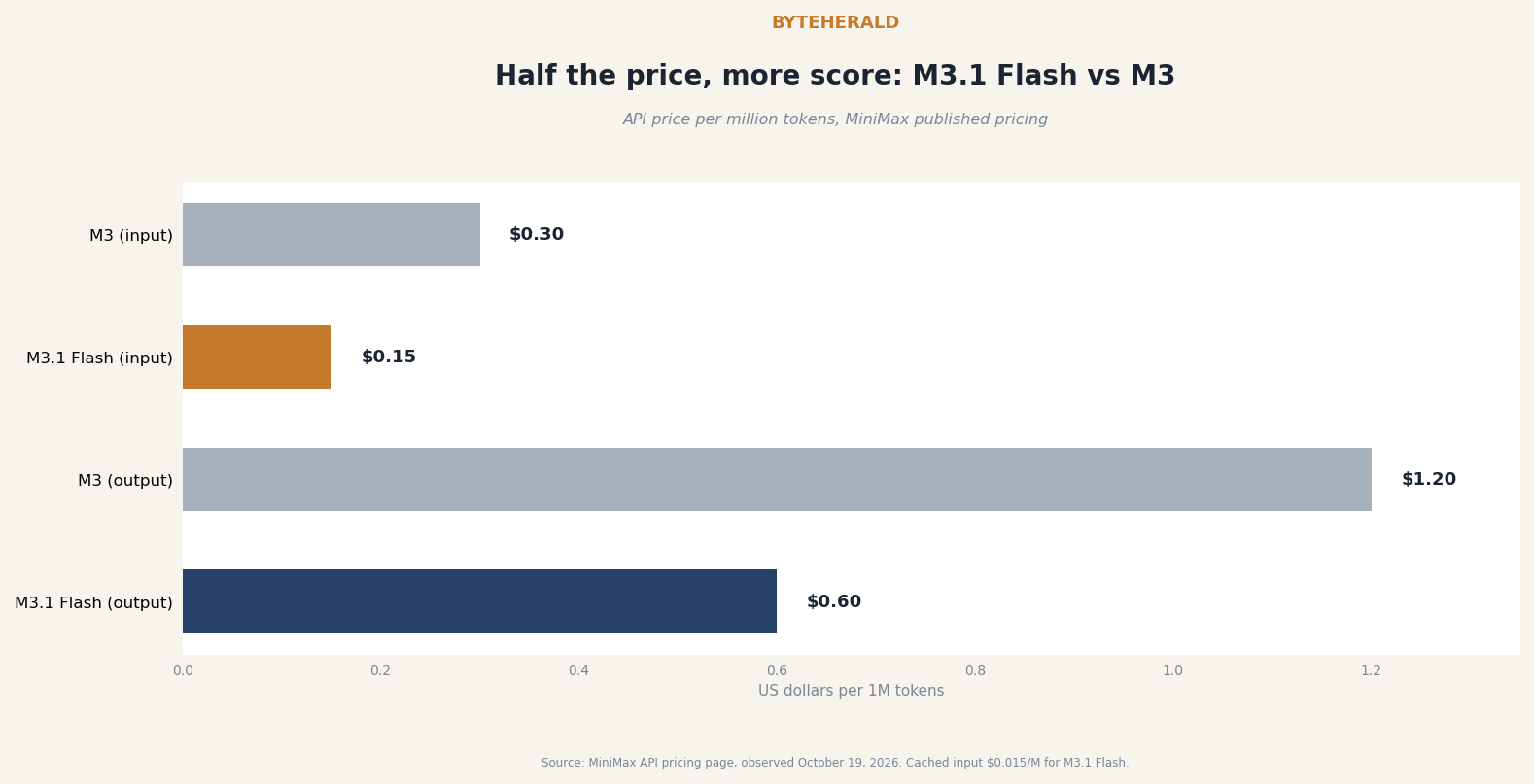
Against its predecessor M3 ($0.30 input, $1.20 output), M3.1 Flash is exactly half the price on both axes while, by MiniMax's own numbers, scoring 42 on the Artificial Analysis Intelligence Index versus M3's 29, a 13-point generational gain. Token prices keep falling; this is what the falling looks like when it comes with a score attached.
The benchmark table, graded for honesty
| Benchmark | M3.1 Flash | Nearest rival | Source |
|---|---|---|---|
| Humanity's Last Exam | 48% | DeepSeek V4.1-Flash-1017, 43% | MiniMax launch table, via aggregators |
| CritPt (physics) | 22% | DeepSeek 24%; GLM-5.3-Flash 15%; Gemini 3.8 Flash 18% | MiniMax launch table, via aggregators |
| AA-Omniscience | 56% | DeepSeek 43%; GLM-5.3-Flash 28% | MiniMax launch table, via aggregators |
| Terminal Bench 4.0 | 38.1 | Opus 5, 51.8 | MiniMax launch table |
| LMArena Code Arena: WebDev | #12, 1588 pts (+106 vs prior variant) | n/a (arena ranking) | LMArena, independent |
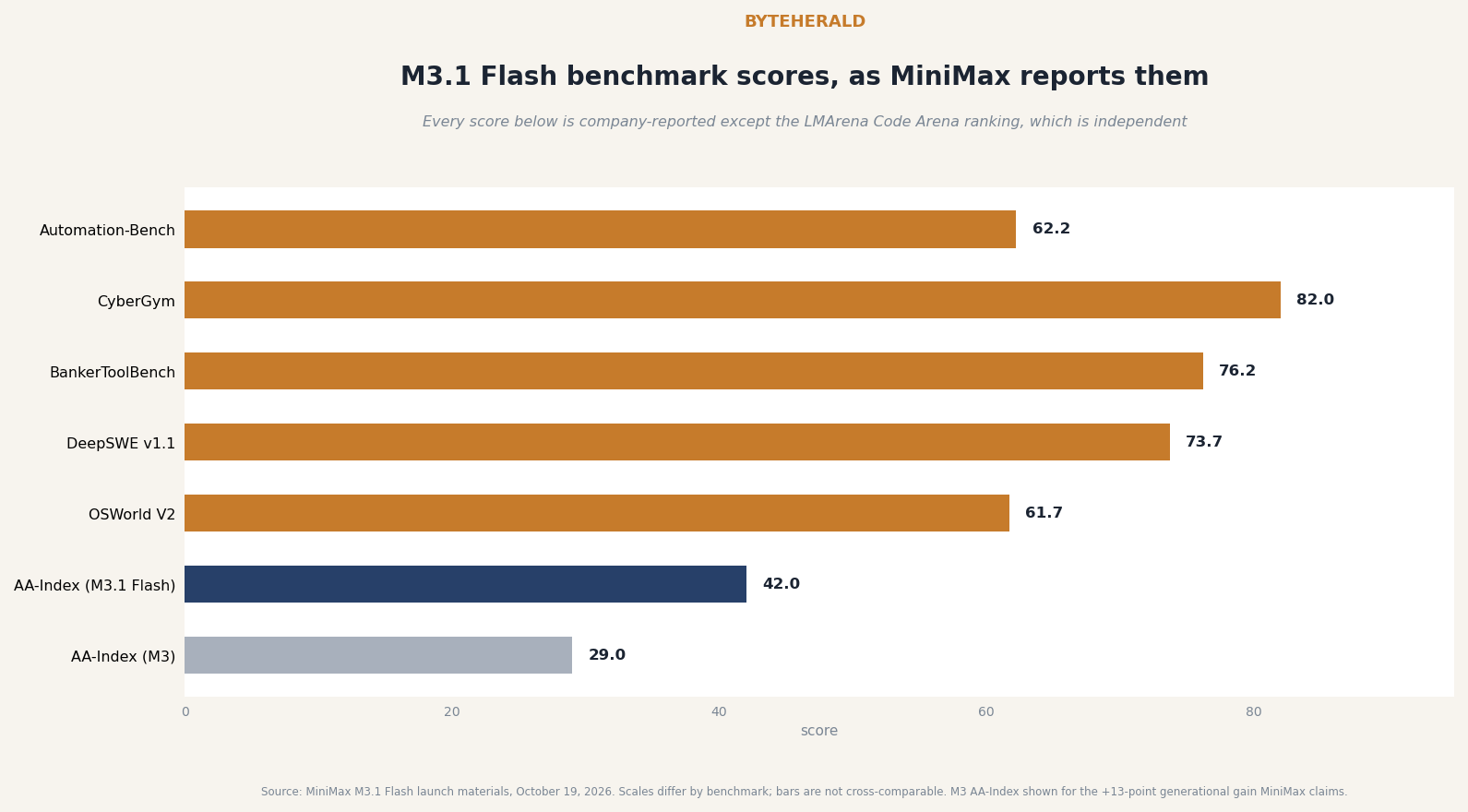
Two readings of this table are both true. The bullish reading: MiniMax leads the Flash tier on agentic benchmarks (Automation-Bench 62.2, claimed best in its table) at roughly a third of the per-task cost, about $0.22 per task by the company's math. The bearish reading: every number in the table except the arena ranking is vendor-reported on vendor-chosen benchmarks, and on the hardest coding test shown, Terminal Bench 4.0, M3.1 Flash trails Opus 5 by nearly 14 points. Both readings matter. The Flash tier is a value play, not a capability crown, which is the same price-versus-claim discipline behind our October price tracker: the great token discount wave had already happened, even as new entrants keep pushing the floor down.
How to read a Flash-tier launch
The news cycle will treat this as a product announcement. The durable question is the one buyers should ask of every Flash-tier launch: what does the token price buy you per unit of work, not per unit of intelligence? Flash models win when the task is high-volume and retryable (agent loops, batch coding, document processing) and lose when the task is high-stakes and single-shot (where a frontier model's first-pass accuracy amortizes its premium). The evergreen checklist: verify the always-on reasoning cost (thinking tokens count as output), check whether your harness can be tuned to the effort levels, and run your own acceptance trial before migrating, because vendor tables are marketing instruments with error bars.
M3.1 Flash is the counterpoint and the confirmation at once: new entrants keep pushing the floor down, while incumbents schedule their prices back up.
The bottom line
MiniMax shipped a genuinely cheap, genuinely fast model with a cleverly staged launch and third-party stealth validation to prove it. The benchmark table is strong where the company chose to compete and weaker where it did not, which is exactly what vendor tables always look like. For agent-heavy workloads where cost per task is the binding constraint, M3.1 Flash deserves a trial. For the hardest coding work, the arena ranking says mid-pack, and the price says so too.
By ByteHerald Staff. Launch details from MiniMax's official blog, October 19, 2026; stealth-run figures from OpenRouter's reveal post, covered by Unite.AI. All benchmark scores are MiniMax-reported unless labeled independent. Prices from MiniMax's API pricing page, observed October 19, 2026.
Comments
Post a Comment