Nvidia chief executive Jensen Huang put a rough price on agent software at GTC Berlin on October 22, 2026, and the number deserves careful handling. Speaking about software licensing as a growing part of Nvidia's business, Huang said the licensing model would be, for example, about 2,000 dollars per GPU per year to run all the software Nvidia provides that runs agents on AI factories. The sentence is quotable, the price is not final, and the gap between those two facts is the story. Nvidia has not said which GPUs the figure covers, which products sit inside it, or when it would take effect, and its existing AI Enterprise platform already lists at 4,500 dollars per GPU for a one year subscription. Treat the 2,000 dollar figure as a direction of travel, not a price list, and the announcement becomes useful: it tells buyers that agent software is becoming a per GPU recurring charge, and tells investors that Nvidia intends to monetize the software layer as deliberately as it monetizes silicon.
What was actually said, and what was not
The remark arrived one day after Nvidia unveiled its OpenShell Reference Architecture on October 21, 2026, a secure runtime for agents built on Vera Rubin systems, Vera CPUs, and BlueField-4 processors running Nvidia Sentry, which watches agent activity and can isolate agents that cross set security limits. Anthropic and Salesforce were named among the partners. That context matters, because the fee discussion is about the software that manages, sandboxes, and supervises agents at scale, not about the model weights or the agent applications themselves. Businesses deploying agents need software to manage workloads and to stop agents from reaching resources they should not touch, and that management layer is what Huang was pricing.
Three things remain undisclosed, and each one changes the bill. First, eligibility: Nvidia has not said whether the figure applies to every data center GPU, only to newer systems, or only to systems running the full agent stack. Second, scope: the company has not said whether the 2,000 dollar figure overlaps with AI Enterprise, replaces part of it, or describes a narrower agent focused bundle. Third, timing: no start date has been given. Any buyer building a 2027 budget from the floated figure alone is building on a sentence, not a contract, and should treat it as a planning scenario with a wide error bar.
The arithmetic that makes the sentence matter
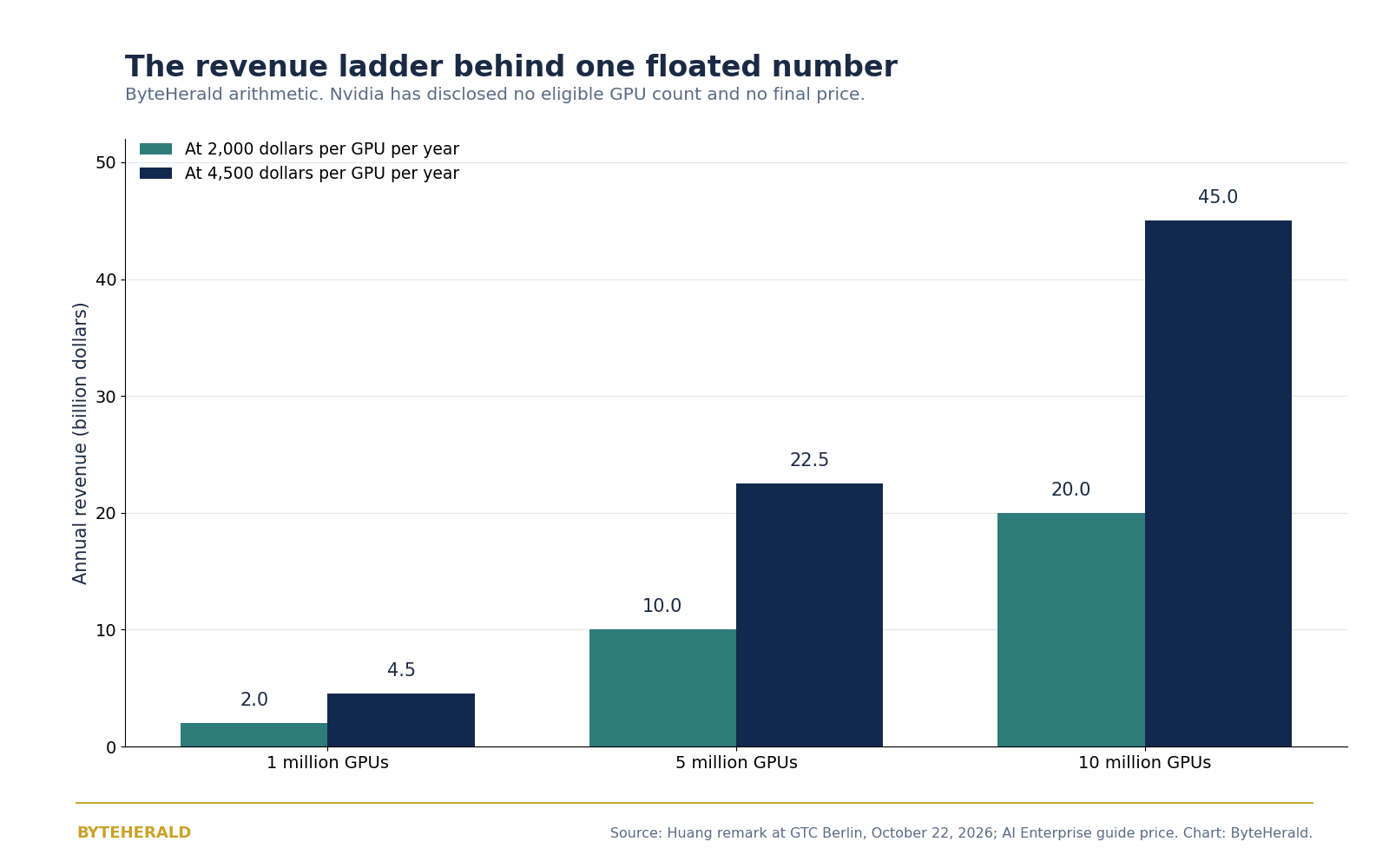
The reason one illustrative sentence moved through the trade press within a day is the multiplication behind it. At 2,000 dollars per GPU per year, one million paid licenses produce 2 billion dollars a year, five million produce 10 billion, and ten million produce 20 billion. At the existing AI Enterprise price of 4,500 dollars, the same counts produce 4.5 billion, 22.5 billion, and 45 billion respectively. ByteHerald computed those figures from the two published prices, and the chart below shows the ladder. None of these totals is Nvidia guidance, since the company has disclosed no eligible GPU count, but the ladder explains why Huang framed licensing as a major future business: a per GPU software charge compounds with every accelerator Nvidia has already sold, long after the hardware revenue is booked.
| Paid GPUs | At 2,000 dollars per year | At 4,500 dollars per year |
|---|---|---|
| 1 million | 2.0 billion dollars | 4.5 billion dollars |
| 5 million | 10.0 billion dollars | 22.5 billion dollars |
| 10 million | 20.0 billion dollars | 45.0 billion dollars |
The overlap question is the one buyers should press first. If the floated agent fee sits on top of AI Enterprise, a data center operator faces 6,500 dollars per GPU per year for the combined stack, which changes the economics of every agent deployment it plans. If it replaces or folds into AI Enterprise for agent workloads, the floated figure is actually a discount against today's list price, and the announcement reads as a price signal rather than a new charge. If it covers a different bundle entirely, the comparison is meaningless until Nvidia publishes the contents of each bundle side by side. Until that comparison exists, the honest description is that Nvidia floated a number in the same range as its existing software business, not that it cut or raised any price.
The evergreen question: who pays for the agent layer
Agent software pricing is becoming a distinct budget line because agents change what software must do. A chatbot answers a question and stops. An agent holds credentials, calls tools, moves data between systems, and acts while no human watches, which means the runtime must enforce permissions, log actions, and quarantine misbehavior. That supervision is infrastructure, and infrastructure vendors charge for it per unit of capacity, which in this case is the GPU. The same logic already appears in the agent lockout economics ByteHerald mapped in October, where blocking, licensing, and partnership became three different prices for the same agent traffic. Nvidia's floated fee is the fourth price in that market: the cost of running agents safely on your own hardware, charged by the company that sold the hardware.
For a buyer, the practical checklist follows from the gaps above. Ask which GPUs qualify and whether the fee follows the GPU or the deployment. Ask for the product list inside the fee, and for a written statement on overlap with AI Enterprise. Ask whether the fee is charged per GPU in the cluster or per GPU actually running agents, since idle capacity is common in AI factories and the difference between those two bases can double a bill. Ask for the renewal terms, since a 2,000 dollar figure that rises with each renewal is a different commitment from a fixed rate. And ask for the exit terms, since agent runtimes that embed themselves in permissions and logging are harder to replace than a model API. None of these questions has a published answer yet, which is itself useful information: the market for agent software pricing is still being negotiated in public, one conference sentence at a time.
The contrast with the consumer side of agent economics is instructive. On the shopping side, Google's Universal Cart and Shopify's agent checkout compete by removing friction, and the fees hide inside existing merchant and payment terms. On the infrastructure side, Nvidia is doing the opposite: naming a per unit price for the supervision layer itself. Both moves point the same way. Agents are leaving the demo stage, and every layer they touch is acquiring a price tag. The companies that publish the clearest price first will set the terms for the rest, and Huang's sentence, however provisional, is Nvidia's opening bid.
By ByteHerald Staff. Nvidia chief executive Jensen Huang, GTC Berlin, October 22, 2026, remark on software licensing at about 2,000 dollars per GPU per year for agent software on AI factories, as first reported by The Register and covered by Tom's Hardware, Notebookcheck, and TweakTown in October 2026. Nvidia AI Enterprise licensing guide, 4,500 dollars per GPU for a one year subscription with support, as cited in the same coverage. Nvidia OpenShell Reference Architecture, October 21, 2026, Vera Rubin systems, Vera CPUs, BlueField-4 processors running Nvidia Sentry, with Anthropic and Salesforce among partners.
Comments
Post a Comment