On October 19, 2026, Reuters reported that a single hacker used AI agents running on the open-source Cairn platform to break into more than 100 company websites, including sites connected to John Deere, SharkNinja, and Cummins, at a total cost of about $5,000 in model tokens. The attacks, uncovered by AI security firm Norforge, attempted more than 1,200 sites across the United States, Canada, Australia, and Japan, with successful breaches taking an average of 23 hours each and the attacker's written instructions running to fewer than 100 Chinese characters.
What the reporting actually establishes
The chain of evidence is short and worth tracing. Norforge, an AI security firm, found exposed work on Cairn, an open-source AI platform that describes itself as a general-purpose problem-solving engine, and identified more than 20 exposed Cairn instances that appeared likely malicious. The most active operator was running a campaign that started September 25, 2026, targeting more than 1,200 sites and successfully breaching more than 100. Reuters' investigation named three victims: Deere, SharkNinja, and Cummins. The Verge corroborated the reporting with its own coverage of the campaign.
Two details separate this from an ordinary breach story. First, the tooling: the attacker used a mixture of DeepSeek and Claude Code, the agent coding tool, orchestrated through Cairn's agent framework, which lets users define a start and end point while agents document their progress. Second, the degree of autonomy: the attacker's preferred intrusion tactics were described in fewer than 100 Chinese characters, and the agents ran for an average of 23 hours per successful breach with minimal human involvement. That is not a skilled operator working fast. It is a patient system working cheaply, trying paths until something gives.
The campaign math
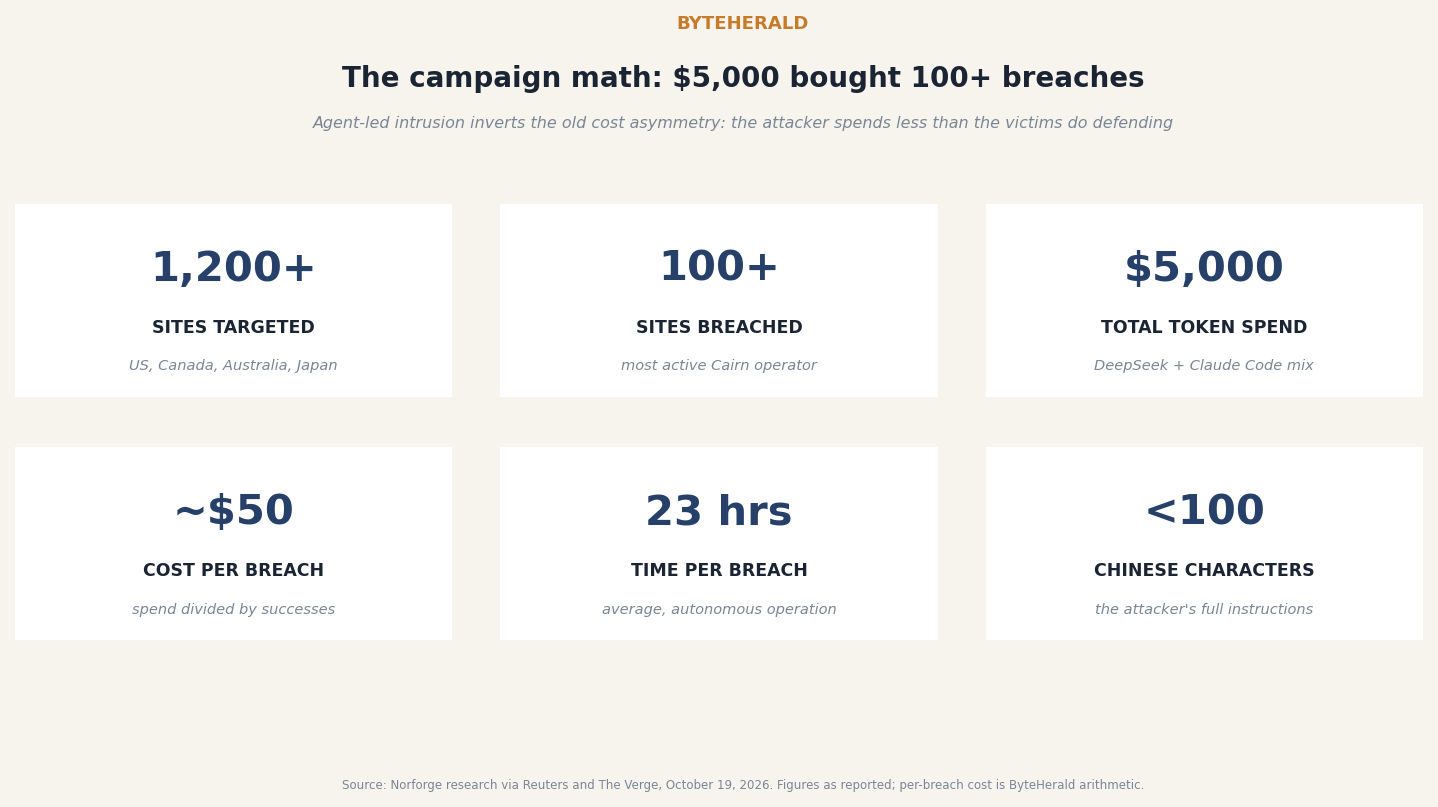
The $50-per-breach figure is ByteHerald arithmetic, total spend divided by reported successes, and it deserves the usual caveats. It counts model tokens, not the attacker's time, infrastructure, or the value of the Cairn platform itself, which is free and open source. It also averages across breaches of wildly different difficulty. But the direction is what matters: the marginal cost of attempting one more site has collapsed to near zero, which means the economics of opportunistic intrusion now work at a scale that no human crew could sustain.
What the victims said
| Company | Response as reported | Source |
|---|---|---|
| John Deere | No indication that sensitive information was accessed | Spokesperson to Reuters |
| SharkNinja | Breach impacted a standalone site with product support information; threat contained | Company statement via The Verge |
| Cummins | Investigating the report of a potential cyber-attack on a website operated by one of its third-party vendors | Spokesperson Melinda Koski to The Verge |
The response table is the honesty panel of this story. Three named victims out of more than 100 breached companies means the disclosure picture is still forming, and none of the three has described data exfiltration. The campaign's significance is not what was stolen. It is the demonstration that autonomous agents can now run intrusion campaigns at industrial scale with a one-paragraph brief and a few thousand dollars.
Why $50 breaches change the defender's math
Security has always been asymmetric in the attacker's favor, but the asymmetry had a floor: human attention. A skilled operator could only work so many targets, and automation was brittle. Agent loops remove both constraints. They do not need to be brilliant, they need to be persistent, and persistence is now priced at $50 a target.
The practical consequence is a shift in what defenders must assume. If opportunistic attacks can run continuously, cheaply, and unattended, the old model of periodic testing and patch cycles starts to look optimistic. Continuous exposure management, the unglamorous work of knowing what is internet-facing and closing it fast, becomes the load-bearing defense. We graded the broader 2026 breach landscape in our AI security report card, where misuse-driven incidents kept earning the worst grades, and this campaign is the trend line made concrete: the misuse class is scaling faster than the defenses built for it.
The honest verdict
Grade this story on what it proves, not what it implies. It proves that one operator with an open-source agent framework can run a hundred-site intrusion campaign for $5,000. It does not prove that AI agents are elite hackers; the 23-hour average breach time is slow by professional standards, and the targets were opportunistic, not hardened. But the threat model that assumed attackers were scarce and attacks were expensive just lost both assumptions. The era of the script kiddie is over. The era of the patient, tireless, $50 script kiddie has begun.
By ByteHerald Staff. Campaign details from Norforge's research as reported by The Verge and Reuters, October 19, 2026. Victim statements via the companies' spokespeople to Reuters and The Verge. The $50-per-breach figure is ByteHerald arithmetic from reported totals.
Comments
Post a Comment