Every serious open-weight AI model in 2026 calls itself open, and almost none of them means the same thing by it. Some ship under plain MIT or Apache 2.0, with no strings beyond keeping a notice attached. Others ship under custom licenses that cap your revenue, demand a separate deal once your product passes a user threshold, or require your product to carry the model's name. The difference is not in the marketing. It is in the license file, and it follows you for the entire life of whatever you build on the model.
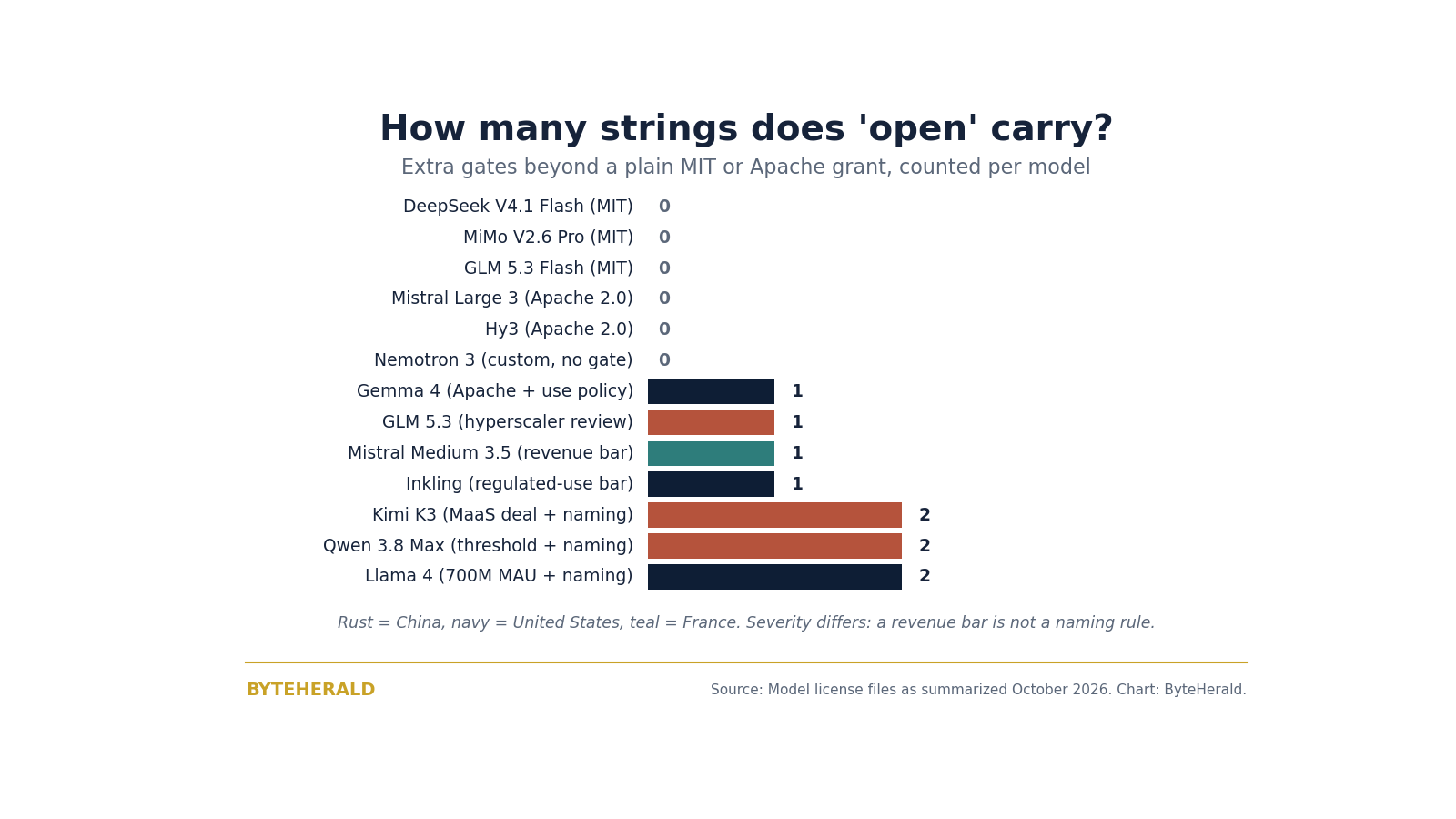
The direct answer: across thirteen leading open-weight models counted gate by gate on October 24, 2026, six carry no extra conditions beyond a standard open grant, four carry one extra gate, and three carry two, and the most permissive licenses now come disproportionately from Chinese labs, while the best known American model, Meta's Llama 4, carries a user cap and naming rules.
The matrix: thirteen models, counted the same way
ByteHerald counted each distinct extra condition once: a revenue or scale gate, a naming or attribution rule, a use-policy restriction, or a security review requirement. Severity differs, and the table says so, but the count gives teams a first screen before counsel reads the fine print. This is not legal advice, and every team should read the repository license file before shipping, because tags on model hubs mislead in both directions.
| Model | Lab and origin | License | Extra gates |
|---|---|---|---|
| DeepSeek V4.1 Flash | DeepSeek, China | MIT | None beyond notice retention |
| MiMo V2.6 Pro | Xiaomi, China | MIT | None beyond notice retention |
| GLM 5.3 Flash | Z.ai, China | MIT | None beyond notice retention |
| Mistral Large 3 | Mistral, France | Apache 2.0 | Standard patent grant and notices only |
| Hy3 | Tencent, China | Apache 2.0 | Standard Apache terms only |
| Nemotron 3 | NVIDIA, United States | NVIDIA Nemotron Open Model License | Custom text, but a perpetual, royalty-free, irrevocable commercial grant with no gate |
| Gemma 4 | Google, United States | Apache 2.0 plus prohibited use policy | Use restrictions that travel with the model |
| GLM 5.3 | Z.ai, China | Custom MIT-style license | Model-as-a-service operators above 10 billion dollars in revenue need a Z.ai security review |
| Mistral Medium 3.5 | Mistral, France | Modified MIT | Use barred above 20 million dollars in global consolidated monthly revenue, and the bar follows third-party fine-tunes |
| Inkling | Thinking Machines, United States | Apache 2.0 plus binding acceptable use policy | Bars automated decisions affecting credit, employment, housing, healthcare, or insurance, and the lab can change the policy |
| Kimi K3 | Moonshot AI, China | Kimi K3 License | Model-as-a-service above 20 million dollars over 12 months needs a separate Moonshot agreement, plus a naming rule above 100 million monthly users or $20 million in monthly revenue; internal use exempt |
| Qwen 3.8 Max | Alibaba, China | Qwen 3.8 Max License | Separate license for model-as-a-service or AI work assistants above 50 million dollars over 12 months, plus a naming rule above 100 million monthly users or $20 million in monthly revenue; internal use exempt |
| Llama 4 Scout and Maverick | Meta, United States | Llama 4 Community License | Separate Meta license above 700 million monthly active users, plus Built with Llama attribution and a rule that distributed fine-tunes put Llama first in the name |
Three findings the table hides in plain sight
First, the most permissive licenses moved. A team picking purely on license freedom in late 2026 ends up with DeepSeek, Xiaomi, Z.ai, and Tencent models, not with the American incumbents. That is a reversal of the 2023 picture, when American labs wrote the open rulebook, and it is also a trap, because license freedom is not the same as freedom to use, as the next section shows.
Second, the new gates are revenue gates, and they are getting tighter. Mistral Medium 3.5 bars use above 20 million dollars in monthly revenue, a test that runs monthly, so one strong month puts a company out of compliance. Kimi K3 and Qwen 3.8 Max set their bars at 20 million and 50 million dollars over twelve months for model-as-a-service, and both extend the logic to customer-facing products through naming rules above 100 million monthly users or $20 million in monthly revenue. The pattern is a tollbooth at the point where a product succeeds, not at the point where it starts.
Third, tags lie. GLM 5.3 carries an "other" tag on model hubs that scares procurement teams off, while its text is an MIT-style grant with a single hyperscaler review condition. The reverse also holds: DeepSeek's MIT label is only true from the V3-0324 release onward, and the original V3 weights shipped under a use-restricted DeepSeek license with PRC governing law, so any model card in a company's inventory that predates March 2025 needs checking. The rule is simple, and it is the same rule that applies to every policy document a company signs without reading: read the file, not the tag. Our audit of WhatsApp's public policy against its hidden AI notes found the same gap between the public document and the real terms, in a different industry, with the same lesson.
A license is not permission: the DeepSeek order
The sharpest proof that license text is only half the story arrived on October 20, 2026, when the United States Department of Homeland Security barred DeepSeek from federal civilian agencies and ordered its removal, including inside third-party products. DeepSeek's current weights are MIT licensed, and that made no difference. A permissive license answers the question of what the lab allows. It does not answer the question of what your government, your customers, or your contracts allow.
That distinction is now the central risk for teams building on Chinese open models. Congress is investigating companies that use Qwen and Moonshot models, and Treasury has floated sanctions over distillation, which means a model a team builds on today may not be one it can use next year. The practical response is architectural, not legal: route through a gateway that can swap a model out in a day, keep the weights self-hosted where the work allows it, and treat origin as a filter that runs before license, not after. The same logic runs through our audit of who blocks AI agents and what it costs: the gatekeepers that matter most are often not the ones who wrote the terms.
How to choose, by situation
For internal employee work, nearly every license in this matrix clears, because the revenue gates target model-as-a-service operators, and Kimi and Qwen both exempt internal use. For a customer-facing product, the shortlist narrows to plain MIT and Apache 2.0 models, checked against monthly-user and naming rules. For federal or regulated work, the list narrows further, to United States and European models, and Inkling drops out for any use case that automates decisions about a person's credit, employment, housing, healthcare, or insurance. For a team that cannot absorb a forced switch, the answer is not the highest-scoring model. It is the model whose license, origin, and support horizon all survive contact with the team's customers.
Support is the last gate nobody counts. A license keeps your weights when a lab walks away, but it does not keep anyone patching them, and Mistral deprecated Devstral 2 about seven months after release. The license tells you what you are allowed to keep. It never tells you what will be maintained. Teams that pick a model on license alone, without a gateway and a fallback, are buying the right to be stranded with a perfectly legal artifact.
By ByteHerald Staff. Codingscape published its open-weight license review on October 20, 2026, reading the license file for thirteen models and reporting Kimi K3 at 1488, GLM 5.3 at 1481, MiMo V2.6 Pro at 1480, and DeepSeek V4.1 Flash at 1475 on the LMArena text leaderboard, with Gemma 4 31B at 1452 as the first United States model. Codingscape reported Mistral Medium 3.5 under a Modified MIT license barring use above 20 million dollars in global consolidated monthly revenue, Kimi K3 requiring a separate Moonshot agreement for model-as-a-service above 20 million dollars over 12 months, Qwen 3.8 Max setting its bar at 50 million dollars over 12 months, Llama 4 requiring a separate Meta license above 700 million monthly active users, and GLM 5.3 requiring a Z.ai security review for model-as-a-service operators above 10 billion dollars in revenue. The United States Department of Homeland Security barred DeepSeek from federal civilian agencies on October 20, 2026, despite its MIT license. Codingscape reported DeepSeek's MIT licensing applies from the V3-0324 release onward, with the original V3 weights under a use-restricted DeepSeek license. Codingscape also reported on October 20, 2026, that Congress is investigating companies that use Qwen and Moonshot models, that Treasury has floated sanctions over distillation, and that Mistral deprecated Devstral 2 about seven months after release.
Comments
Post a Comment