OpenAI announced on October 26, 2026, that its internal models produced three claimed results in mathematics, computer science, and physics, and that only the first two arrived with public Lean formalizations while the physics materials were held back by their own review group. That split is the most important fact in the announcement, because it means the three claims do not stand on the same evidence, and any article that reports them as three equal breakthroughs is misleading its readers. This pillar is a verification ledger: what was claimed, what is public, what is checked, and what would have to happen for each claim to move from announced to accepted.
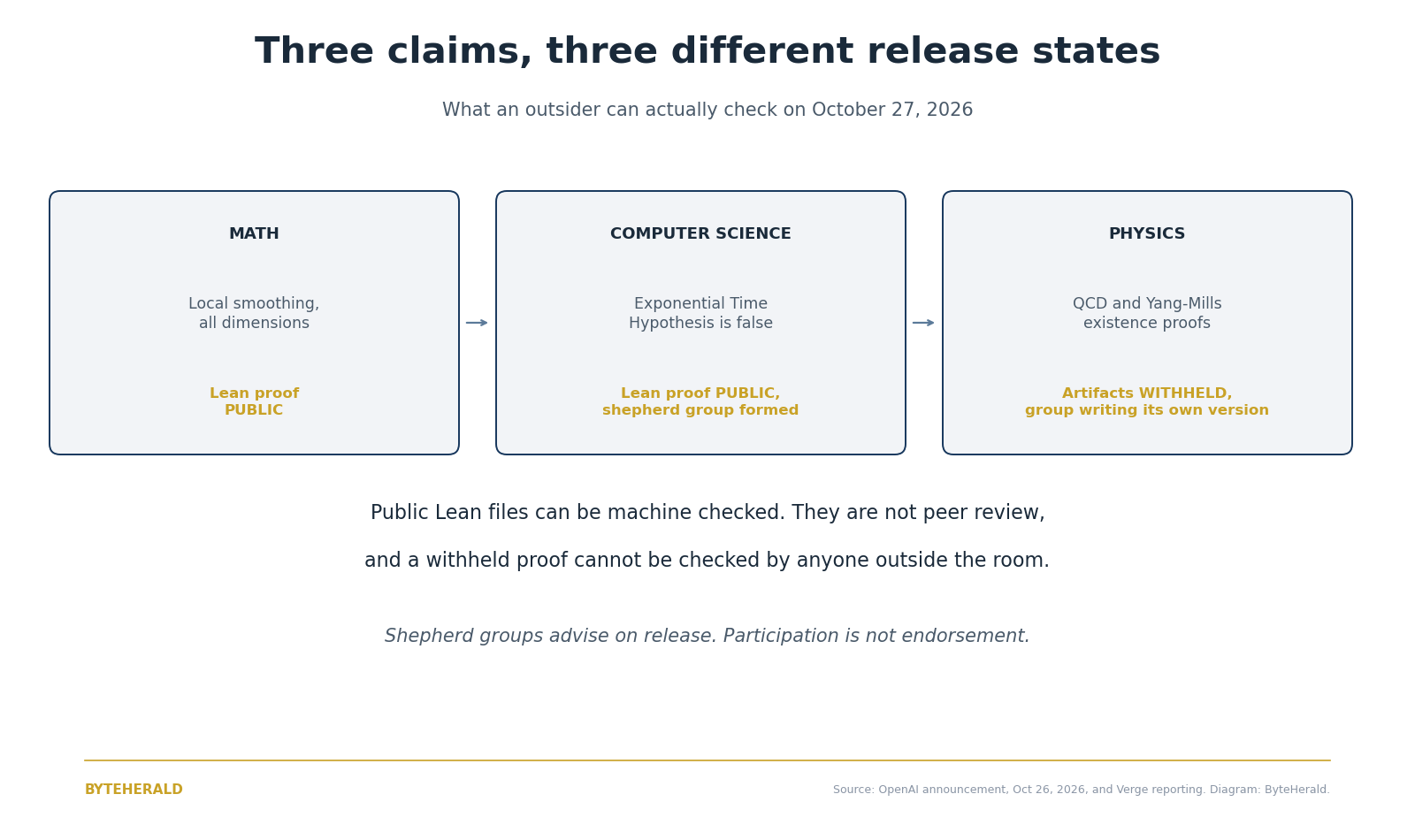
The three claims, side by side
| Field | Claim, as announced | What is public | Verification status on October 27 |
|---|---|---|---|
| Mathematics | Proof of the local smoothing conjecture in all dimensions, resolving the Kakeya and Stein restriction conjectures | Natural-language proof and Lean formalization, released October 26 | Machine checked in Lean; human peer review pending |
| Computer science | Refutation of the Exponential Time Hypothesis, via a subexponential counting algorithm | Manuscript and Lean formalization, released October 26 | Machine checked in Lean; independent examination by a shepherd group pending |
| Physics | Rigorous existence proofs for quantum chromodynamics and related four-dimensional theories, including pure Yang-Mills theory | Not released in full; the review group is writing up the work itself | Not independently auditable by outsiders yet |
Mathematics: a 1991 conjecture, claimed in every dimension
The mathematics claim concerns how waves focus. Christopher Sogge proposed the local smoothing conjecture in 1991: roughly, the worst focusing of a wave cannot persist, because averaging over time improves the bounds available at the worst instant. The conjecture sits at the top of a tower in harmonic analysis, implying the Bochner-Riesz conjecture, which implies the restriction conjecture, which implies the Kakeya conjecture about the smallest set that can contain a needle pointing in every direction. Progress came dimension by dimension: the two-dimensional case was proved by Guth, Wang, and Zhang in 2019, and Hong Wang and Joshua Zahl proved the three-dimensional Kakeya result in 2025. OpenAI says its system produced a proof in all dimensions using a novel auxiliary partial differential equation, with the natural-language output produced on October 18, 2026, and the Lean formalization completed the following day, and that the result also yields the Kakeya maximal and dimension conjectures and Stein's spherical restriction estimates. If the proof holds, it is not an incremental step but the close of a 35-year program. That scale is exactly why the verification standard matters: a claim this large, from a machine, needs more than a press release, and OpenAI's decision to release both the proof and its formalization is the right starting point. It is a starting point, not a verdict, because no peer review has yet been reported. The context here is OpenAI's own recent history: the company had already released a large batch of AI-generated mathematics manuscripts earlier in October, covered in our report on the 722-manuscript release, and the debate that batch prompted is the backdrop to the shepherd model in this announcement.
Computer science: the hypothesis that hundreds of papers assumed
The computer science claim is, in one sense, the easiest to state and the hardest to believe. The Exponential Time Hypothesis says that 3-SAT, the problem of deciding whether a Boolean formula in a certain form has a satisfying assignment, cannot be solved in subexponential time. Hundreds of papers have used ETH as an assumption to derive conditional hardness results across graph theory, computational biology, databases, and computational geometry: if ETH holds, then these problems cannot be solved faster than a certain bound. OpenAI says its system produced a deterministic algorithm that exactly counts the satisfying assignments of fixed-width CNF formulas in subexponential time and polynomial space, and that the 3-SAT case refutes ETH. OpenAI's own caution, stated in the announcement, is worth repeating: the result reopens questions about how much faster these tasks could become, but finding such algorithms and turning theoretical advances into practical improvements will require significant further research. A refutation of ETH does not hand anyone a faster solver tomorrow. It removes a ceiling that researchers assumed, and the practical consequences, if any, are years of work away. The examination group here is unusually well chosen: Russell Impagliazzo and Ramamohan Paturi of UC San Diego, who are among the hypothesis's originators, with Ryan Williams of MIT, who has refuted strong versions of related hypotheses. The group asked that all raw data be made public and that OpenAI fund a conference on the implications, and OpenAI agreed. That is a good process. It is also, as of October 27, a process that has just begun, and the group's participation is not an endorsement of the result.
Physics: the strongest claim, the weakest public evidence
The physics claim is where the ledger turns uncomfortable. OpenAI says its models produced mathematically rigorous existence proofs for certain interacting quantum field theories in four dimensions, including quantum chromodynamics, the theory of the strong force that binds quarks and gluons, and a completed Standard Model, with a proof concerning the existence of pure Yang-Mills theory, a subproblem of a Clay Mathematics Institute Millennium Prize problem. If correct, that is a landmark in mathematical physics. But the physics materials were not released in full. The review group, led by Nobel laureate David Gross with Michael Douglas, Arthur Jaffe, Igor Klebanov, and Nikita Nekrasov, decided to hold back the AI-produced artifacts and write up the work themselves. That decision is defensible on its own terms: a group that will be asked to vouch for a Millennium-scale claim wants to understand it first, in its own words. It also means the claim with the largest consequences is currently the least checkable. No outsider can audit a proof that has not been published, and no reader should treat the physics claim as standing on the same footing as the two Lean-formalized claims. The honest summary is an inversion: the more a claim would change science, the less public evidence it currently carries, and the longer its verification will take.
What Lean verification does and does not settle
Lean is a proof assistant: a formal language in which a proof is written as a sequence of machine-checkable steps, so that a computer can verify that each step follows from the stated axioms and definitions. When OpenAI says a result was verified in Lean, it means the formal proof checks out as written. That is a real achievement, and it rules out an entire class of failure: a hand-waving gap, a skipped case, an unjustified inference inside the formal argument. It does not rule out three other classes of failure, and readers should know them. First, the formal statement might not capture the intended conjecture, if a definition is subtly different from the standard one. Second, the formal proof might depend on an assumption that is itself unexamined, buried in the setup rather than the argument. Third, the result might be correct but already known, or a special case dressed as a general theorem, which is a question of novelty and scope that no proof checker answers. Lean verification also says nothing about whether the model's reasoning was original, or whether it reconstructed known material. Those are human questions, and they are why peer review, shepherd writeups, and independent formal audits still matter after a Lean check passes. A model that produces text, which is what transformers do at their core, can produce a formally valid proof whose real content still needs a human to understand and certify.
The five-question checklist for any AI science claim
The ledger above generalizes into a checklist readers can apply to the next announcement, from any lab, without needing a mathematics degree. First, is the artifact public, in full, or is the claim resting on a summary? Second, is it machine checked, and in what system, with the formal files available to download? Third, who is shepherding the review, and have they endorsed the result or merely agreed to examine it? Fourth, what is withheld, and does the withheld part include the strongest claim? Fifth, what would falsify the claim, and who is in a position to find the gap? A claim that passes all five is not proven, but it is checkable, and checkability is the threshold that separates science from publicity. OpenAI's October 26 announcement passes the first two questions for mathematics and computer science, partially passes the third for all three fields, and fails the fourth for physics, for reasons its own review group chose. That is a mixed record, and a mixed record is a fair headline. The shepherd model itself deserves credit as an institutional innovation: OpenAI says participants sign no nondisclosure agreements, participate voluntarily and unpaid, and that the company seeks no academic credit for the discoveries. Those four principles, transparency, no credit for OpenAI, recognition for the groups, and independence, are the right rules for this kind of collaboration, and other labs should be judged against them.
What would change the ledger
Four developments, in order of increasing weight, would move a claim from announced to accepted. An independent Lean audit, in which a group other than OpenAI re-checks the formal files and confirms the statements match the conjectures, would settle the machine-checkable layer. Shepherd writeups, in which the examination groups publish their own explanations and assessments, would settle the human-understanding layer. Journal submission and peer review would settle the community layer, which is slow and adversarial by design. And for physics, the simple act of publication, the release of the artifacts the Gross group is currently writing up, would move the claim from unauditable to auditable, which is the single largest step available. Until then, the correct stance for a reader is neither dismissal nor celebration. It is the stance this ledger takes: two claims are public and machine checked and await human verdicts, one claim is announced and withheld and awaits even the chance of a verdict, and the difference between those states is the story.
By ByteHerald Staff. OpenAI, October 26, 2026, announced three results in mathematics, computer science, and physics, stating that the mathematics proof was produced on October 18, 2026, and formalized in Lean the following day, and that the computer science result was verified in Lean with an independent examination group led by Russell Impagliazzo, Ramamohan Paturi, and Ryan Williams. The Verge, October 26, 2026, reported that OpenAI announced the three discoveries alongside a new way of working with academics, and that the physics group led by David Gross would shepherd that work. MIT Sloan Management Review, October 27, 2026, reported that the mathematics result addresses Christopher Sogge's 1991 local smoothing conjecture and that independent researchers are now examining the findings.
Comments
Post a Comment