OpenAI is expanding ads inside ChatGPT, and the newest format will appear right where you create images. The company says it will begin testing visual ads during image generation later this month in the United States, with an initial group of advertisers. The ads will be clearly labeled and kept separate from the image being created, and OpenAI reiterated that ads do not influence ChatGPT's answers.
What the new format looks like
According to OpenAI, these visual ads could use images to show product inspiration, how a product is used, or experiences associated with a service, giving advertisers a more visual way to promote themselves inside ChatGPT. The company frames it plainly: ChatGPT now reaches 1.2 billion people every week, and advertising is a way to monetize users who may not pay for a subscription.
Alongside the format, OpenAI is getting more serious about measurement. It is integrating with Hightouch, Tealium and LiveRamp for conversion data, with attribution partners including AppsFlyer, Adjust, Branch, Triple Whale and Kochava. It is also working with DoubleVerify and Integral Ad Science on brand suitability, which matters in ChatGPT because ads appear around conversations rather than on a traditional webpage. The company says its safeguards are designed to prevent ads from appearing in emotionally vulnerable, sensitive or otherwise unsuitable conversations, and that these partners will not get access to private user conversations while evaluating safeguards.
The monetization timeline
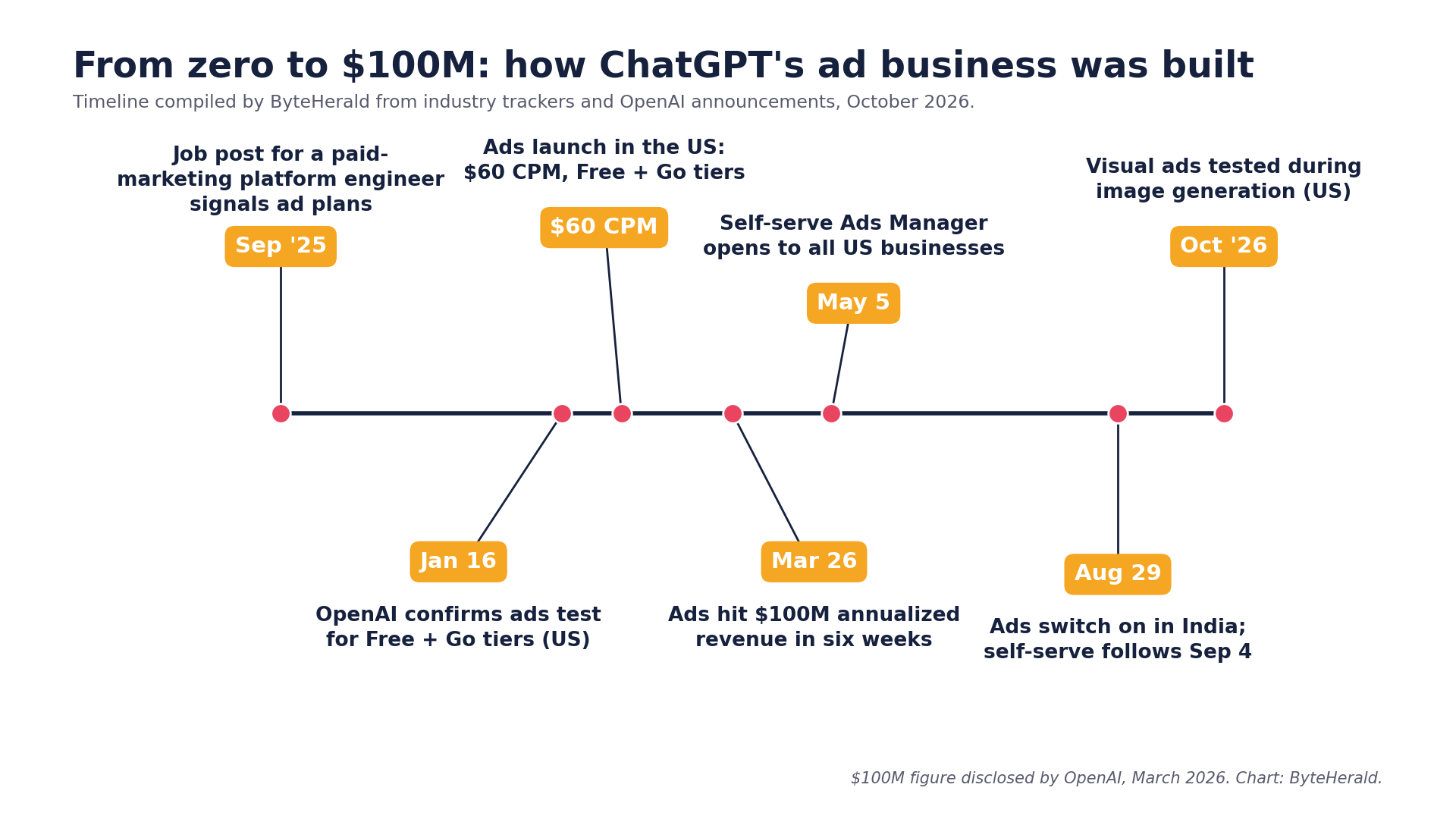
The visual-ads test is the latest step in the fastest monetization push OpenAI has ever run. ByteHerald's dated rollout table:
| Date | Milestone |
|---|---|
| September 2025 | Job posting for a paid-marketing platform engineer signals internal ad infrastructure |
| December 2025 | CEO's "code red" directive pauses ad development to focus on product quality |
| January 16, 2026 | OpenAI formally confirms ad tests for Free and Go tiers in the US, with five governing principles |
| February 9, 2026 | Ads launch in the US at $60 CPM for Free and Go tier users; early advertisers include Target, Ford and Adobe |
| February 20, 2026 | First independently verified ad sightings; ads appear in about 0.8% of analyzed prompts |
| March 26, 2026 | Ads cross $100 million in annualized revenue within six weeks; expansion to Canada, Australia and New Zealand announced |
| April 17, 2026 | CPMs reported as low as $25, down from $60 at launch |
| May 5, 2026 | Self-serve Ads Manager opens to all US businesses; minimum spend dropped |
| August 29, 2026 | Ads switch on in India; self-serve access follows September 4 |
| October 11, 2026 | Visual ads during image generation enter testing in the US |
Confirmed vs unknown
| Confirmed | Unknown |
|---|---|
| Ads appear only for Free and Go ($8/mo) users; Plus, Pro, Business, Enterprise and Edu stay ad-free | When visual ads move beyond the US test, or to paying tiers |
| Ads are labeled and separated from answers; OpenAI says they do not influence responses | Whether CPMs settle near $25 or keep falling as inventory grows |
| No ads for users under 18, and none alongside politics, health or mental-health conversations | How strict the "emotionally vulnerable" safeguards prove in practice |
| Advertisers see aggregate metrics only, never chat content | Whether 1.2 billion weekly users convert ad impressions into real revenue growth |
Why this matters
Ads are how OpenAI pays the inference bills for a free product used by more than a billion people a week. The economics behind that free tier are visible in the model pricing: our October price tracker shows what each million tokens costs across ten frontier models, and every free image generation draws on those same per-unit costs. Advertising turns that cost into revenue instead of a loss.
The timing is also worth noting. Earlier this month OpenAI announced it will watermark ChatGPT text in the EU, a move aimed at content provenance and trust. Now it is placing visual ads inside the creative process itself. OpenAI is simultaneously asking users to trust ChatGPT's outputs more, and to accept commerce inside them. How it keeps those two promises separate is the question to watch.
By ByteHerald Staff. Reporting based on BleepingComputer and industry tracker timelines; rollout dates cross-checked across multiple trackers.
Comments
Post a Comment