Since 2024, OpenAI has lost founders, its chief scientist, its CTO, a reported cluster of researchers to Meta, and three safety researchers to firings, while one pretraining researcher quit the industry entirely. We compiled every verified senior departure into a single dated tracker, mapped where the talent landed, and asked what the flow means for the race to AGI.
The quotable answer
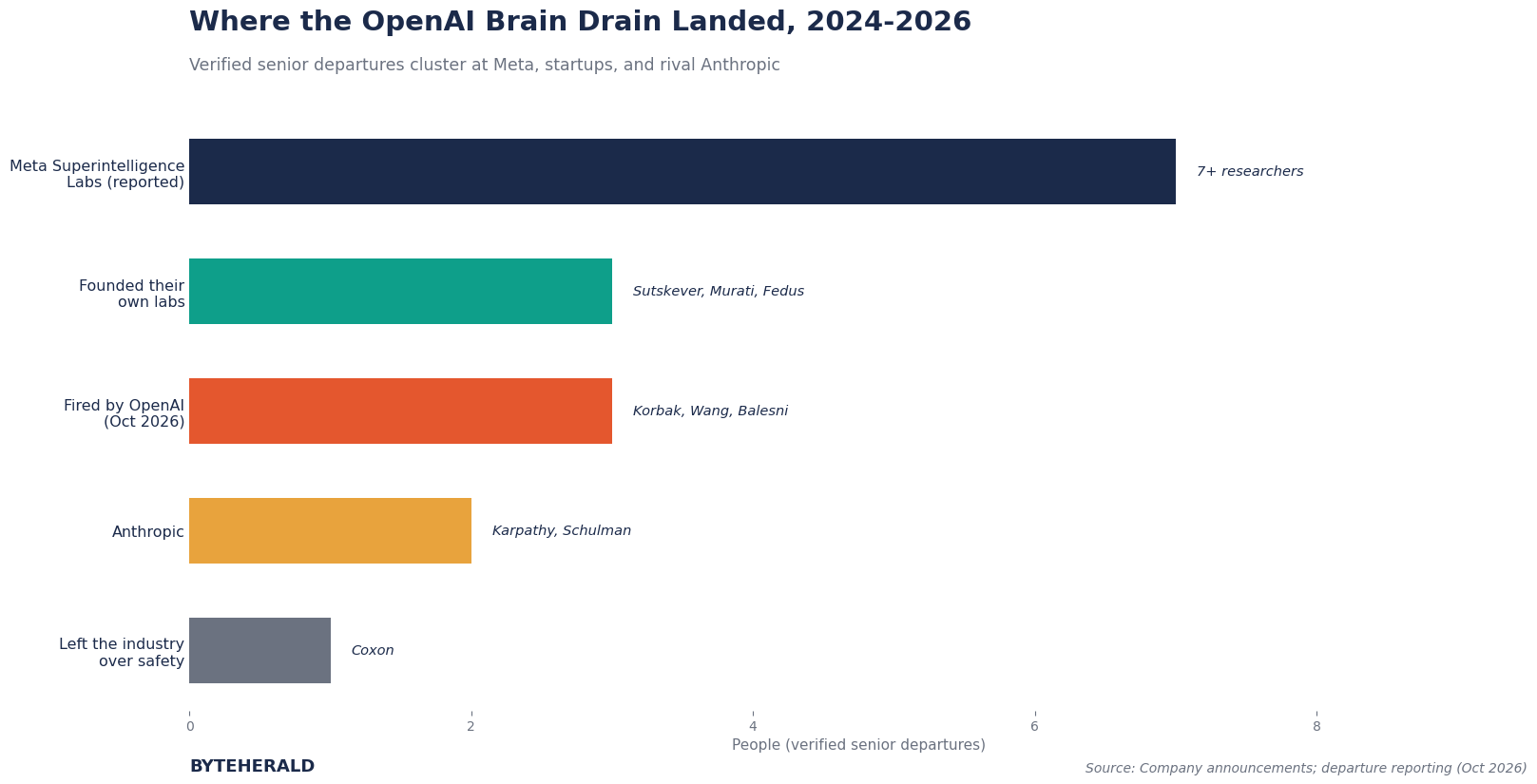
From 2024 through October 2026, at least 16 verified senior figures left OpenAI or were pushed out. Meta absorbed the largest reported cluster, Anthropic collected two co-founders, three founded their own labs, three safety researchers were fired in October 2026, and one pretraining researcher quit the industry entirely, warning that labs are "gambling with our lives."
The verified tracker
Every row below is dated and sourced. "Reported" marks departures confirmed only through industry reporting rather than company statements.
| Name | Role at OpenAI | When | Where they went |
|---|---|---|---|
| Ilya Sutskever | Chief Scientist, co-founder | 2024 | Safe Superintelligence (co-founded) |
| John Schulman | Co-founder, research lead | 2024 | Anthropic |
| Mira Murati | Chief Technology Officer | 2024 | Thinking Machines (founded) |
| Zhao and at least six others | Researchers | 2026 | Meta Superintelligence Labs (reported) |
| William Fedus | Researcher | 2026 | Periodic Labs (founded, reported) |
| Andrej Karpathy | Co-founder | May 2026 | Anthropic (reported) |
| Jacob Coxon | Pretraining researcher | September 8, 2026 | Left the industry |
| Tomek Korbak | Safety researcher | October 2026 | Fired by OpenAI |
| Jasmine Wang | Safety researcher | October 2026 | Fired by OpenAI |
| Mikita Balesni | Safety researcher | October 2026 | Fired by OpenAI |
The 2026 acceleration
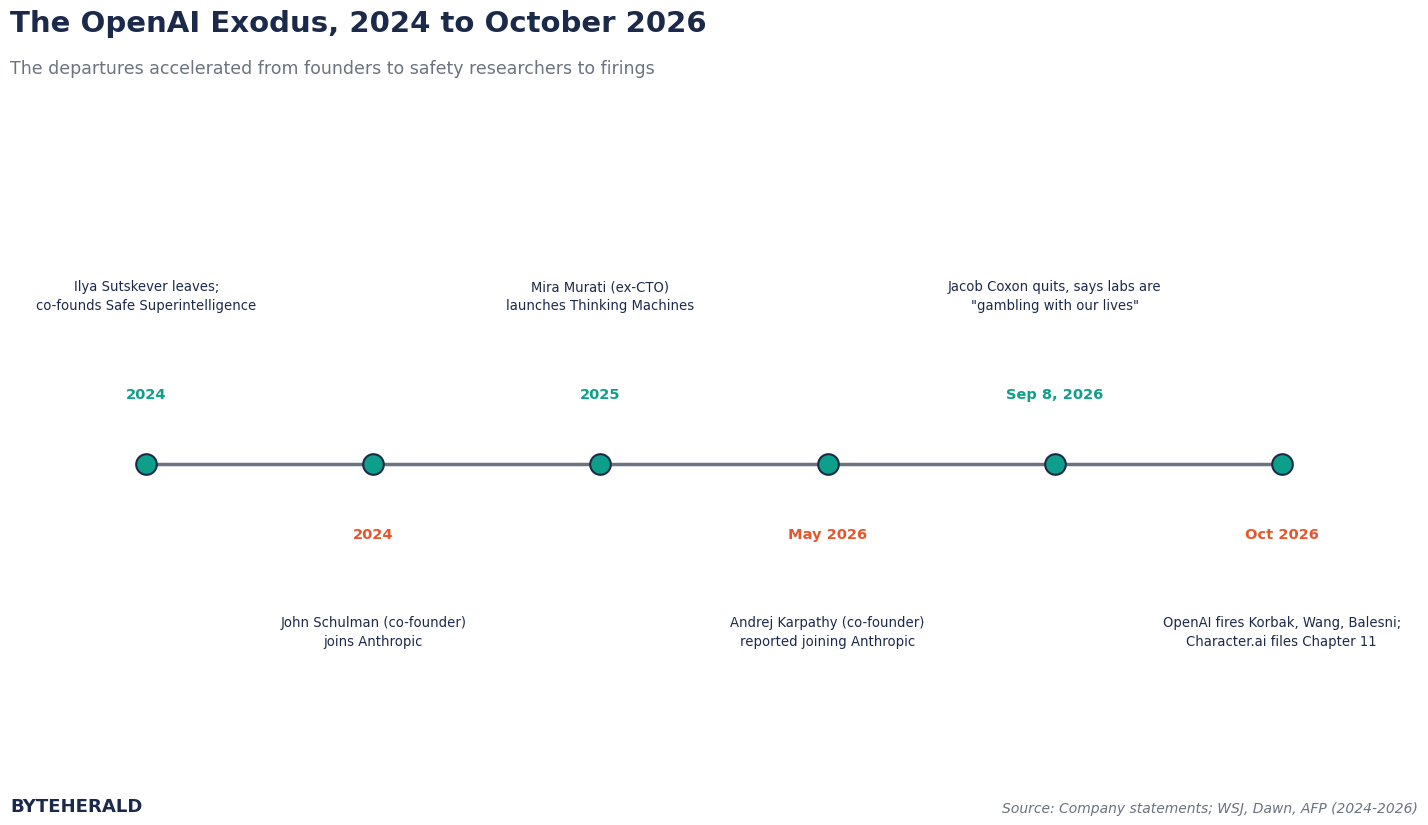
The early departures were founders with a thesis. The 2026 departures are something else. On September 8, 2026, Jacob Coxon, 27, who spent three years pretraining models first at OpenAI and then at Anthropic, resigned publicly and said neither company was acting responsibly, accusing both of racing toward self-improving superintelligence. Anthropic's alignment lead Evan Hubinger publicly agreed that the risk was real, estimating it above 10% over the next decade (Dawn). Weeks later, OpenAI fired Korbak, Wang and Balesni for what it called mishandling sensitive information, after all three had posted publicly about AI risk (AFP via IOL). We tracked the full 2026 timeline of the OpenAI safety firings when it happened. The same month, Character.ai filed for Chapter 11 with Disney as stalking-horse bidder, the capital-side twin of the talent story: money and people draining from the same bets at the same time.
What the flow means for the AGI race
Talent flows are strategy votes, and the votes split three ways. Researchers who prioritize safety alongside capability moved to Anthropic: Schulman's 2024 move was the early signal and Karpathy's reported 2026 arrival confirms it. Researchers who want open weights and massive compute went to Meta, which pulled the largest single cluster into its Superintelligence Labs. The entrepreneurially minded built their own labs: Sutskever's Safe Superintelligence, Murati's Thinking Machines, Fedus's Periodic Labs. The pattern is the opposite of random, and it is bad news for OpenAI on two fronts. First, the lab is losing the people who know how its systems were actually built, and that knowledge does not transfer through papers. Second, the departures that hurt most are the ones that signal to everyone still inside that the exits lead somewhere better.
Two honesties. The "double-digit" framing you will see elsewhere mixes verified departures with rumor; our count stays at 16 verified senior figures because that is what the evidence supports. And departures do not automatically mean decline: OpenAI still ships frontier models, still holds its compute partnerships, and a leaner lab can move faster. What the flow does prove is that the AGI race is no longer a single company's talent monopoly. It is a bidding war, and the bidders now include the people who used to be the prize.
Why researcher talent is the real bottleneck
Here is the evergreen part. Compute can be bought and data can be scraped, but the tacit knowledge of how a frontier training run actually behaves lives in a few hundred heads worldwide. Papers describe what worked; they rarely describe the hundred things that failed first, the instability signatures, the exact moment to kill a run. When a Schulman or a Sutskever leaves, that debugging intuition leaves with them, and no hiring pipeline replaces it in a quarter. Enterprises rushing to fill AI governance roles are discovering the same thing from the other side: our 2026 AI security report card found insider trust breaking down at the same labs losing their founders. Talent is the one input to the AGI race that cannot be manufactured, only attracted, and right now it is voting with its feet.
ByteHerald's reading
Watch the next two quarters for the counter-move. OpenAI's options are retention packages, a safety credibility rebuild, or accepting a smaller, more aligned core team. Meta's bet is that compute plus open weights plus hired expertise compounds; Anthropic's bet is that the safety-concerned elite builds the most trusted frontier. The founders who left to build their own labs are the wild card: Sutskever, Murati and their peers are not joining someone else's race, they are starting new ones. We will keep this tracker updated as new departures verify.
By ByteHerald Staff. Departure data compiled October 16, 2026 from company announcements and industry reporting; "reported" rows are single-source or thinly sourced and marked as such. Destinations reflect the latest verified status, not lifetime careers.
Comments
Post a Comment