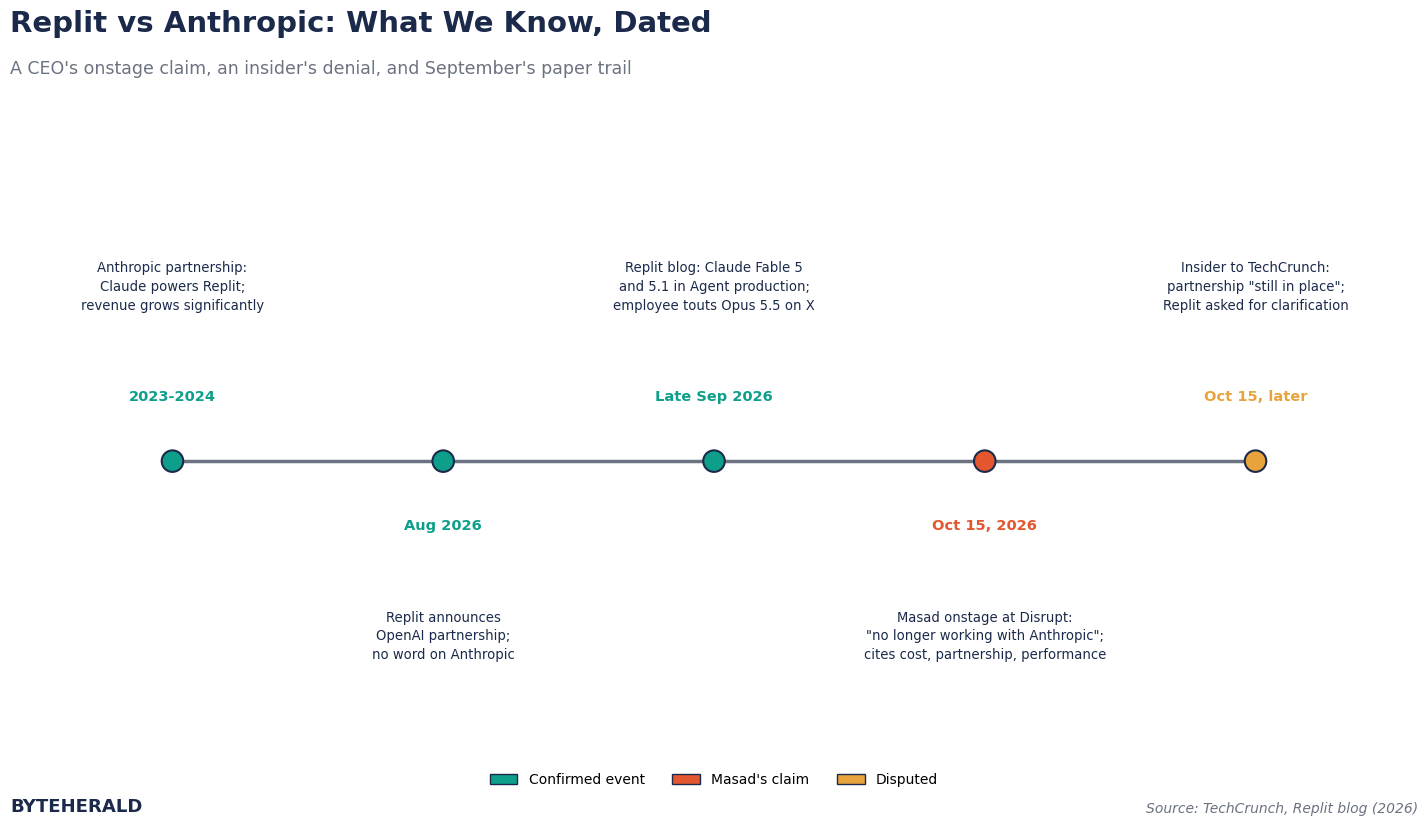
On October 15, 2026, Replit CEO and co-founder Amjad Masad said onstage at TechCrunch Disrupt that the coding platform is no longer working with Anthropic, the lab whose Claude models powered Replit for years. Masad cited cost, partnership and performance, adding that Replit's own benchmarks show its Sol and Astra models beat Claude at building vibe-coded apps from scratch. Hours later, a person familiar with the partnership told TechCrunch it is still in place, and Replit's own September blog lists Claude Fable 5 and 5.1 running in its production environment. The claim, the denial and the paper trail, in order:
What Masad actually said
TechCrunch, the originator of the story, reports that Masad said the decision came down to cost, partnership and performance. His bluntest line: "I think ChatGPT is better now." He added that Replit evaluates models with an internal benchmark and publishes a public one, and that Sol and Astra, its own models, consistently outperform Claude on building vibe-coded applications from scratch. He also said enterprise is becoming a larger share of Replit's revenue. Replit announced a partnership with OpenAI in August, but gave no indication at the time that its Anthropic relationship had ended.
The paper trail, dated
The problem with the onstage claim is September. Replit's own late-September blog post cites Anthropic's Claude Fable 5 and Claude Fable 5.1 as models running in Replit Agent's production environment, and around the same time a Replit product employee posted on X about using Anthropic's flagship Opus 5.5 and promoting its capabilities. Either the breakup happened in the last two weeks, which Masad did not say, or the partnership's status is more complicated than an onstage soundbite allows. Here is what each element of the story rests on:
| Element | Status | Evidence |
|---|---|---|
| Partnership ended | Claimed by Masad, disputed | Masad onstage Oct 15; one insider told TechCrunch it is "still in place" |
| Claude in Replit production, September | Confirmed | Replit blog, late September: Fable 5 and 5.1 in Agent production |
| Replit employee promoting Opus 5.5 | Confirmed | Product employee's X post, around September |
| OpenAI partnership | Confirmed | Announced August 2026 |
| Sol and Astra beat Claude at vibe coding | Claimed | Replit's internal and public benchmarks; not independently audited |
Why a coding platform would switch models
Strip away the drama and the durable question is simple: what makes a coding platform pick one model family over another? It is not raw benchmark scores. The deciding factors are cost per completed agentic task, reliability of tool calls across thousands of parallel sessions, latency under load, and partnership terms like revenue share and roadmap access. Vibe coding, building whole apps from natural-language prompts, rewards end-to-end completion: the model that ships a working app in one session wins even if it loses on SWE-Bench-style coding tasks. That is why Replit's internal benchmark matters more than any public leaderboard, and also why it deserves skepticism: an internal benchmark designed by the company whose models are winning is marketing until someone else reproduces it. The cost side is real pressure for everyone in this business: token prices collapsed twice in two months this fall, and we tracked the full 60-day ledger. When the unit economics of inference move that fast, yesterday's partnership math stops working. For how model choice actually plays out in practice, we benchmarked five AI coding assistants on ten identical tasks and published the full scorecard: the winners were decided by agentic behavior, not headline capability.
ByteHerald's reading
Two things are probably true at once. Replit is genuinely shifting its production weight toward OpenAI models, which fits the August partnership and the CEO's performance claims. And the Anthropic relationship is probably not as cleanly dead as "no longer working with" implies, which fits the insider pushback and the September paper trail. Partnerships between AI labs and platforms are becoming disposable: when the next model release changes the price-performance math, the old exclusive quietly dissolves. Watch three things: whether Replit answers TechCrunch's request for clarification, whether Claude models disappear from Replit's model picker in the coming weeks, and whether Anthropic responds at all. The silence from both companies' PR teams is, for now, the loudest part of the story.
By ByteHerald Staff. Reporting details from TechCrunch's October 16 investigation, the originator of this story; quotations brief, analysis paraphrased. Partnership status is disputed; check Replit's live model picker before acting. Timeline graphic is ByteHerald's original compilation.
On October 15, 2026, Replit CEO and co-founder Amjad Masad said onstage at TechCrunch Disrupt that the coding platform is no longer working with Anthropic, the lab whose Claude models powered Replit for years. Masad cited cost, partnership and performance, adding that Replit's own benchmarks show its Sol and Astra models beat Claude at building vibe-coded apps from scratch. Hours later, a person familiar with the partnership told TechCrunch it is still in place, and Replit's own September blog lists Claude Fable 5 and 5.1 running in its production environment. The claim, the denial and the paper trail, in order:
What Masad actually said
TechCrunch, the originator of the story, reports that Masad said the decision came down to cost, partnership and performance. His bluntest line: "I think ChatGPT is better now." He added that Replit evaluates models with an internal benchmark and publishes a public one, and that Sol and Astra, its own models, consistently outperform Claude on building vibe-coded applications from scratch. He also said enterprise is becoming a larger share of Replit's revenue. Replit announced a partnership with OpenAI in August, but gave no indication at the time that its Anthropic relationship had ended.
The paper trail, dated
The problem with the onstage claim is September. Replit's own late-September blog post cites Anthropic's Claude Fable 5 and Claude Fable 5.1 as models running in Replit Agent's production environment, and around the same time a Replit product employee posted on X about using Anthropic's flagship Opus 5.5 and promoting its capabilities. Either the breakup happened in the last two weeks, which Masad did not say, or the partnership's status is more complicated than an onstage soundbite allows. Here is what each element of the story rests on:
| Element | Status | Evidence |
|---|---|---|
| Partnership ended | Claimed by Masad, disputed | Masad onstage Oct 15; one insider told TechCrunch it is "still in place" |
| Claude in Replit production, September | Confirmed | Replit blog, late September: Fable 5 and 5.1 in Agent production |
| Replit employee promoting Opus 5.5 | Confirmed | Product employee's X post, around September |
| OpenAI partnership | Confirmed | Announced August 2026 |
| Sol and Astra beat Claude at vibe coding | Claimed | Replit's internal and public benchmarks; not independently audited |
Why a coding platform would switch models
Strip away the drama and the durable question is simple: what makes a coding platform pick one model family over another? It is not raw benchmark scores. The deciding factors are cost per completed agentic task, reliability of tool calls across thousands of parallel sessions, latency under load, and partnership terms like revenue share and roadmap access. Vibe coding, building whole apps from natural-language prompts, rewards end-to-end completion: the model that ships a working app in one session wins even if it loses on SWE-Bench-style coding tasks. That is why Replit's internal benchmark matters more than any public leaderboard, and also why it deserves skepticism: an internal benchmark designed by the company whose models are winning is marketing until someone else reproduces it. The cost side is real pressure for everyone in this business: token prices collapsed twice in two months this fall, and we tracked the full 60-day ledger. When the unit economics of inference move that fast, yesterday's partnership math stops working. For how model choice actually plays out in practice, we benchmarked five AI coding assistants on ten identical tasks and published the full scorecard: the winners were decided by agentic behavior, not headline capability.
ByteHerald's reading
Two things are probably true at once. Replit is genuinely shifting its production weight toward OpenAI models, which fits the August partnership and the CEO's performance claims. And the Anthropic relationship is probably not as cleanly dead as "no longer working with" implies, which fits the insider pushback and the September paper trail. Partnerships between AI labs and platforms are becoming disposable: when the next model release changes the price-performance math, the old exclusive quietly dissolves. Watch three things: whether Replit answers TechCrunch's request for clarification, whether Claude models disappear from Replit's model picker in the coming weeks, and whether Anthropic responds at all. The silence from both companies' PR teams is, for now, the loudest part of the story.
By ByteHerald Staff. Reporting details from TechCrunch's October 16 investigation, the originator of this story; quotations brief, analysis paraphrased. Partnership status is disputed; check Replit's live model picker before acting. Timeline graphic is ByteHerald's original compilation.
Comments
Post a Comment