SpaceX disclosed on October 26, 2026, a binding commitment signed October 24, 2026, for about $40 billion in Apollo-managed financing to buy Nvidia Vera Rubin chips and related equipment, then lease them back to SpaceX over about five years, with individual leases starting in the first half of 2027. The deal is a lease, not a bond sale, and that distinction is the story: private credit is now willing to fund AI compute at a scale the bond market, in Elon Musk's own words, has largely stopped funding for companies without revenue outside AI data centers.
What was actually signed
SpaceX disclosed the deal in a regulatory filing on October 26, 2026, following a post by Musk on October 25 saying the financing had closed. The filing language is more careful than the post: a binding commitment letter, a master finance lease to be finalized before year end subject to closing conditions, and equipment arriving in tranches. Nothing is leased yet. What exists is a committed pipeline of hardware purchases, with rent starting as each tranche is delivered.
| Term | What the filing says |
|---|---|
| Amount | About $40 billion in aggregate principal payments under the leases, excluding interest and other expenses |
| Buyer and lessor | An entity managed by Apollo Global Management buys the chips and equipment, then leases them to SpaceX |
| Hardware | Nvidia Vera Rubin chips and related data center equipment, for the terrestrial compute buildout |
| Lease length | About five to five and a quarter years per tranche, from delivery |
| Payments | Quarterly, at one twentieth of each tranche's financed cost plus a fixed annual rate on the outstanding balance |
| Interest rate | Not yet determined |
| Close and start | Master lease expected before year end 2026; leases expected to begin in the first half of 2027 |
| Lead and participants | Apollo and Goldman Sachs led the financing, Goldman Sachs was structuring agent, with commitments from affiliates of BlackRock, Goldman Sachs Asset Management, and KKR |
The quarterly math, with the hole labeled
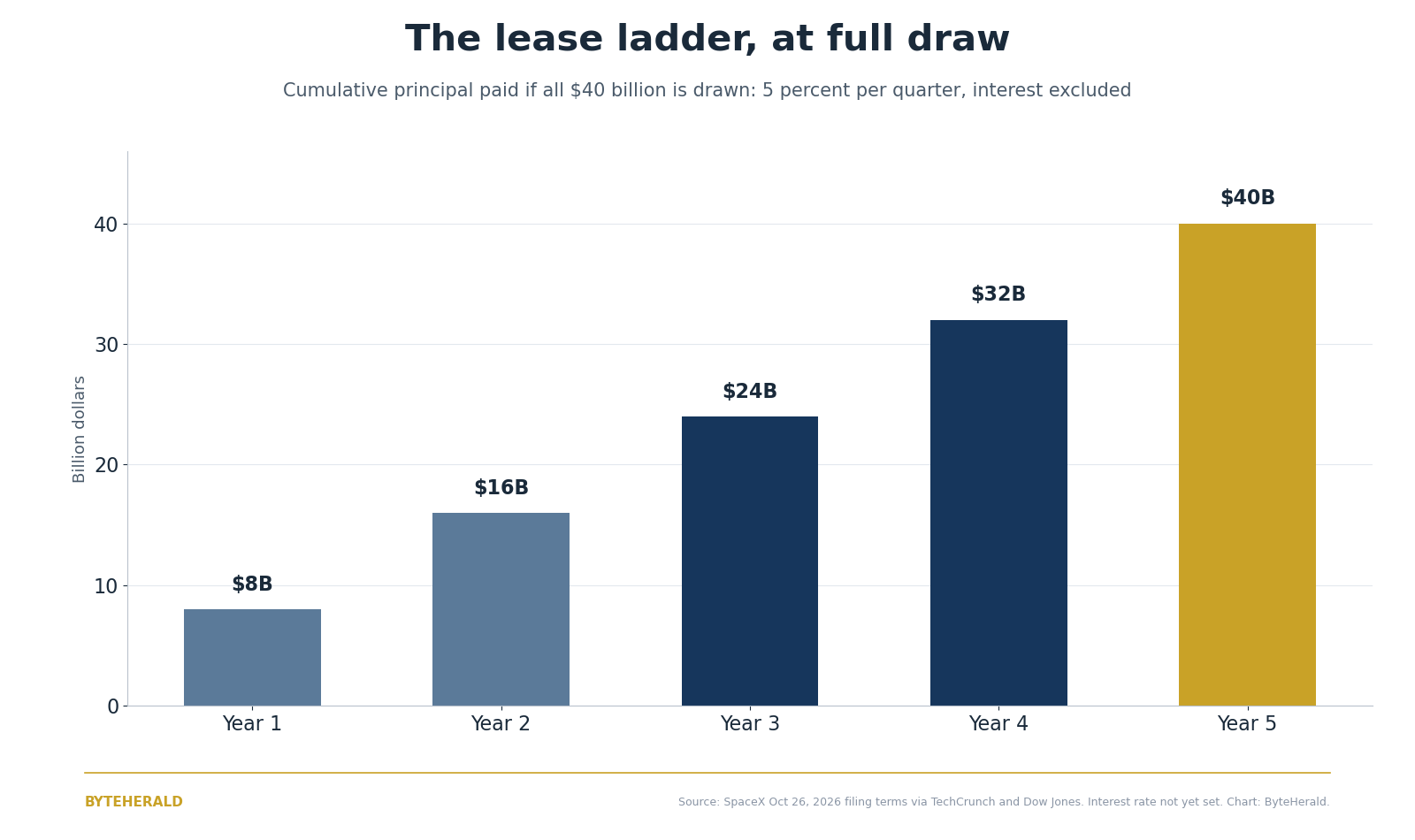
The filing's payment formula lets us compute the principal schedule, and only the principal schedule. One twentieth of the financed cost per quarter means 5 percent of each tranche per quarter, or 20 percent per year. At the full $40 billion draw, that is $2 billion of principal per quarter and $8 billion per year, before a dollar of interest. The total cash cost of the deal is therefore unknowable from the filing, because the fixed annual rate has not been set, and five years of interest on a $40 billion declining balance is not a rounding error. Any article that quotes $40 billion as the cost of this deal is understating it; $40 billion is the principal floor, and the real bill is principal plus five years of interest plus expenses. SpaceX called it the largest committed GPU financing to date, and on principal it clears the previous marker: a $36 billion structured notes deal finalized in the summer of 2026 to buy and lease GPUs to Anthropic, led by Apollo and Blackstone and backstopped by Broadcom. The SpaceX deal is $4 billion larger on principal, and it arrives four months later, which says something about how fast this market is scaling.
Why a lease and not a bond
Musk's framing, posted October 25, was blunt: debt markets have almost entirely shut off access to money for any company that does not have substantial revenue independent of AI data centers, while SpaceX is investment grade and has Starlink and launch revenue. That claim is about other companies' access, not SpaceX's, and it explains why the lease structure exists at all. A bond puts the hardware risk on the borrower and the repayment risk on the bondholder. A finance lease puts titled hardware in the hands of an Apollo-managed entity, with rent as the repayment stream, and lets SpaceX fund a $40 billion build without a bond roadshow or a balance-sheet debt raise. SpaceX finance chief Bret Johnsen said the lease diversifies funding sources and addresses a notable portion of the funding required for the company's growth plans. The context for that growth claim is in SpaceX's third quarter: its AI segment, including the Grok chatbot, the Cursor coding tool, and its cloud compute business, brought in $7.6 billion of $14.6 billion in total revenue, more than Starlink and rocket launches combined. That is 52 percent of revenue from AI in one quarter, which is both the reason the build is happening and the reason a lender wants titled hardware behind the loan.
The bet inside the lease
Johnsen also said SpaceX is seeing less than one-year payback periods on its AI infrastructure investments as it scales compute for Grok and cloud services. Read that as a company assessment of current returns, not as a guarantee for this equipment: payback on past infrastructure at current demand does not promise the same on Vera Rubin hardware arriving in 2027, over leases running into 2032. The risk that matters is duration mismatch. A five and a quarter year lease locks SpaceX into rent on hardware whose competitive life is set by Nvidia's roadmap, not by the lease schedule, and if a better chip generation arrives in 2029, SpaceX still pays rent on 2027 hardware. The counterweight is that the hardware is titled to the lessor, the payments are quarterly and tranche by tranche, and the company can stop drawing new tranches if demand breaks. That optionality is worth more than it looks in a market where the last year has taught everyone how fast AI demand narratives reverse. The deal sits in the same financing wave as Anthropic's IPO filing, which laid out the same industry's risks in 94 pages, and the same capital wave as the Gartner estimate that $3.5 trillion of AI spending may never pay back. SpaceX is betting its own payback claim against that industry-wide doubt, with titled hardware as the collateral.
What to watch
Three dates settle whether this is a landmark or a headline. First, whether the master lease actually closes before year end, and at what fixed rate, since the rate determines the true cost above the $40 billion principal floor. Second, whether the first tranches actually begin leasing in the first half of 2027, on schedule, with Vera Rubin hardware as specified. Third, whether SpaceX draws the full $40 billion or stops early, which will be the cleanest signal of whether AI demand in 2027 matches the demand in the third quarter of 2026. Until the rate is disclosed, every total-cost number for this deal is a guess, and ours is labeled as such: $40 billion of principal, plus interest to be determined, over about five years per tranche.
By ByteHerald Staff. SpaceX, October 26, 2026, disclosed in a regulatory filing a binding commitment signed October 24, 2026, for about $40 billion in Apollo-managed financing for Nvidia Vera Rubin chips and related equipment, leased over about five to five and a quarter years per tranche with leases starting in the first half of 2027. TechCrunch, October 26, 2026, reported that SpaceX called the deal the largest committed GPU financing, that Apollo and Goldman Sachs led the financing, and that SpaceX's AI segment brought in $7.6 billion of $14.6 billion in third quarter revenue. Dow Jones, October 26, 2026, reported that quarterly payments will include one twentieth of each tranche's financed cost plus a fixed annual rate not yet determined.
Comments
Post a Comment