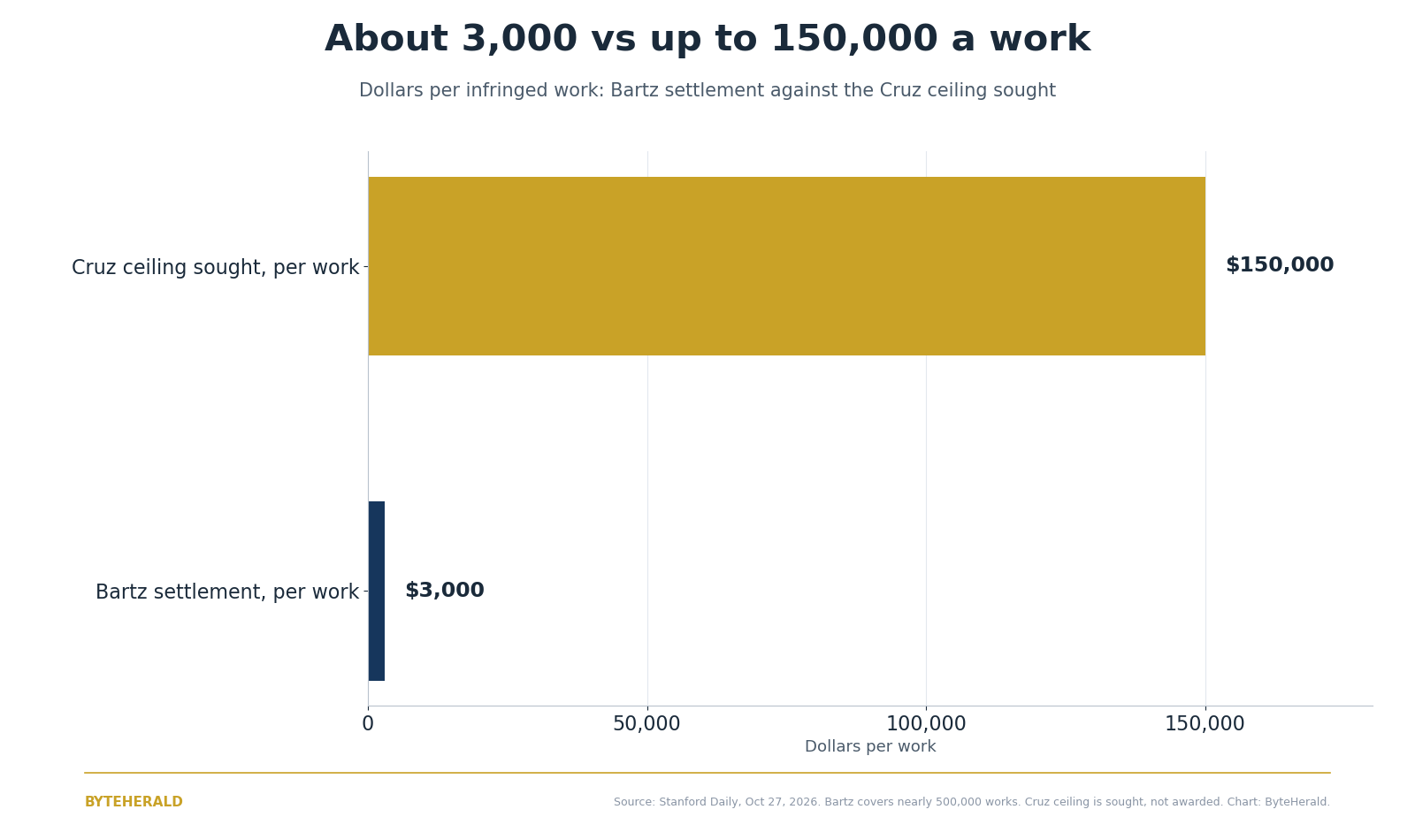
The Stanford Daily reported on October 27, 2026, that Tobias Wolff and Chang-rae Lee opted out of Anthropic's $1.5 billion book settlement and filed a separate case, Cruz v. Anthropic, in May 2026, seeking a jury trial and statutory damages of up to $150,000 per infringed work. The direct answer is the gap: the Bartz settlement works out to about $3,000 per work, while the ceiling Cruz seeks is $150,000 per work, fifty times as much, and that gap is why a $1.5 billion settlement did not end the fight.
What Judge Alsup actually split
The Daily's report rests on a split ruling in Bartz v. Anthropic, and the split is the whole story. Judge William Alsup ruled that Anthropic could no longer pirate books to create a permanent central library, while holding that training on lawfully acquired books could qualify as fair use. His comparison, quoted by the Daily, was to a reader: like any reader aspiring to be a writer, Anthropic's models trained on works not to race ahead and replicate or supplant them, but to turn a hard corner and create something different. That is a ruling about two different acts, not a single verdict on AI training. Acquisition and use were judged separately, and only one side of the line was protected.
| Question | What the ruling said | What it left open |
|---|---|---|
| Can training on lawfully acquired books be fair use? | Yes, it can qualify, on the reader analogy Alsup used | Whether any given training set was in fact lawfully acquired |
| Can a company pirate books to build a central library? | No, Anthropic was barred from pirating books for that library | Damages for the piracy that had already happened |
| Does the settlement end every author's claim? | No, authors who opted out kept their own claims | What a jury would award in Cruz, and whether an injunction follows |
Why $3,000 and $150,000 are different kinds of numbers
Readers should not compare the two figures as if both were awards. The $3,000 figure is an approximate per-work average from the Bartz settlement: $1.5 billion spread across nearly 500,000 registered works. The $150,000 figure is the statutory ceiling Cruz seeks per infringed work, not a sum any court has awarded in that case. The ratio is still informative: 150,000 divided by 3,000 is 50, so the ceiling is fifty times the settlement average. That is the arithmetic behind the opt-out decision. An author who believes the settlement undervalues their work, or who wants an injunction rather than a payment, gains nothing by staying in a class whose average is $3,000 a work when the law allows a jury to consider up to $150,000.
What Cruz asks for that Bartz did not settle
Cruz is a non-class case, and its asks are personal in a way a class settlement cannot be. Wolff and Lee, with fellow authors, allege that Anthropic illegally downloaded, reproduced and distributed their copyrighted books from shadow libraries such as LibGen and PiLiMi, and stored the pirated files in a central library. Those are allegations in Cruz, not findings in that case, and the distinction matters: Bartz established the piracy finding for its own record, Cruz must prove its own. The Daily reports that 10 of Wolff's publications were used for AI training without permission, and quotes Wolff directly: to put him to work that way, without remittance, is a form of slave labor, and the settlement still gives Anthropic pretty free rein to roam through literature and take what it thinks will be useful and profitable. If the Cruz authors prevail, they seek a permanent injunction against Claude model training using their works, which is a remedy no payment can substitute for. The Daily also reports that Wolff and 27 other authors say the settlement is not enough, a broader dissatisfaction than the two named opt-outs alone.
The Stanford names, and the wider field
The Daily names six Stanford professors whose work was involved: Tobias Wolff, Abraham Verghese, Chang-Rae Lee, Daniel Mason, Hayagreeva Rao and Myra Strober, and reports that the work of more than 10 Stanford professors was involved in total. Beyond Stanford, the Daily reports more than 70 infringement lawsuits against AI companies from authors, visual artists and news outlets, including The New York Times and Getty Images, and notes that the Authors Guild is pursuing other lawsuits, including one against OpenAI and Microsoft, as part of a multi-pronged approach to require licensing. Stanford Law scholar Paul Goldstein, quoted by the Daily, frames the structural problem as transaction costs: millions of individual copyrighted works may be copied in any training run, and it is simply impracticable for a platform to obtain a license from every owner. That is why the Guild is working with Congress on national licensing legislation, and why the Daily's story is bigger than two authors. The question is not whether one settlement was generous. It is whether licensing at training scale is workable at all, and who bears the cost when it is not.
The IPO timing, and what it does not prove
Timing gives this story its edge, and also its limit. Anthropic filed to go public on October 26, 2026, the day before the Daily's report, so the book dispute now travels with the company into public markets. That does not prove the filing caused the report, or that investors price the Cruz risk in any particular way, and this article claims neither. What the timing does establish is exposure: a company heading to market carries a live copyright case in which named authors seek a jury trial, a statutory ceiling fifty times the settlement average, and an injunction. The settlement removed the class risk. Cruz keeps the individual risk alive, in public, at the exact moment Anthropic asks public investors to trust its legal footing.
What to watch next
Three developments will decide whether Cruz is a footnote or a second settlement. First, whether a court allows the case to reach a jury, and what that jury is asked to value: the books themselves, the library built from them, or the models trained on them. Second, whether other opted-out authors join or file parallel cases, which would test whether the Bartz average holds as a market price for book rights or collapses as a floor. Third, whether Congress moves on the licensing legislation the Authors Guild is pushing, which would replace case-by-case litigation with a system for compensating authors and requiring output filters. Until one of those moves, the honest summary is narrow: a $1.5 billion settlement closed the class case, the ruling drew the line between fair-use training and pirated libraries, and a separate case now asks a jury to price the difference.
By ByteHerald Staff. The Stanford Daily, October 27, 2026, reported that Tobias Wolff and Chang-rae Lee opted out of Anthropic's $1.5 billion book settlement, filed Cruz v. Anthropic in May 2026 seeking a jury trial and statutory damages of up to $150,000 per infringed work, and that 10 of Wolff's publications were used for AI training without permission. The Stanford Daily, October 27, 2026, also reported Judge William Alsup's split ruling in Bartz v. Anthropic, that Anthropic could no longer pirate books for a permanent central library while training on lawfully acquired books could qualify as fair use, that the settlement covered nearly 500,000 registered works, and that Wolff and 27 other authors say the settlement is not enough.
Comments
Post a Comment