Texas could lose two decades of clean-air progress in five years, and the deciding factor is not how many data centers get built. It is how they get powered. The Houston Advanced Research Center modeled the state's data center buildout to 2031 and found that on the grid-mix path, fine-particle pollution from the power sector more than triples to its highest level since 2006, smog-forming nitrogen oxides rise 136 percent toward their 2004 level, and carbon dioxide climbs 90 percent above 2025 levels.
The report, covered this week by The Verge, is the first detailed look at what the AI infrastructure boom means for the air in the state building most of it. Texas already leads the nation in data center capacity. What happens next depends on choices developers are making right now, under grid-connection waits of three to five years, about whether to wait for the grid, build renewables alongside it, or fire up gas engines on site and ask questions later.
The numbers that rewind the clock
On the scenario where all planned data centers connect to the Texas grid and run on its anticipated energy mix, the report's projections for 2031 rewind each pollutant to a different year of the past:
| Pollutant | Change by 2031 | Rewound to |
|---|---|---|
| Nitrogen oxides (NOx, smog-forming) | Up 136 percent | Approaching 2004 levels |
| Fine particles (PM2.5, soot) | More than triple | Highest since 2006 |
| Volatile organic compounds | Up 32 percent | Beyond the 2002 level |
| Carbon dioxide | Up 90 percent vs 2025 | Nearly double the 2025 level |
Particulate matter is the number to sit with. Scientists call it the deadliest form of air pollution because the particles penetrate deep into the lungs and enter the bloodstream, triggering asthma attacks, irregular heartbeat, and respiratory disease. Tripling it is not an abstract environmental cost. It is a public-health ledger entry, written in the same years the state is adding the most compute on earth.
Three power paths, three futures
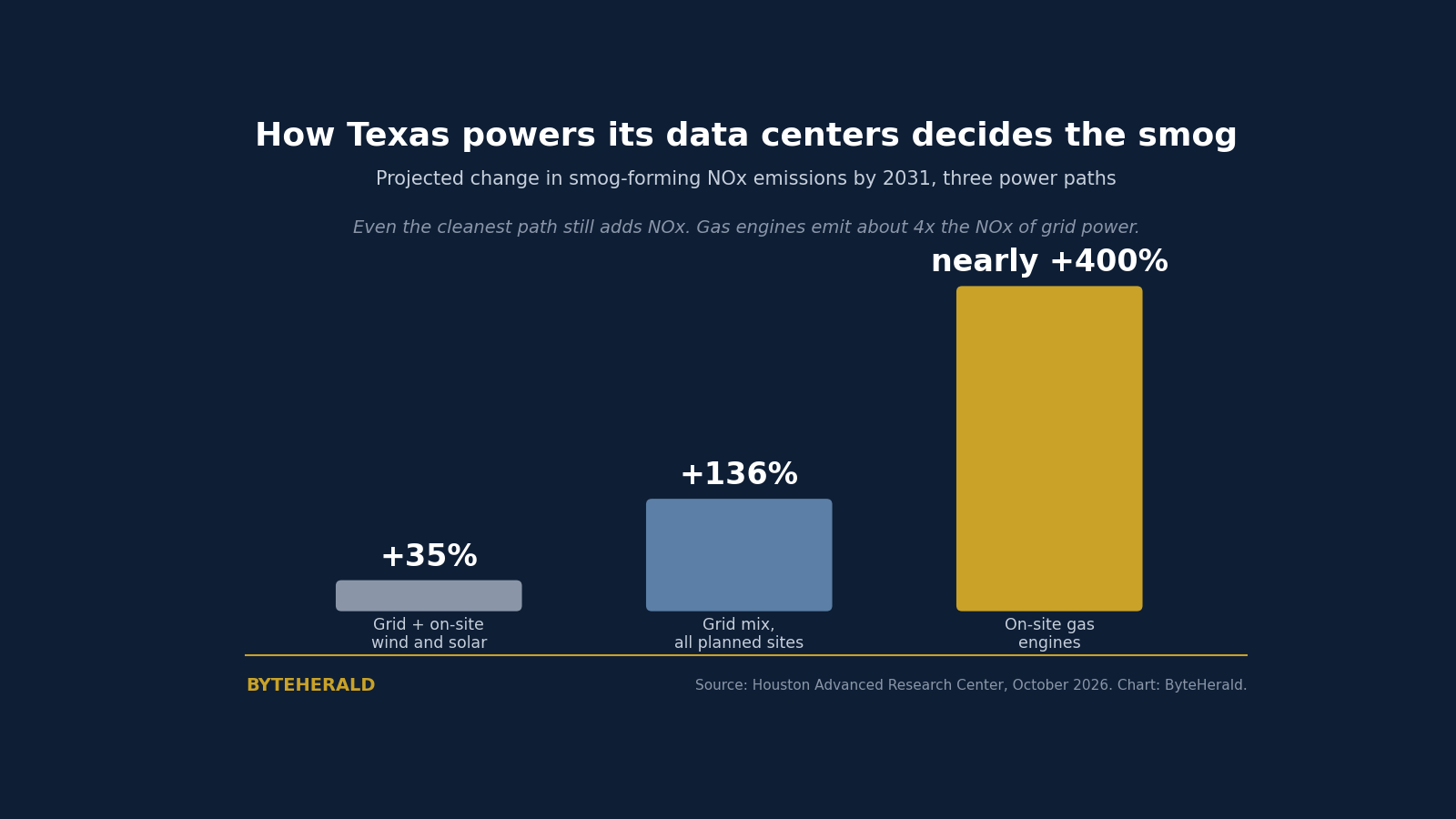
The report's real contribution is not one forecast but the gap between paths. The same data centers, powered three ways, produce three different states:
| Power path | NOx change by 2031 | What it means |
|---|---|---|
| Grid plus on-site wind and solar | Up 35 percent | Still worse, but the least bad path; renewables cut NOx up to 10 times vs the gas path in some scenarios |
| Grid mix, all planned sites | Up 136 percent | The central case: two decades of progress reversed |
| On-site natural gas engines | Nearly up 400 percent | The worst modeled outcome; gas engines emit about 4 times the NOx of grid power for the same data center |
The mechanism is mundane, which is why it is believable. Developers who cannot wait three to five years for a grid connection build their own power, and they do not always pick the cleanest version. On-site gas gets a data center running on a construction timeline instead of a utility timeline, and the emissions follow the shortcut. The report puts on-site combustion NOx at 2 to 10 times higher than the grid-plus-renewables path, depending on the demand forecast. That range is the whole policy debate in one number.
HARC vice president Carlos Gamarra, who led the work, wants data centers treated as what they are. "Treated as the industrial facilities they are," he told the Texas Tribune, so they face the same emissions standards that produced the state's air quality progress in the first place. That progress, he notes, came from a changing electricity mix, especially wind and solar growth, pollution controls across power generation and transport, and coal retirements. Every one of those drivers now runs against a new load that could swamp it.
Why Texas, why now
Texas is not a random case study. It is where the buildout is most concentrated, and the concentration is the risk. The state holds 26 gigawatts of existing and under-construction data center capacity, more than any other state. A Texas Tribune count found at least 288 planned projects statewide, ranging from 5 megawatts to 11,000 megawatts each. A separate Wood Mackenzie analysis from March found Texas also has four times more proposed capacity running on on-site power than any other state, and at least 32 natural gas plants planned, more than anywhere else.
The air story is the other half of a ledger we have been tracking all year. Our datacenter resource ledger covered the megawatts and the water: an industry trajectory from 485 to 950 terawatt-hours globally, gigawatt campuses, and a water disclosure record that is only now emerging. Power draw decides the grid strain and the water bill. The power source decides what the neighbors breathe, and that second ledger was mostly blank until this report.
What the model does not prove
Scenarios are not predictions, and this report is explicit about its uncertainties. HARC modeled three different projections for data center demand, and many proposed projects are speculative. Some will never be built, and the buildout's true size could land well below the modeled paths. That caveat cuts both ways: it also means the worst path requires both the full buildout and the dirtiest power choices, a combination that is possible but not inevitable.
The speculative-project problem is not theoretical. Our bragawatt audit found that most planned AI datacenters will never be built at all, with hundreds of gigawatts already delayed or abandoned. If the Texas pipeline deflates the same way, the air projections deflate with it. The honest way to read the HARC report is as a conditional: if Texas builds what is proposed, and powers it the way developers are currently choosing to, the air goes back twenty years.
The decision in one paragraph
Every path in the report is still open, and that is the point. Grid-plus-renewables still adds NOx, but at a quarter of the grid-mix rate. On-site gas is the fastest way to open a data center and the fastest way to erase the progress. The choice is being made project by project, in interconnection queues and turbine orders, years before any smokestack reading confirms it. By the time the monitors show 2004 again, the decisions that produced it will be a decade old.
By ByteHerald Staff. The Houston Advanced Research Center published its Texas data center air quality modeling in October 2026, projecting nitrogen oxide emissions up 136 percent by 2031 on the grid-mix path and nearly 400 percent on on-site natural gas, as covered by The Verge and Route Fifty. The Texas Tribune reported in October 2026 that it counted at least 288 planned data center projects statewide. Wood Mackenzie reported in March 2026 that Texas has four times more proposed on-site power capacity than any other state and at least 32 planned natural gas plants.
Comments
Post a Comment