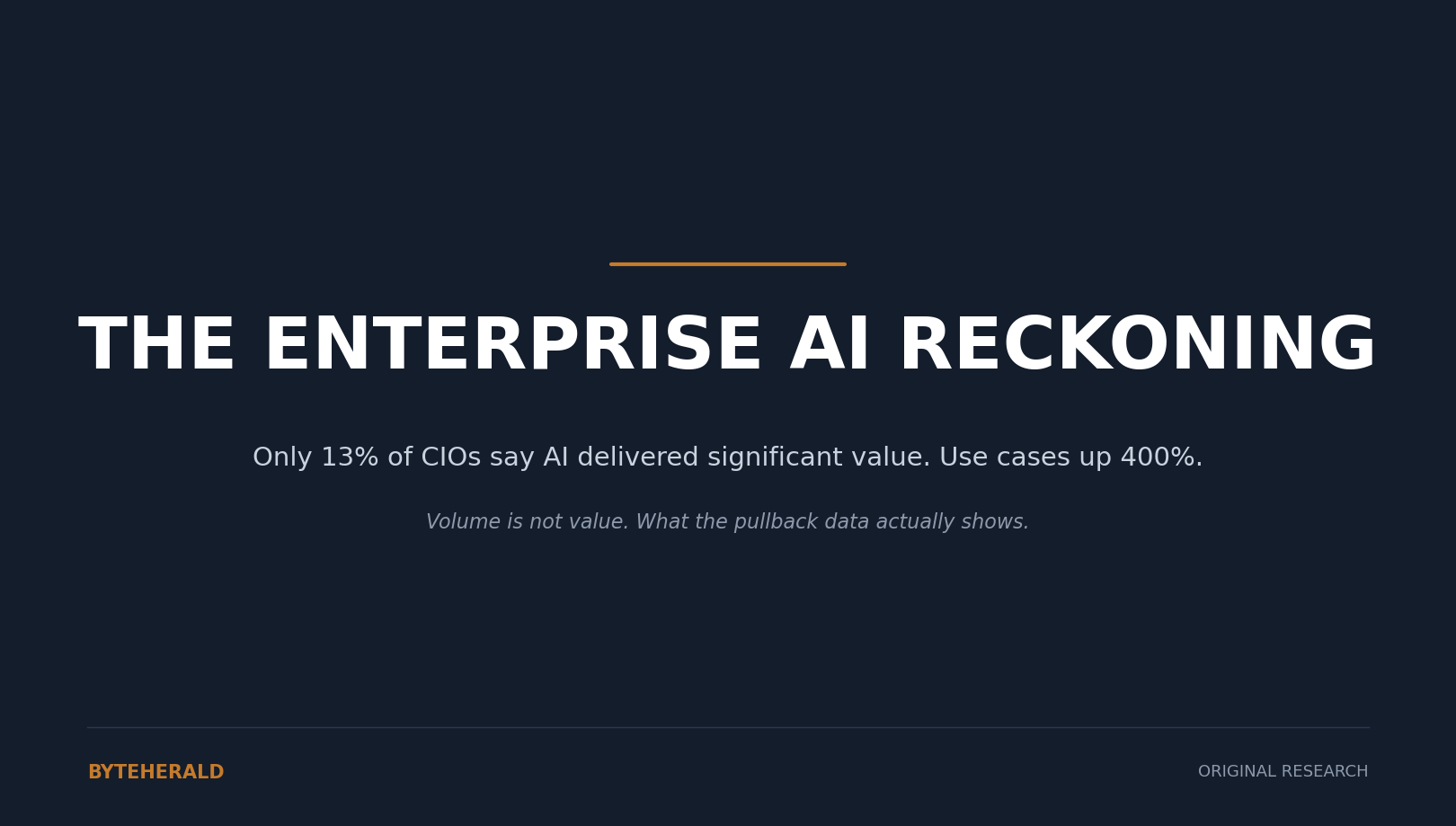
Only 13% of CIOs say their enterprise has realized significant or transformational value from AI, according to Gartner's survey of 2,002 technology leaders conducted from May to July 2026 and released on October 19. Over the same period, the average enterprise's AI use cases grew 400%. Gartner analyst Alicia Mullery's verdict, delivered at the IT Symposium in Orlando: "Volume is not value. AI is creating a reckoning for organizations that lack fundamental disciplines."
The reckoning in six numbers
Start with the full scoreboard, because no single statistic captures a correction. Every figure below is dated and sourced:

Read the cards as a system, not a list. The 400% growth in use cases is the denominator: enterprises ran four times as many AI experiments in a year. The 1-in-5 success likelihood and 13% value realization are the numerator: most of that volume produced nothing durable. The 58% cost-pressure figure is the consequence: CFOs are now asking what the experiments bought. And the 36% serious-incident rate, from an Ernst and Young survey of senior AI executives at companies above $1 billion in revenue, is the hidden tax: financial, operational, data, or reputational damage from AI deployments.
The vanguard gap: the discipline almost nobody has
Gartner's survey contains the closest thing the industry has to a prescription. Eleven percent of respondents qualified as "vanguards": CIOs delivering better business outcomes while reporting high CEO-perceived AI value. What separates them is not budget or model choice. It is stopping rules.
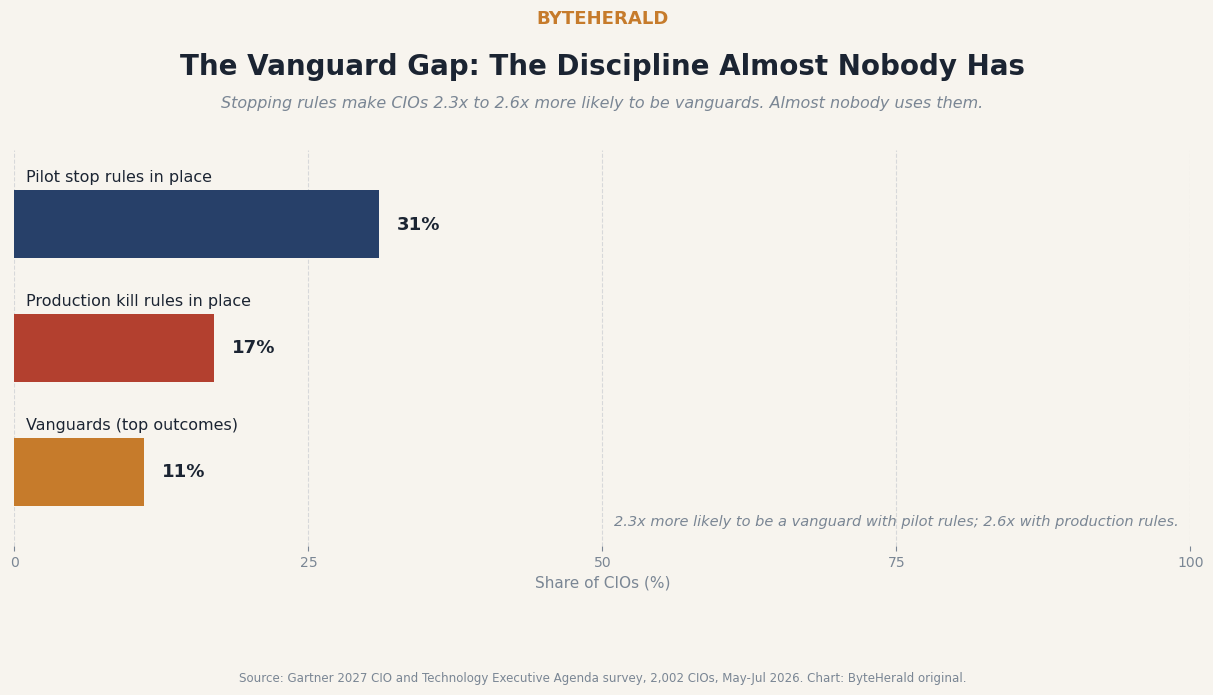
Organizations with guidelines for when an AI pilot should not move to production are 2.3 times more likely to be vanguards; those with guidelines for killing low-value AI already in production are 2.6 times more likely. Yet only 31% and 17% of CIOs, respectively, have these practices in place. "Establishing and adhering to these criteria is a team sport," Mullery said. "CIOs need business partners who are willing and ready to walk away from low value investments."
The failure modes are well documented by now. We catalogued seven of them from real 2026 production deployments, from evaluation gaps to silent data drift, and the through-line is the same one Gartner found: nobody wrote down the conditions for stopping. Pilots that cannot be killed become production systems by default.
Two months of pullback signals
The correction did not arrive as a single event. It arrived as a sequence, and the sequence is the story:

On August 21, Microsoft executive vice president Ryan Roslansky posted on LinkedIn about what he called a "doom loop": a colleague sent an AI-written document, he asked AI to summarize it, and the result added nothing. "AI slop isn't happening just on social networks... it's happening in the day to day of work." On October 18, Futurism reported that companies including Meta and Microsoft are scaling back aggressive AI spending and automation plans, citing Reuters and Guardian reporting, with executives questioning whether the technology improves productivity or generates costly low-quality work (independent roundup of the Reuters and Guardian reporting). The same day, CNN reported LinkedIn's own war on AI slop: a Pangram study found more than 40% of long-form posts were AI-generated, users clicked a new "seems like AI slop" flag more than a million times in two weeks, and the company built a team of former journalists to train its detection systems. Slop views are down 40%.
The irony CNN noted is structural: LinkedIn is owned by Microsoft, the company pushing AI hardest into the workplace, and it scaled back its own AI post-editing tools. The platform that sells AI productivity is now taxing AI output. On October 19, analyst Paul Tocatlian named the mechanism precisely: slop has a second bill, the people who fix it. An AI invoice records the cost of generating something; the hours colleagues spend checking, correcting, and interpreting it belong in the calculation too.
Where the money leaks
Pull the threads together and enterprise AI budgets leak in four places. First, pilot purgatory: experiments with no pre-defined success criteria and no kill date, which the Gartner data shows is the norm, not the exception. Second, production zombies: deployed systems nobody uses and nobody kills, protected by the sunk-cost instinct Mullery warned about. Third, the second bill: review labor that never appears in the AI budget line, which is why token costs understate true cost. The training-versus-inference economics we mapped in October show how much of AI's cost structure is already downstream of the model itself. Fourth, incident cleanup: the 36% serious-incident rate means more than a third of large-company AI leaders have paid a financial, operational, or reputational price for a deployment.
The Society for Human Resource Management's CEO, Johnny Taylor Jr., gave the correction its plainest sentence in the Guardian: "we're driving the truck and building it at the same time, and that's a problem." His prescription, "If we could all rewind... we would have introduced [this] in a more thoughtful, slow way," is the enterprise version of Gartner's stopping rules. Both say the same thing: the discipline was supposed to come before the volume.
The evergreen lesson: stopping rules
Strip out the news cycle and one durable practice survives, because it is the only intervention the data supports. Before any AI pilot starts, write down the value it must demonstrate and the date it dies if it does not. Before any pilot becomes production, write down the conditions under which it gets killed in production. Assign the kill decision to someone with the authority to make it, because "a team sport" fails the moment the team has to fire its own project.
This is not anti-AI guidance. The vanguards, the 11%, are not the companies that spent least; they are the companies that stopped fastest. The reckoning is not a verdict on the technology. It is a verdict on undisciplined adoption, and the fix is a management practice, not a better model.
What the data demands
Score the moment on what the data actually says. The pullback is real and measurable: budgets cut, slop taxed, a 13% value-realization rate that should embarrass an industry selling transformation. But it is also specific: the failure is concentrated in undisciplined pilots and unkillable production systems, not in AI capability. The same survey that delivered the 13% figure identified the 11% who are winning, and the difference is process.
The question for the next twelve months is not whether enterprises keep spending on AI. Fifty-eight percent face pressure to show cost improvement from it, which means the spending continues under scrutiny. The question is whether the stopping-rule discipline spreads from 31% and 17% to the majority. If it does, the reckoning was a correction. If it does not, the next survey will read the same, and the volume will keep not being value.
By ByteHerald Staff. Gartner figures from the 2027 CIO and Technology Executive Agenda survey (2,002 CIOs, May-July 2026), released October 19, 2026. Budget-cut reporting via Futurism (October 18), citing Reuters and the Guardian; EY incident figure via the same. LinkedIn figures via CNN (October 18), Pangram July 2026 study. Review-cost analysis via tocatlian.com (October 19).
Comments
Post a Comment