Upwind Security closed a 400 million dollar Series C funding round on October 28, 2026, at a 3.8 billion dollar valuation, more than double the 1.5 billion dollar valuation it carried in January 2026. The round, led by Bessemer Venture Partners, also upsized a deal that had been announced at 300 million dollars in September at the same 3.8 billion dollar valuation, and it caps a year in which the company says its revenue quadrupled. The headline number is the valuation. The more interesting number is the multiple behind it, because on the reported revenue figures, the multiple barely moved at all.
The multiple arithmetic, shown with its inputs
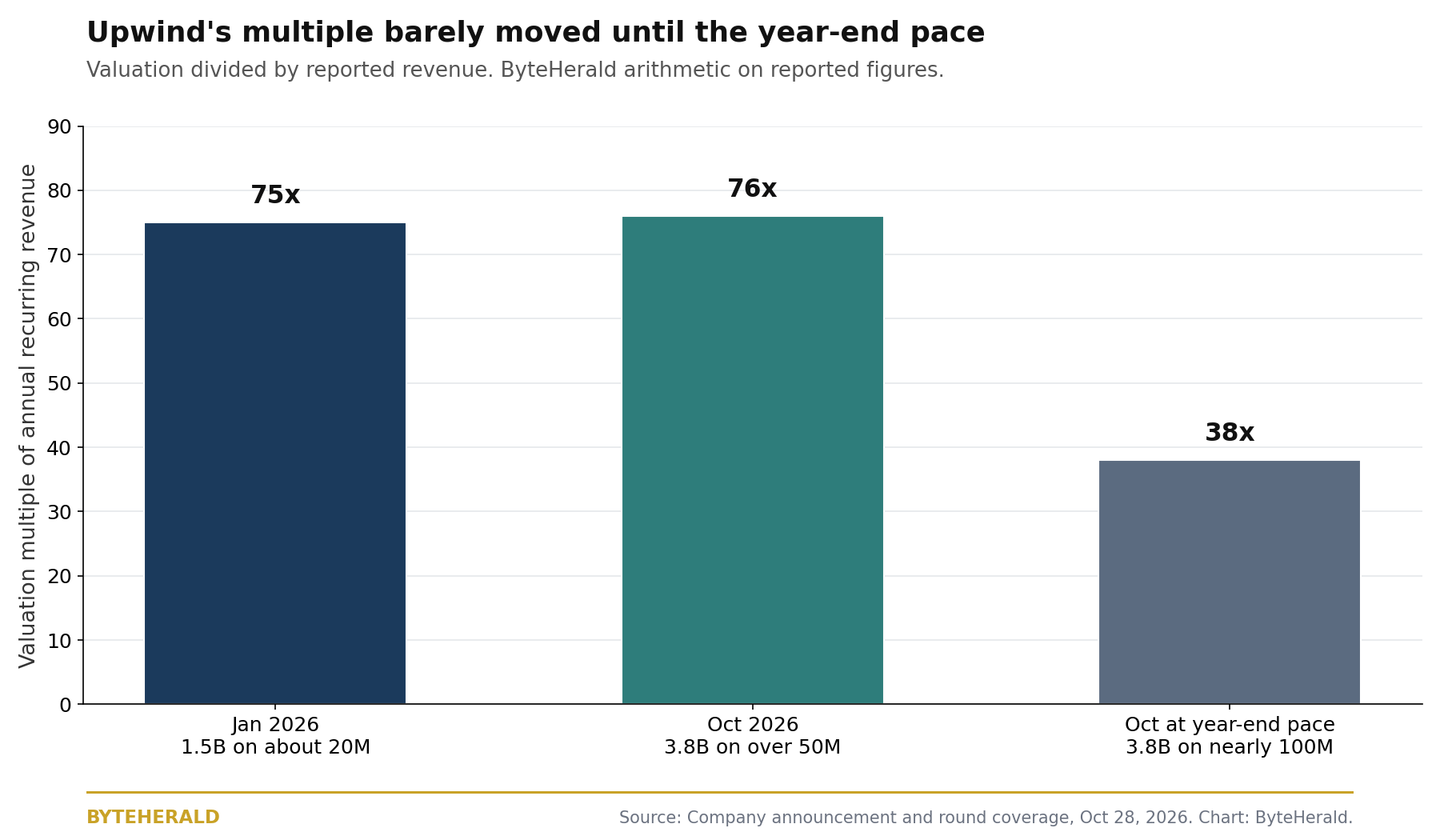
Valuation multiples are only honest when the inputs are visible, so here are Upwind's, with their sources and their limits. At the January 2026 Series B, the company was valued at 1.5 billion dollars against annual recurring revenue of about 20 million dollars at the end of 2025, as reported by The Information and carried in round coverage. Dividing one by the other gives a multiple of about 75 times annual recurring revenue. At the October 2026 Series C, the company is valued at 3.8 billion dollars against annual recurring revenue now reported at more than 50 million dollars. Dividing those figures gives a multiple of under 76 times. In other words, the valuation grew about 2.5 times and the reported revenue base grew about 2.5 times, so the price investors paid per dollar of revenue stayed roughly flat. If the chief executive's reported pace of nearly 100 million dollars in annual recurring revenue by the end of the year is reached, the same 3.8 billion dollar valuation would equal about 38 times that run rate, which would mean the multiple compressing as revenue catches up with price. All three multiples are ByteHerald arithmetic on reported figures, not audited financials, and the revenue figures themselves are company reported or press reported, not independently verified. The point of showing the work is that the story changes with the denominator: at 50 million dollars of revenue this is a richly priced security company, and at 100 million dollars it is a much more conventionally priced one.
| Round | Valuation, billion dollars | Reported annual recurring revenue, million dollars | Implied multiple |
|---|---|---|---|
| Series B, January 2026 | 1.5 | About 20 at end of 2025 | About 75x |
| Series C, October 2026 | 3.8 | More than 50 | Under 76x |
| Series C at year end pace | 3.8 | Nearly 100, reported pace | About 38x |
| Total capital raised since 2022 | Not a valuation | More than 50 | Not a multiple: 0.83 billion raised, equal to about 16x revenue at 50 million and about 8x at the 100 million pace |
An upsized round at an unchanged price
The second detail that separates this round from a routine funding announcement is the upsize. In September 2026 the round was announced at 300 million dollars, led by Bessemer Venture Partners and TCV, at the 3.8 billion dollar valuation. In October it closed at 400 million dollars at the same valuation, with Canapi Ventures joining as a new investor alongside existing backers including Cyberstarts, Greylock Partners, Craft Ventures, Salesforce Ventures, and TCV. An extra 100 million dollars at an unchanged price is a vote of confidence that is easy to misread: it means new money accepted the September price after another month of diligence, not that the price rose. It also brings total capital raised since the company's 2022 founding to about 830 million dollars, a sum that now stands at roughly 8 to 16 times the reported revenue base, depending on whether revenue is counted at 50 million or at the 100 million year end pace. That ratio is the real risk in the story. Upwind has to grow into a capital base that is many times its current revenue, and the round gives it the cash to try, not proof that it will. Gartner's $3.5 trillion AI spending forecast is the wider context: the whole industry is funding capacity ahead of proven returns, and a security vendor raising 400 million dollars is part of that same bet, even when its revenue is genuinely growing.
The Datadog bid, reported and unconfirmed
Round coverage also reports that Upwind rejected a roughly 4 billion dollar acquisition offer from Datadog, a figure that deserves careful handling because neither company has confirmed it. If the report is accurate, the comparison is striking: a strategic buyer was willing to pay about what private investors just paid, which means the private round price and the takeover price converged. That convergence cuts two ways. It supports the valuation, because a buyer with its own diligence reached a similar number. It also caps the easy upside story, because the company turned down a price barely above the round valuation in a bet that independence will be worth more later, in a market where Google paid 32 billion dollars for Wiz and where Palo Alto Networks and CrowdStrike compete directly. The honest treatment is to keep the bid in the reported column, not the confirmed column, and to note what would settle it: a statement from either company, or a filing. Until then, the confirmed facts are the round itself, the valuation, the upsize, and the revenue growth claim, and the bid is context that explains why the founders chose to stay independent.
What Upwind actually sells, and why agents matter to it
Upwind's product is runtime security: instead of scanning code periodically for vulnerabilities, it watches live cloud workloads, application programming interfaces, and autonomous AI agents, and tries to separate flaws that can actually be reached and exploited from the far larger pile that cannot. That distinction is the company's pitch, and it connects directly to the agent wave: the chief executive's argument, quoted in the company announcement, is that autonomous agents can change cloud infrastructure faster than human teams can track manually, which makes live telemetry more valuable than periodic scans. The company says it will spend the new capital on product development and go to market expansion, including AI sensors for endpoints, scanners for AI agents and skills, and a rebuilt inventory graph, plus AI agents of its own in three roles: Blue, which assembles the full picture of an attack; Red, which verifies whether a flaw is actually exploitable in a customer's environment; and Green, which narrows findings to the few that need fixing. It launched an AI Labs research unit in September 2026 and disclosed the acquisition of the Israeli startup Aegis in a stock swap reported to be in the tens of millions of dollars. Customers named by the company include Siemens, Roku, and Carvana, with Nubank and ClickUp also named in round coverage. Assume Breach: The 2026 AI Security Report Card is the incident record behind this pitch: when breaches, data theft, and jailbreaks fill a year, a vendor that watches systems live has a story that writes itself, and Upwind's funding is a measure of how much investors believe that story.
What the round proves, and what it does not
Funding announcements are designed to be repeated, not examined, so a reader needs a short routine for them. First, divide valuation by revenue and ask whether growth or multiple expansion did the work; for Upwind, growth did it, which is the healthier of the two. Second, ask what changed between announcement and close; here the round grew by 100 million dollars at a flat price, which is confidence without repricing. Third, separate confirmed facts from reported context; here the round and valuation are confirmed by the company announcement, while the Datadog bid and the precise revenue figures are reported and should be weighted accordingly. Fourth, compare capital raised with revenue; here about 830 million dollars raised against a revenue base in the tens of millions means the company must sustain very fast growth to justify its price, even if the multiple looks stable. Upwind's round passes the first test cleanly, which is rarer than it sounds in a year of AI funding headlines: the valuation and the reported revenue each grew about 2.5 times, so the multiple stayed roughly flat, not because investors simply paid more for the same business. Whether that growth continues to the reported 100 million dollar pace is the number to watch, because it is the number that turns a 76 times multiple into a 38 times one.
By ByteHerald Staff. Upwind Security, October 28, 2026, announced the close of its 400 million dollar Series C funding round at a 3.8 billion dollar valuation, led by Bessemer Venture Partners with Canapi Ventures joining existing investors, following revenue that quadrupled in 2026 and a Series B valuation of 1.5 billion dollars in January 2026. CTech, October 28, 2026, reported that the round was upsized from 300 million dollars announced in September 2026 at the same 3.8 billion dollar valuation, with annual recurring revenue above 50 million dollars against about 20 million dollars at the end of 2025. Dealroom, October 28, 2026, reported a roughly 4 billion dollar acquisition offer from Datadog that Upwind rejected, annual recurring revenue rising from about 20 million dollars to more than 50 million dollars as reported by The Information, and customers including Siemens, Roku, Carvana, Nubank, and ClickUp.
Comments
Post a Comment