On October 19, 2026, the Department of Homeland Security ordered US civilian federal agencies to remove DeepSeek products, and any third-party services built on DeepSeek's models, from their information technology systems, and barred the Chinese AI company from federal contracts. DHS said the models pose "multiple threat vectors," including the risk that sensitive data could be transferred to China if government employees or vendors use them. It is the broadest US government action against an AI lab to date.
What the order actually does
The paper trail is unusually crisp for a federal AI action. The Federal Register notice, document number 2026-21447, filed October 19 and scheduled for official publication October 20, is titled "Order: Exclusion and Removal of DeepSeek Products from Federal Civilian Executive Branch Information Technology Systems and Procurements." An accompanying order dated July 24 and signed by Homeland Security Secretary Markwayne Mullin bars DeepSeek from participating in federal government contracts (Bloomberg Law; Reuters).
The scope matters more than the headline. The order covers not only DeepSeek's own products but third-party services built on DeepSeek's AI models, which closes the obvious workaround of wrapping the same weights in a different vendor's packaging. A July memo made public the same day told federal agencies to monitor traffic flows in and out of government websites to address the potential risks. Removal without monitoring would be a one-time sweep; the pairing is designed to be permanent.
Why DHS says DeepSeek is a threat
The department's language is worth quoting exactly, because it is the government's threat model for an AI company, not just a ban. DHS said DeepSeek could be a "multiple threat vector," and listed three: the transfer of sensitive data to China if US government employees or vendors use the products; the generation of "practically actionable information" about US citizens and agencies; and the possibility that the models themselves contain "malware or other security vulnerabilities."
Three caveats, because the order invites overreading. First, this is a risk assessment, not a proven incident; DHS has not published evidence of actual data exfiltration or embedded malware. Second, the scope is civilian executive branch agencies, not the whole economy. Third, the practical question nobody has answered is inventory: agencies now have to discover what DeepSeek-derived tooling they actually run before they can remove it, and shadow AI adoption makes that a real project.
The 21-month path to the removal order
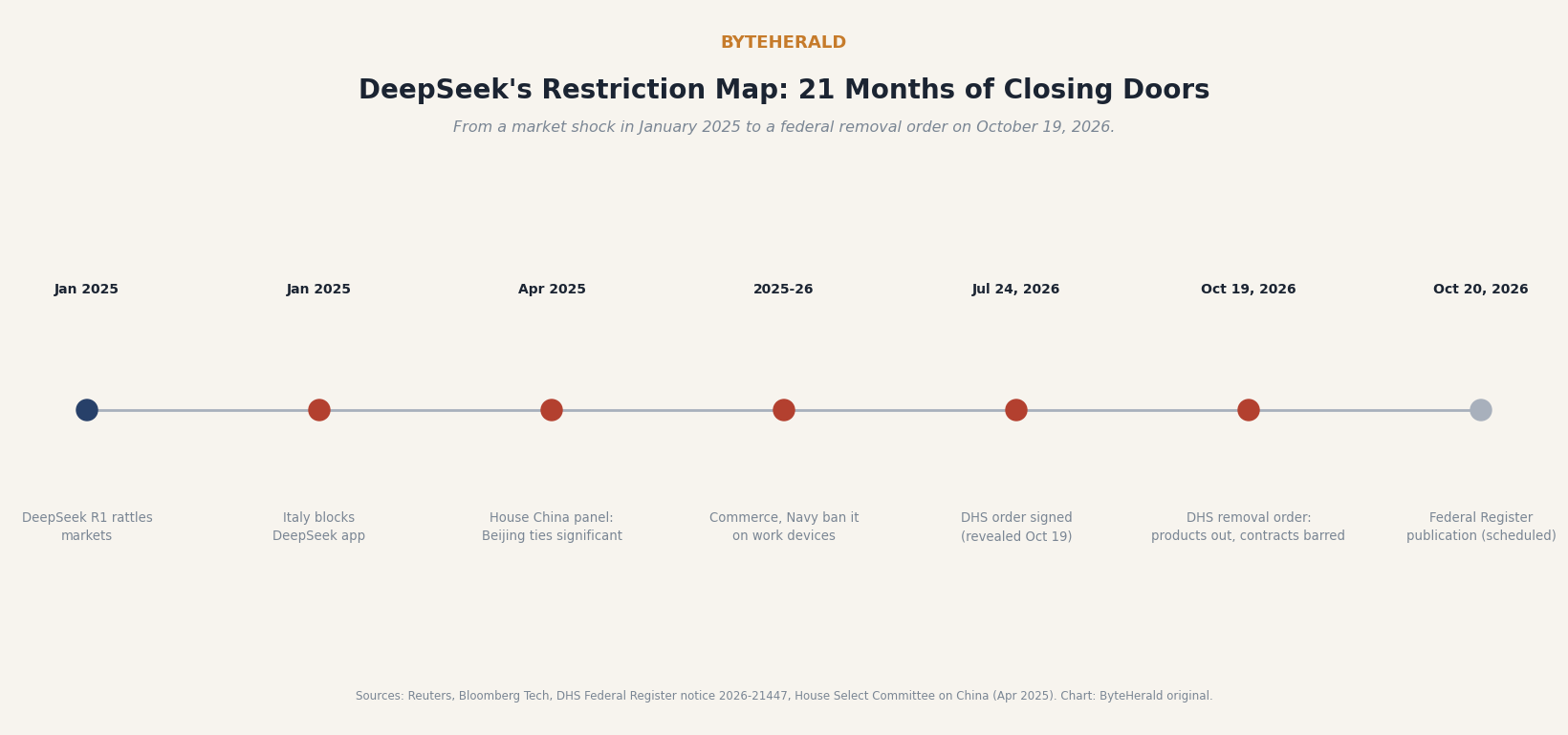
The October order did not come from nowhere; it is the end of a sequence that started with DeepSeek's R1 breakthrough rattling global markets in January 2025. Later that month, Italy's data protection authority blocked the app over data-handling concerns. In April 2025, the House Select Committee on China reported that DeepSeek's ties to Beijing were "significant." Through 2025 and 2026, the Commerce Department and the Navy banned DeepSeek on government devices, and states including New York, Tennessee, and Virginia took similar steps. The DHS order standardizes those piecemeal bans across the entire civilian federal IT estate.
The timing also fits a broader campaign. The FCC will vote on October 29 on barring all Chinese labs from testing electronic devices for US use, and in December it banned imports of new Chinese-made drones and consumer routers. DeepSeek is the AI front of a China-tech crackdown that now spans drones, routers, and device certification.
Why governments restrict AI models: the three-bucket framework
The news will fade; the framework behind it will not. Governments restrict AI models for three recurring reasons, and every future restriction will cite some combination of them. First, data sovereignty: where do prompts, documents, and telemetry physically go, and whose law governs that storage. Second, intelligence value: what can an adversary infer from aggregate usage, which is why DHS named "actionable intelligence on US persons and agencies" explicitly. Third, supply-chain integrity: whether the artifact itself, weights, code, updates, can be trusted, which is the malware-and-vulnerabilities clause. Open-weight models score badly on all three from a restriction-minded government's perspective, because the weights can be rehosted anywhere and the provenance is hard to audit.
That framework also explains what the order does not do. It does not touch DeepSeek's open weights on public repositories, which cannot be un-published. It does not stop private-sector use. And it says nothing about the many US labs whose models have the same theoretical properties but different jurisdictions. The restriction is geopolitical, not technical, and it should be read that way.
The honest verdict
Grade the order on what it is. As a security measure, the two-door design, removal plus procurement exclusion, plus traffic monitoring, is the first coherent federal treatment of an AI supply chain, and it will become the template for the next target. As a market event, it barely touches DeepSeek's actual business, which is overwhelmingly outside US federal procurement. The real audience is every other vendor selling AI into government: the inventory question, what models are inside your stack, just became a compliance question.
Government intervention in AI models is no longer theoretical, and it is getting faster. We mapped every proposal for stopping a dangerous AI model, from Anthropic's draft bill to the EU AI Act, and the DHS order is what the fastest real-world version looks like: no judge, no trigger threshold, just an agency order under cybersecurity law.
By ByteHerald Staff. Order details from the DHS Federal Register notice (document 2026-21447, filed October 19, 2026) via Bloomberg Law and Reuters reporting. Threat-vector quotes are DHS's language. The 21-month timeline is compiled from Reuters, Bloomberg, and House Select Committee on China materials.
Comments
Post a Comment