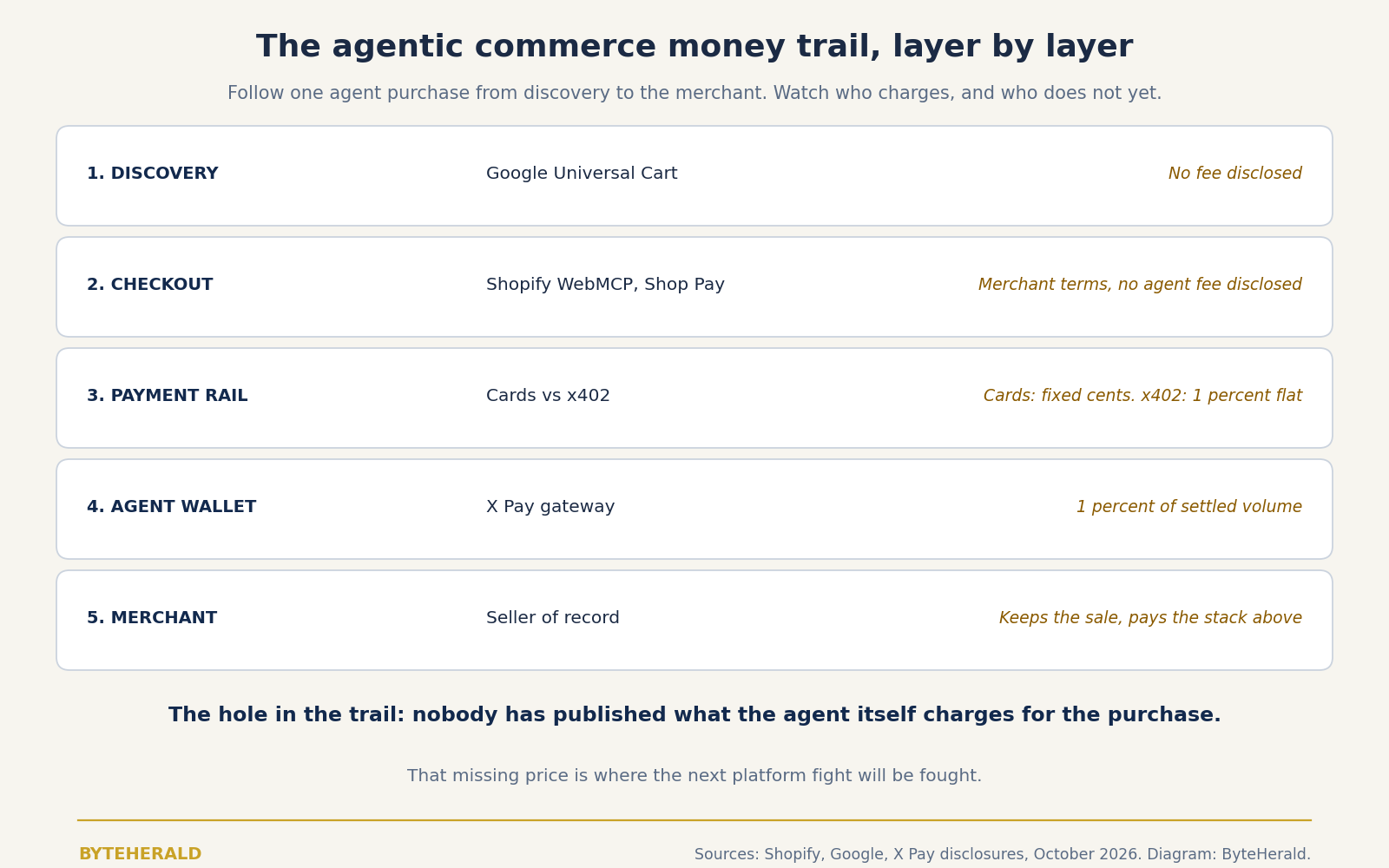
When an AI agent buys something for you, at least five different layers touch the money before the merchant is paid, and only some of them have published a price. Google's Universal Cart went live in the United States on October 15, 2026, Shopify opened agent checkout to browser based agents on September 28, 2026, Amazon blocks agent purchases while Walmart welcomes them, and a payments startup called X Pay has settled more than 50,000 machine payments since September 11, 2026. Put those facts together and a pattern appears: the plumbing for agent shopping is being built in public, layer by layer, but the price list is being published only where it suits the company charging. This pillar maps the whole money trail, names what each layer charges where that number is public, marks what is still undisclosed, and identifies the one price nobody has published at all, which is what the agent itself charges for making the purchase.
Layer one: discovery, where Google holds the cart
Google's Universal Cart, launched across Search and the Gemini app in the United States, lets shoppers save items from different retailers in one place, track price drops and restocks, surface promo codes, and check out with Google Pay at participating merchants including Nike, Sephora, Target, Ulta Beauty, Walmart, Wayfair, and select Shopify merchants. At other retailers, shoppers transfer the cart to the merchant's site to finish. The cart runs on Google's Shopping Graph, which Google says holds more than 60 billion continually updated listings, and on the Universal Commerce Protocol, the open standard for agent and retailer communication across discovery and checkout. Google has also described an Agent Payments Protocol for setting budget and brand guardrails on agentic transactions.
What Google charges for sitting in the middle of that flow is not part of the launch story. No fee for Universal Cart participation appears in the launch coverage, and the merchant remains the seller of record, which means Google's compensation, if any, lives in its existing advertising and payments relationships rather than in a published agent checkout rate. That silence is itself a data point. Discovery is the layer with the most leverage, because the agent's recommendation decides which merchant gets the sale, and the company that controls discovery has the least incentive to publish what that leverage is worth.
Layer two: checkout, where Shopify opened the door
Shopify's move is the clearest of the five layers. On September 28, 2026, the company extended its WebMCP support from storefronts and carts to checkout, so browser based agents can read a checkout, update details such as delivery options and discounts, and submit the order after the buyer authorizes it, including through Shop Pay. Three tools do the work: get_checkout reads the order state, update_checkout changes fields, and complete_checkout places the order. The guardrails are strict in ways that matter for money: the agent must show the buyer the current order and total and get permission before submitting, must ask again if the total changes, cannot enter new card details, and hands authentication challenges such as 3D Secure back to the shopper.
Shopify's bet is structural rather than transactional. Agents do not scrape pages or imitate clicks under WebMCP; they call structured tools the merchant's storefront registers, which makes agent orders more reliable and more auditable than screen scraping. The company also opened its catalog of more than one billion listings to agents shoppers connect through its Shop app, moving from partnerships with specific platforms to a neutral product layer any agent can use. What Shopify has not published is an agent specific fee: checkout runs under the merchant's existing Shopify and Shop Pay terms, and no additional charge for agent originated orders appears in the checkout documentation. For merchants, that means agent traffic currently arrives at the price they already pay. For Shopify, it means the agent channel is being seeded before it is monetized, a pattern worth watching because seeded channels rarely stay free once they carry volume.
Layer three: the payment rail, where the old math breaks
The sharpest economics in the whole trail sit at the payment rail, because agents do not shop the way humans do. A human makes a few purchases a month. An agent planning a trip, reconciling a ledger, or researching a market makes thousands of tiny calls, each worth a fraction of a cent, and card rails cannot clear those at a profit. The fixed cost of a card transaction runs roughly twenty to thirty cents, so selling a two tenths of a cent API call on card rails loses money by two orders of magnitude. That mismatch is why the internet learned to bundle: subscriptions, prepaid credits, and API keys with no ceiling are all workarounds for a rail that cannot price small things.
The alternative rail now being built for agents is x402, an open payment standard contributed by Coinbase and run under the Linux Foundation. Under x402, a server answers a request with a price, the client signs a payment, and the response arrives in the same round trip, with no account, no API key, and no subscription. X Pay, a gateway built on x402, went live on Base mainnet on September 11, 2026, began operating its own facilitator on September 22, and has since settled more than 50,000 payments in USDC. It charges a flat 1 percent of settled volume, holds no customer funds, and pays merchants to their own wallets. On a 100 dollar agent purchase, 1 percent is 1 dollar. On a two tenths of a cent API call, 1 percent is two ten thousandths of a cent, a fee the old rail cannot express at all. The comparison below makes the point with ByteHerald arithmetic.
| Transaction | Card rail at 25 cents fixed | x402 at 1 percent |
|---|---|---|
| 0.002 dollar API call | 25 cents, a loss of about 12,400 percent | 0.00002 dollars |
| 1 dollar micro purchase | 25 cents, 25 percent of the sale | 1 cent |
| 100 dollar agent purchase | 25 cents, 0.25 percent of the sale | 1 dollar |
The table cuts both ways, and honest analysis should say so. Percentage rails win decisively on micro transactions and lose on large ones, where a fixed fee is cheaper than 1 percent. That crossover, at roughly 25 dollars for a 25 cent fixed fee against 1 percent, is the real commercial boundary: below it, the new rails are the only viable option, and above it, the old rails still win on price. Any agent payment provider that charges only one way will eventually face a competitor charging the other way for the transactions it prices worst.
Layer four: the agent wallet, and layer five: the merchant
X Pay's 1 million dollar raise in October 2026, from nine investors including DCI, Skyland Ventures, Zerra Ventures, and Dubai Blockchain Lab, shows how early this layer is. The funding will extend settlement from Base to BNB Chain and Solana, fund an independent security review, build an API marketplace where an agent can discover a service and pay for it in the same moment, and prepare for European Union compliance under MiCA. A 1 million dollar round with 50,000 settled payments is a seed stage business describing a market, not a market leader defending one, and its 21 endpoint catalog, priced from fractions of a cent to per task AI routes, reads like a laboratory for machine pricing rather than a finished economy.
The fifth layer is the merchant, and its position is the most constrained in the stack. Merchants remain the seller of record in Google's cart and in Shopify's checkout, which means they carry fulfillment, returns, and customer support, while every layer above them takes its cut or prepares to. The lockout map ByteHerald published in October showed the other side of merchant power: Amazon blocks agent purchases outright, Delta blocks agent ticket booking, and banks including JPMorgan Chase and Charles Schwab block agent account access, while Shopify and Walmart opened their doors. Blocking is itself a price, set at infinity, and merchants choosing between blocking, licensing, and opening are choosing between three different revenue models for the same agent traffic. The merchants that open earliest, like Shopify's storefronts, gain distribution while the tolls are still low. The merchants that block are betting that the tolls will fall, or that direct relationships are worth more than agent volume.
The missing price, and what happens when it appears
That leaves the hole in the trail, which is the agent's own cut. Nobody has published what an agent charges, or is charged, for completing a purchase: not the model providers whose assistants do the shopping, not the agent platforms, and not the retailers. Three futures follow from that gap. In the first, the agent's cut is bundled into a subscription, and shoppers pay a flat monthly fee for unlimited agent shopping, which hides the per transaction price but caps the agent provider's upside. In the second, the agent takes a referral fee from the merchant, which makes the agent a commission salesperson with an incentive to recommend the highest paying merchant rather than the best product, a conflict that will need disclosure rules. In the third, the agent charges per task, like X Pay's per call model applied to shopping, which is transparent but makes every purchase feel metered.
Each future has a precedent, and each precedent has a regulator attached. Subscription bundling is the streaming model. Referral fees are the travel agent model, which acquired disclosure obligations. Per task metering is the cloud API model, which acquired billing disputes. The agentic commerce stack will likely end up with all three, split by transaction size, exactly like the payment rail crossover above. Small agent tasks will meter through rails like x402. Large agent purchases will carry referral or subscription economics. And the discovery layer, which decides what the agent recommends, will face the hardest questions, because a recommendation that earns its recommender a fee is advertising, whatever the interface calls it.
For shoppers, the practical rule until those prices appear is to ask one question at every agent checkout: who is paid for this recommendation, and how much. If the agent cannot answer, the answer is that you are paying for it somewhere you cannot see, in price, in choice, or in data. For merchants, the rule is to measure agent traffic separately from human traffic from the first order, because a channel whose economics are still being set is a channel whose terms will change, and the merchants with their own numbers will negotiate the new terms from evidence rather than from hope. For builders, the Universal Cart launch coverage and the Shopify checkout documentation are the two documents to read first, since they define the two ends of the consumer stack today. And for anyone sizing the whole bet, the Gartner analysis of AI spending that may never pay off is the cautionary counterpart: infrastructure built ahead of revenue eventually has to justify itself, and agent commerce is infrastructure being built ahead of its price list.
By ByteHerald Staff. Google, October 15, 2026, Universal Cart launch in the United States across Search and Gemini, with Shopping Graph of more than 60 billion listings, Universal Commerce Protocol, Agent Payments Protocol guardrails, and participating merchants including Nike, Sephora, Target, Ulta Beauty, Walmart, Wayfair, and select Shopify merchants. Shopify, September 28, 2026, WebMCP checkout announcement, with get_checkout, update_checkout, and complete_checkout tools, Shop Pay support, buyer authorization requirements, and no new card details accepted. X Pay, October 2026, 1 million dollar funding round from nine investors, live on Base mainnet since September 11, 2026, more than 50,000 payments settled in USDC, flat 1 percent of settled volume, non-custodial model, and x402 standard contributed by Coinbase under the Linux Foundation.
Comments
Post a Comment