Tech companies have started asking religious leaders how to make AI morally good, and the most interesting part of that story is what nobody will say on the record. Anthropic says it has met scholars, clergy, philosophers, and ethicists from more than 15 religious and cross-cultural groups. Executives from Meta, Google, and Amazon have met with the Vatican, and Microsoft has pursued religious outreach vigorously. Yet no major lab publishes which tradition changed which behavior in its models. Labs are borrowing morality in public and keeping the receipt private, which means the borrowing cannot yet be audited.
The reporting that forced this question into the open comes from the Associated Press, which describes a race among labs to build the most powerful AI alongside a quieter race to teach chatbots right from wrong. Anthropic co-founder Chris Olah put the premise plainly earlier this year at the Vatican's presentation of Pope Leo XIV's encyclical on AI, saying these are not questions a lab can answer, because they are questions traditions have carried for millennia. OpenAI chief executive Sam Altman offered a different formula last year, saying ChatGPT should reflect the weighted average, or whatever, of humanity's moral view. Those two sentences contain the whole problem: one treats morality as inherited wisdom, the other as an average to compute, and neither can be true in the same way at the same time.
What the labs have actually disclosed
ByteHerald audited the public record rather than the labs' intentions, and the table below is the result. It records only what each lab has disclosed in public documents or in the AP reporting, and it marks everything else as undisclosed. That discipline matters, because most coverage of AI morality grades labs on their aspirations. This table grades them on their paper trail.
| Lab | Public moral document | Faith engagement disclosed | What stays undisclosed |
|---|---|---|---|
| Anthropic | Published Charter for Claude, with virtues including honesty, fidelity, coordination-friendliness, and beneficence | Meetings with scholars, clergy, philosophers, and ethicists from more than 15 religious and cross-cultural groups, per a May blog post | Which inputs changed which model behaviors |
| OpenAI | Published Model Spec, a behavioral charter for its models | Altman's weighted average formulation of humanity's moral view | How the average is weighted, and whose views count |
| Meta, Google, Amazon, Microsoft | No equivalent public moral charter described in the AP reporting | Representatives met with the Vatican; Microsoft's religious outreach described as vigorous | Meeting outcomes and any resulting model changes |
The pattern is consistent across rows. Disclosure stops exactly where auditability would begin. Anthropic's meetings are described in unusual detail by the standards of corporate ethics pages: philosopher Meghan Sullivan of the University of Notre Dame attended a session split into two parts, first explaining the models in lay terms, then gathering feedback on questions ranging from whether humans have souls to whether third graders should use a chatbot for literacy education. Sullivan described the engagement as rigorous. What the public still lacks is any before and after account of a model behavior that changed because of those conversations.
Three models of moral sourcing
Strip away the branding and labs describe three different ways of sourcing morality. The diagram below names them, because confusing them is how vague reassurance passes for an answer.
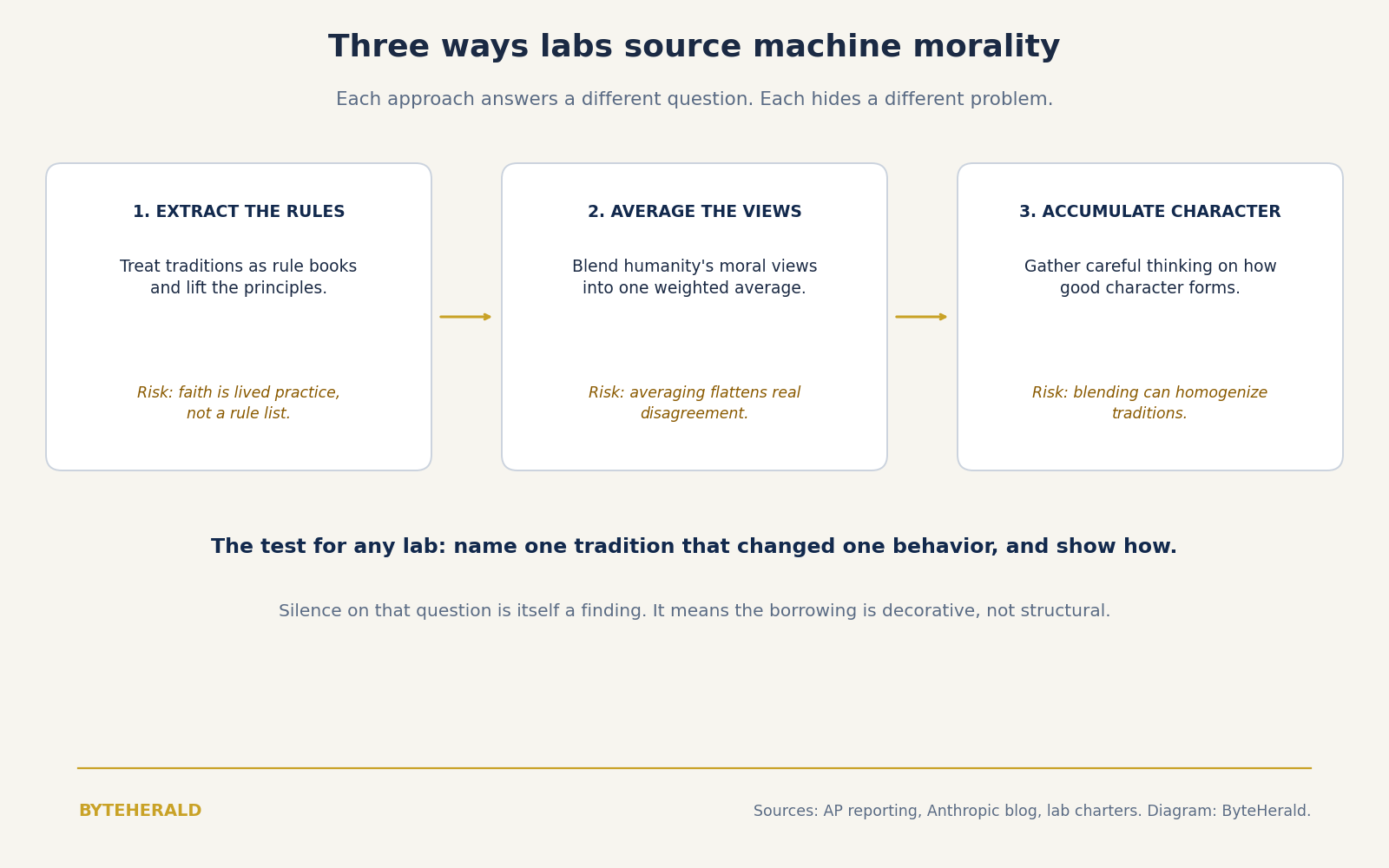
The first model extracts rules. It treats traditions as rule books from which principles can be lifted and installed. Anthropologist Webb Keane of the University of Michigan argues this view is itself a distortion, because it treats religion as a set of extractable rules divorced from the messy, practical ways adherents actually live. His warning has a specific edge: a rule book model privileges scriptural traditions, above all the Abrahamic faiths, and distorts traditions that do not understand themselves primarily as systems of ethics.
The second model averages views. It treats humanity's moral opinion as a distribution with a center, and aims the model at that center. The problem is that moral disagreement is not noise around a true value; it is the data. Averaging views on questions where traditions genuinely contradict each other does not resolve the contradiction, it hides it inside a confident sounding answer. Altman's own qualifier, or whatever, reads as an admission that the formula is placeholder rather than method.
The third model accumulates character. Anthropic's blog post phrases it as careful, accumulated thinking on how good character actually forms, drawn from a full range of viewpoints with equal depth and rigor, and explicitly not alignment with any one tradition's worldview. That is the most sophisticated formulation on offer, and it still faces the objection raised by Paolo Carozza of the Meta Oversight Board: living traditions absorb outside knowledge organically over time, while AI blending throws everything together at once, mixes it up, and risks making sense of none of it, pulling toward the middle or toward Western traditions.
Why the categories themselves are suspect
A deeper critique, from scholars of religion, questions whether the borrowing exercise is well formed at all. Tomoko Masuzawa's work argues that Buddhism and Hinduism were not recognized as clearly bounded traditions by their own practitioners before European scholars arrived, and that the modern notion of distinct, comparable world religions dates to as late as the 19th century. If that is right, then asking a panel of world religions to each contribute their moral principles assumes a map of the world that the mapmakers invented. The lab that believes it has consulted every tradition may simply have consulted every category on a Western list.
This is not an argument against talking to faith leaders. Sullivan's account of the Anthropic meeting suggests genuine intellectual engagement, and the questions raised there are the right ones. It is an argument against treating consultation as a solution. A meeting produces insight; a model needs a mechanism. Until a lab can show the mechanism, the difference between seeking wisdom and staging diversity remains unmeasurable from outside.
What the charters agree on, and where they split
Independent analysis of the published charters offers one more checkable finding, with its limits stated. A researcher at the London School of Economics coded the three major published charters against a standard map of human values and found broad agreement: helpfulness and honesty first, safety second at nearly the same weight, and no endorsement of power. The same coding found one sharp split. Anthropic's charter asks its model to think for itself about five times for every three times it asks it to defer, and to refuse even Anthropic itself if asked to do wrong, while Microsoft and OpenAI reverse that ratio toward deference. That coding is one researcher's work, so it is indicative rather than definitive, but it points to the real fault line: how much self direction a model should have when its instructions conflict with its values. That question will matter far more than any single moral rule once agents act on users' behalf, which is why our earlier coverage of the agent standards race frames governance as the next contest: the great agent lockout, who blocks AI agents, and the cost.
The test readers can apply
Three questions cut through any lab's morality announcement. First, name one tradition whose input changed one specific model behavior, and show the change. Second, name one moral question on which consulted traditions disagreed, and say what the model does with that disagreement instead of averaging it away. Third, publish the charter version history alongside the model version history, so the public can see whether moral commitments changed when commercial pressure rose. A lab that answers all three has a moral sourcing program. A lab that answers none has a meetings program.
The stakes are not abstract. Models already advise on hiring, tutoring, medical questions, and personal disputes, and the moral assumptions inside those answers will shape millions of decisions made by people who never see a charter. Faith traditions spent millennia developing ways to hold disagreement, uncertainty, and authority together without pretending the tension had been solved. If labs want that inheritance, they must accept its discipline too: show the disagreement, show the reasoning, and let outsiders check the work. Until then, the honest headline is not that AI has learned morality from religion. It is that AI companies have started attending the lectures, and the exam is still ungraded.
By ByteHerald Staff. Associated Press, October 2026, reporting on tech companies turning to religion for AI morality (Anthropic meetings with more than 15 religious and cross-cultural groups, Vatican meetings by Meta, Google, and Amazon, Microsoft religious outreach, Olah Vatican statement, Altman weighted average statement, Keane, Masuzawa, and Carozza critiques). Anthropic blog post, May 2026, on faith engagement and accumulated thinking on good character. London School of Economics Business Review, October 19, 2026, single researcher coding of three published AI charters (helpfulness and honesty first, safety second, Anthropic self-direction split, indicative finding).
Comments
Post a Comment