IEEE Spectrum published an interview on October 21, 2026, with Ellia Lebleu, a founding member of WikiProject AI Cleanup, the volunteer effort that has spent three years finding and removing AI-generated material from Wikipedia. Lebleu's own caution is the story: detection firm Pangram flagged about 20 percent of new English Wikipedia articles and drafts as AI-generated in late 2025, falling to 15 or 16 percent in early 2026, and she says plainly that nobody yet knows whether that fall came from new rules, from beginners learning the rules, or from models getting harder to detect. The cleanup works. Its headline number does not yet prove it.
The cleanup ledger: three years in one timeline
The project began in December 2023, when Lebleu and other editors chatting on Wikipedia's Discord server kept seeing the same strange articles. They repeated phrases like stands as a testament or rich cultural heritage, and they carried conclusion sections, or sections called Why is this important, that were typical of ChatGPT in 2023 and early 2024 but very odd for Wikipedia. Lebleu created an official project so more editors could deal with the flood. By 2025 the tells had changed. By 2026, English Wikipedia had prohibited editors from using large language models to generate articles, and the cleanup project had moved from spotting clichés to building tools, checking citations, and defending a human-written identity that has become part of Wikipedia's public image.
| Date | What changed | Why it matters |
|---|---|---|
| December 2023 | WikiProject AI Cleanup founded | A flood of odd articles got a coordinated response |
| 2023 to early 2024 | Cliché tells dominate | ChatGPT habits were easy to spot and easy to remove |
| By 2025 | Structural tells take over | Detection moved from words to patterns and behavior |
| Recently, before Oct 2026 | LLM-generated articles prohibited | The rule gave patrollers a clear standard to enforce |
| October 21, 2026 | IEEE Spectrum interview published | Lebleu states the flag rates and their limits in public |
Three numbers that are not one trend
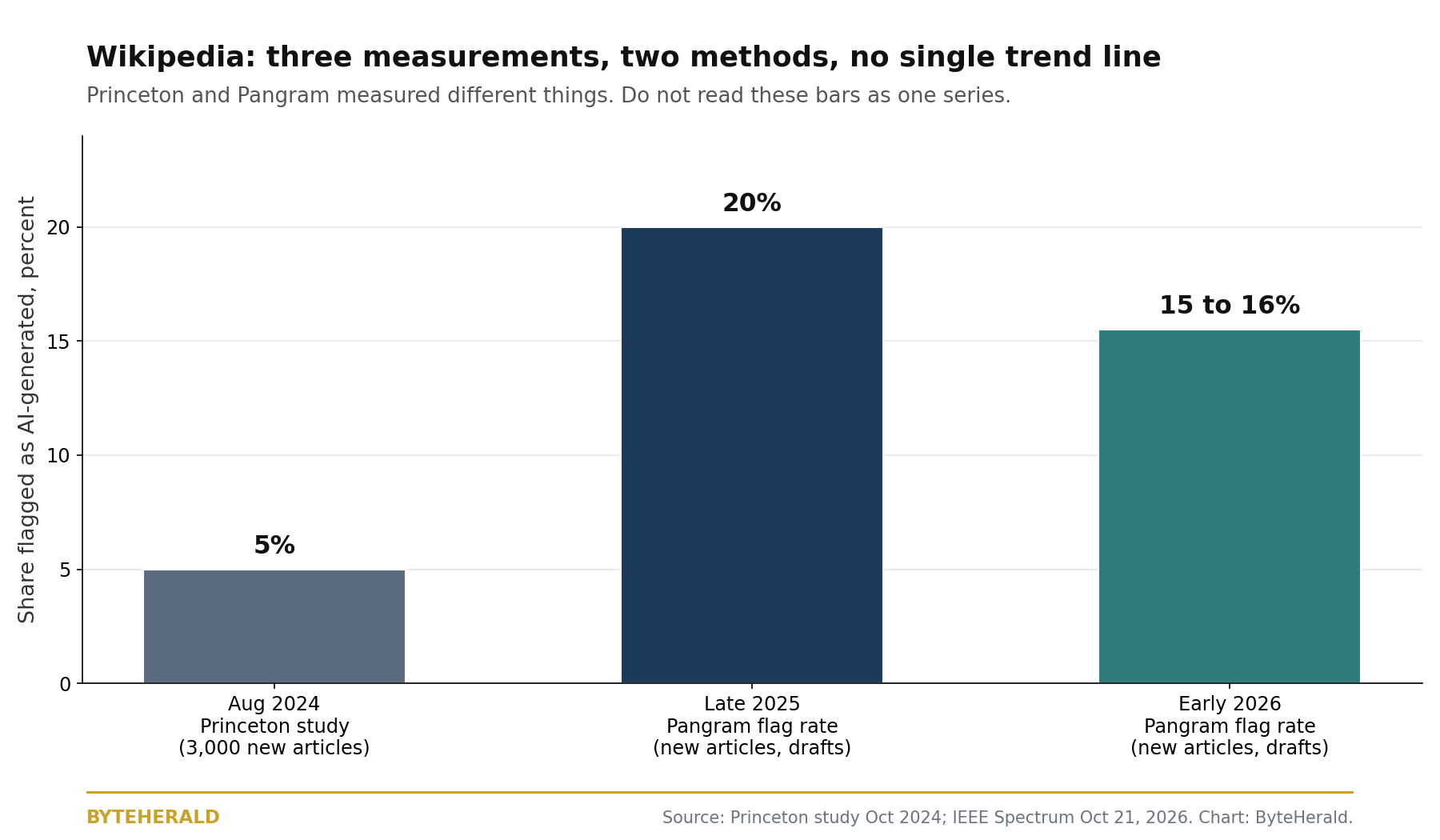
ByteHerald's chart for this story deliberately refuses to draw a trend line, because the three available numbers come from two different methods. A Princeton University study of 3,000 newly created articles from August 2024 put the AI-created share at about 5 percent. Pangram's later flag rate for new articles and drafts was about 20 percent in late 2025 and 15 or 16 percent in early 2026. Lebleu says she tested Pangram on pre-ChatGPT Wikipedia content and found no false positives, so its results provide a very conservative lower bound, meaning the true share could be higher, not lower. That honesty is the most important number in the story: a lower bound that falls from 20 to about 15.5 percent could mean the rules are working, or it could mean the detector is falling behind newer models, and Lebleu refuses to choose between those readings until better evidence exists.
How detection changed: words, then structure, then behavior
The detection story is a textbook case of an adversary adapting, and it is the most useful part of the interview for any reader who edits, teaches, or publishes online. In the first phase, editors looked for words: repeated phrases, promotional tone, and conclusion sections that Wikipedia articles do not normally carry. In the second phase, by 2025, the signs became structural: AI writing loves the rule of three, negative parallelisms, and other speech structures that mean little alone but accumulate into suspicion. In the third phase, editors look beyond the text entirely, at behavior: an account that produces five articles of several thousand words each in five minutes has a production rate no human writer matches, whatever the prose looks like. That progression matters because it explains why simple detectors fail: a tool that only hunts for banned phrases will miss the polished article whose only giveaway is that it was written impossibly fast, or whose citations look perfect until someone opens them.
The citation problem is worse than the prose problem
Lebleu's sharpest warning is not about style at all. It is about citations. A fully hallucinated reference, a source that does not exist, has become rarer, she says, because retrieval-augmented generation lets models find real sources. The common failure now is subtler and harder to fix: the model finds a real source and gets its content completely wrong, so the citation exists but does not support the claim attached to it. Lebleu calls such citations extremely commonplace. That changes the cleanup job from deleting bad prose to verifying every claim against its cited source, which is slower, more skilled work, and it is why the project's final standard remains human judgment. An editor must check not only whether a source exists, but whether it actually says what the article claims it says, especially on pages where a convincing citation can launder a false claim into respectability. Readers can apply the same test to any AI-written text they meet: open the citation, read the passage, and ask whether it supports the sentence, because a real link is not the same as a true claim.
AI is now fighting AI, with human judgment as the judge
The cleanup has entered a phase where AI tools do the first pass and humans do the deciding, a pattern ByteHerald has covered in other domains. Another Wikipedia editor built an AI source verifier that goes through the sources on a page and checks whether they match the claims, and Lebleu is candid that it carries no guarantee of being correct every time, but works as a first filter for obvious cases. The Wikimedia Foundation is working on a tool called Paste Check, which can flag text pasted directly from some AI chatbots. And Lebleu notes that Claude sometimes refuses with a line about Wikipedia's policies, saying it cannot write a Wikipedia article because that would go against those policies, a refusal that would help with casual users of commercial models even though open-weight models can be tweaked to avoid such restrictions. The through line is the same one ByteHerald traced in its visual explainer of how the underlying machinery works: How Transformers Actually Work: The Visual Explainer showed that these models predict plausible text, not verified fact, and a prediction engine makes a good first-pass checker but a bad final judge, because its errors look as confident as its correct answers.
Why Wikipedia is defending a human-written identity
When the guideline against LLM-generated articles was passed, Lebleu says, the reasons were practical: the site was flooded, the tools were poor, and a stop was needed. Since then the question has taken on a philosophical dimension. Many people call Wikipedia the last good place on the internet, and being free from AI slop has become part of its identity. That identity also has a practical value that AI companies themselves recognize: a purely human-written corpus is a precious training resource that is not replicated anywhere else, precisely because it was written by people checking each other. Lebleu also raises the opposite pressure, which she calls Google Zero: a future in which readers get AI answers that cite Wikipedia without ever visiting it, so they never learn that Wikipedia is a living project they can edit. The Foundation's answer, still in development, is an attribution framework that would show when an article was last edited, how comprehensive it is, whether editors flagged problems, and perhaps a call to action inviting a reader who spots an error to request an edit. The future Lebleu sketches is symbiotic rather than defensive: yesterday AI was something to clean up, today it helps with the cleanup, and tomorrow it will be the air the project breathes, which means the human-written core must be defended precisely because everything around it will be machine-generated.
What would prove the rule is working
Three tests would turn Lebleu's cautious numbers into a verdict, and none of them is yet available in the interview. First, run the same detector, recalibrated for newer models, over the same kind of sample at regular intervals, so a fall cannot be explained away as detector lag. Second, measure beginner behavior directly: what share of new editors submit AI-generated drafts, and does that share fall after the rule is made visible in welcome messages and editing help, which Lebleu says the project has worked hard to do? Third, audit outcomes, not just flags: what share of flagged articles are deleted, corrected, or kept after human review, and does that share change over time? Until those tests exist, the honest headline is the one Lebleu herself gives: a possible effect, a possible detector lag, and a majority of submissions coming from beginners who may simply be learning the rules. That restraint is also why this story belongs alongside ByteHerald's earlier coverage of the technology that makes detection necessary in the first place, including How AI Watermarking Actually Works, and Where It Breaks, which showed that marking AI content is itself an unfinished project with its own failure modes. Wikipedia's cleanup is not a victory lap. It is a working system, run by volunteers, against an adversary that improves every few months, and its most credible claim is that it has not yet lost.
By ByteHerald Staff. IEEE Spectrum, October 21, 2026, interviewed Ellia Lebleu, a founding member of WikiProject AI Cleanup, who said the project began in December 2023, that Pangram flagged about 20 percent of new English Wikipedia articles and drafts as AI-generated in late 2025 falling to 15 or 16 percent in early 2026, that AI citations that do not support their claims are extremely commonplace, and that the Wikimedia Foundation is working on a Paste Check tool for pasted chatbot text. Princeton University study, October 2024, found that about 5 percent of 3,000 newly created English Wikipedia articles from August 2024 were created using AI.
Comments
Post a Comment