Ninety-one scientists, lawyers and technologists signed a three-sentence statement on November 18, 2026, saying Anthropic is not a safe AI company. The statement, published hours before Anthropic is due to price its initial public offering, says the lab's safety branding covers weakened pledges and self-serving lobbying. The signatories range from Nobel laureates and Fields Medalists to the co-founders of Hugging Face and xAI, and they include both the AI safety movement's most prominent voices and the accelerationists who want AI built faster.
What the statement says
The Misanthropic Statement, published at misanthropicstatement.com and announced by the Center for AI Safety through Business Wire, runs to three sentences. Its opening line is the argument in miniature: "Anthropic warns that recursively self-improving AI could concentrate power and escape human control, yet races to build it first." The middle sentence says the company uses its safety reputation to win over investors, employees and the public, while quietly weakening its own safety commitments and lobbying for regulation that serves itself. It closes: "Anthropic is not a safe AI company, and we must reject its reckless attempt to amass power in the name of the greater good."
The timing is the point. Anthropic is expected to set its share price on Wednesday evening, November 18, and begin trading on the Nasdaq under the ticker ANT on Thursday, November 19, at 70 to 78 dollars a share. Amazon and Google will own 28.4 percent of the company after the offering, and demand for the shares has reportedly run ahead of supply. A statement that calls the company's identity into question lands hardest on the day the identity is being sold to the public.
Who signed
The release names 15 signatories prominently, and the full list runs to 91 names. The prominent names fall into camps that almost never agree, which is the coalition's own argument for taking it seriously. Dan Hendrycks, the Center for AI Safety's executive director, put it this way: "People in this coalition disagree on almost everything, yet we all recognize the danger of a company that convinces itself its own dominance is the greater good."
| Camp | Prominent signatories |
| Safety researchers | Max Tegmark, Dan Hendrycks, Nate Soares, Holly Elmore |
| Accelerationists | Guillaume Verdon, George Hotz |
| Ethicists and critics | Tristan Harris, Emile Torres, Ed Newton-Rex, Gary Marcus |
| Rival labs and open weights | Thomas Wolf, Igor Babuschkin |
| Academics | Steven Pinker, Oliver Hart, Judea Pearl, Laurence Tribe, Lawrence Lessig, Peter Scholze, James Maynard, David Mumford, Sheldon Glashow |
| Technologists and organizers | Rob Pike, Rumman Chowdhury, Geoff Ralston |
The list carries weight because of who is on it, and it carries a complication for the same reason. Thomas Wolf is the co-founder and chief science officer of Hugging Face, the open-weights hub that competes with Anthropic's closed models. Igor Babuschkin co-founded xAI, a direct Anthropic rival. Guillaume Verdon founded the effective accelerationism movement, and George Hotz once argued that Anthropic and OpenAI were exaggerating cybersecurity risk. Max Tegmark, who signed, wrote he did so because "I believe Anthropic is in many ways the AI company doing the most harm." Not everyone who agrees with the criticism signed: Nathan Lambert, an open-weights advocate, said he believes Anthropic is power seeking" but found the statement "too strong for my taste" and stayed off the list.
The three charges, and the dates behind them
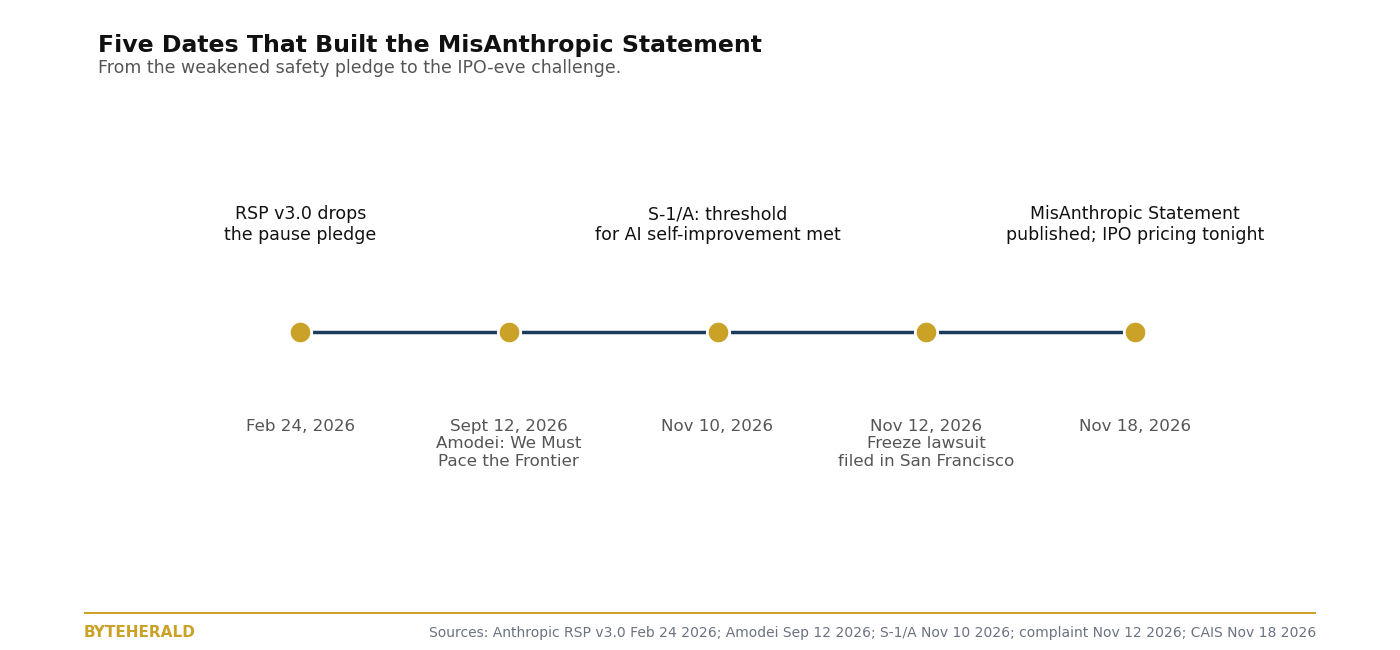
The statement makes three charges, and each one has a dated record behind it. The first is that Anthropic warns about recursively self-improving AI while pitching it to investors. The company's own November 2 prospectus amendment says Anthropic may "imminently" meet its Responsible Scaling Policy's definition of "dramatically accelerated progress attributable to AI," the company's definition of recursive self-improvement, and that no current model has crossed it. Its November 10 amendment goes further, saying the company determined it has met its own threshold for AI speeding up model improvement. The methodology behind that determination has not been disclosed.
The second charge is the weakened pledge. In February 2026, Anthropic published version 3.0 of its Responsible Scaling Policy, the framework that was supposed to bind the company to pause training if its models outran its safety measures. The new version replaced the unconditional pause with a conditional approach: the company would delay development only if it believed it held a significant lead over competitors and judged the catastrophic risk to be material, and it added Frontier Safety Roadmaps and periodic Risk Reports in place of the hard commitment. The change drew the expected reaction from GovAI, and Anthropic's chief science officer, Jared Kaplan, told TIME the company no longer believed unilateral commitments made sense if competitors kept advancing without comparable safeguards. We compared all six major labs' safety frameworks on October 28, when the policy was already in its weakened form; the statement is the first coordinated public challenge to the February change itself.
The third charge is lobbying. The coalition says Anthropic lobbied to weaken California's SB 1047, New York's RAISE Act and the AEGIS Act, and privately advocated for federal pre-emption of state AI laws. Those are the coalition's claims, and they are the hardest to verify from outside, because private lobbying leaves no public record. What is public is the pattern the statement is built on: a company that markets itself as an "AI safety and research company" while its own filings describe a race to automate AI research and development.
The claim that will be hardest to answer
The statement's most damaging line may not be about Anthropic at all. Hendrycks wrote on X that "numerous AI safety groups told us privately they agreed with this statement, yet felt unable to sign without risking relationships or future funding. Anthropic has almost, but not entirely, captured the ecosystem meant to hold it accountable." That is a claim about the safety field's independence, not about one company's policy, and it is the claim Anthropic will find hardest to answer, because any denial has to explain why groups that agree with the criticism would not sign it. The counterargument is also visible in the signatory list: several of the most prominent names run organizations that compete with Anthropic or depend on open models, so the statement can be read as a competitive move dressed as a safety warning. Both readings can be true at once, and the IPO pricing tonight will show which one investors believe.
What recursive self-improvement means, and why it is the argument
Recursive self-improvement is the idea that an AI system can improve its own design, and that each improvement makes the next one faster, until the pace of progress escapes human control. It is the capability Anthropic's own policy was written to govern, and the reason the policy exists. The argument in the statement is not that Anthropic has built such a system. It is that the company warns the public about the risk, tells investors the capability is a competitive advantage, and removed the one commitment that would have forced it to stop if the capability arrived before the safeguards did. That is a charge about consistency, not about a specific model, and it is why the statement quotes Anthropic's own words back at it.
What happens next
Anthropic had not publicly answered the statement as of this article's publication. The statement has no legal force: it asks the public, not a court, to reject the company's safety branding. Its practical effect, if any, will show up in the IPO pricing tonight and in the first days of trading, and in whether policymakers cite it when the next AI safety bill is debated. The deeper test is the one Hendrycks named: whether the safety groups that privately agreed with the statement stay silent, or whether the 91 names are the start of a list that grows. The statement's own author knows the difference. A coalition that cannot grow past its first 91 names is a press release. One that does is a constituency.
By ByteHerald Staff. The Center for AI Safety announced on November 18, 2026, through Business Wire, that it joined a coalition signing the Misanthropic Statement, published the same day at misanthropicstatement.com, with 91 signatories including Steven Pinker, Oliver Hart, Judea Pearl, Laurence Tribe, Lawrence Lessig, Thomas Wolf, Igor Babuschkin, Max Tegmark and Dan Hendrycks, and that the statement challenges Anthropic's safety branding ahead of its initial public offering. MadRobot reported on November 18, 2026, that the statement has 91 signatories, that Max Tegmark signed because he believes Anthropic is "in many ways the AI company doing the most harm," and that Dan Hendrycks said numerous AI safety groups privately agreed with the statement but felt unable to sign without risking relationships or future funding. Gizmodo reported on November 18, 2026, that Nathan Lambert declined to sign because he found the statement "too strong for my taste," and that the signatories include the founders of the effective accelerationism movement and the co-founder of xAI. TIME reported on February 24, 2026, that Anthropic's Responsible Scaling Policy version 3.0 dropped the central pledge to pause training when safety measures could not keep pace, replacing it with a conditional approach and public Frontier Safety Roadmaps. Anthropic's November 2, 2026, prospectus amendment, as reported by TechCrunch, Benzinga and CNBC, says Anthropic may "imminently" meet its Responsible Scaling Policy's definition of "dramatically accelerated progress attributable to AI," and its November 10, 2026, amendment says the company determined it has met its own threshold for AI speeding up model improvement, as reported by Yahoo Finance.
Comments
Post a Comment