Someone is paying to police AI agents, and the receipts are now big enough to add up. In the last nine months, $565 million of confirmed venture money went into companies that secure AI agents, $26 billion of closed acquisitions bought the companies that already do it, and another $500 million sits in talks that may or may not close. This is the first dated ledger of that money: every raise, every deal, and every talk, checked against its source, with the talks labeled as talks.
The ledger
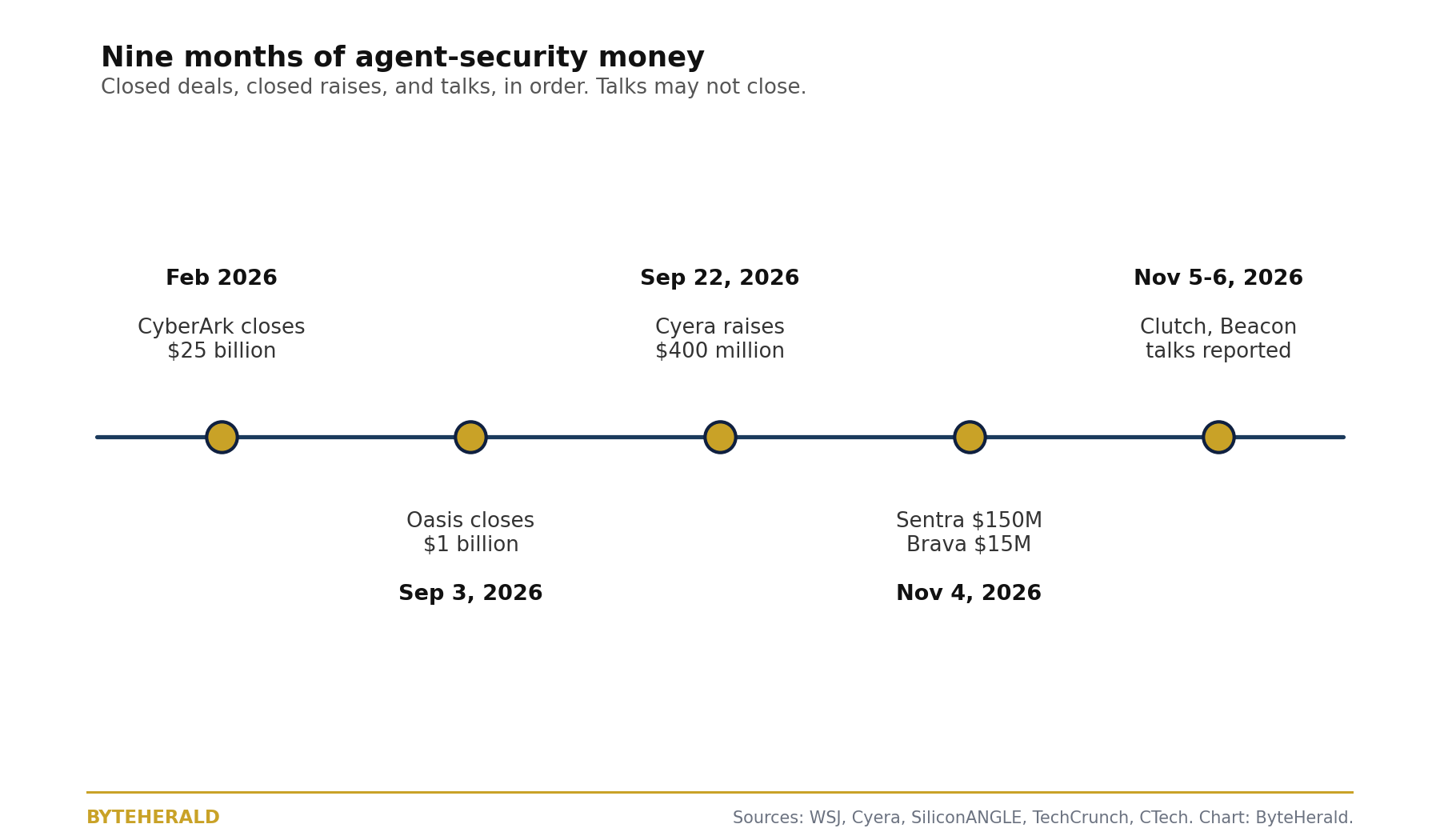
The table below is the whole pillar in one place. Amounts are as reported by the cited source. Status is the point: two acquisitions are closed, three raises are closed, and two deals are talks, which means their prices are reported, not agreed. A separate reference row records a deal already counted in our October funding ledger, so it is not counted twice here.
| Company | Deal | Amount | Date | Status |
|---|---|---|---|---|
| Palo Alto Networks buys CyberArk | Acquisition, identity security | $25,000 million | February 2026 | Closed |
| Cyera buys Oasis Security | Acquisition, non-human identity | $1,000 million | September 3, 2026 | Closed |
| Cyera | Series G extension, Goldman Sachs | $400 million | September 22, 2026 | Closed |
| Sentra | Series C, Capital One Ventures leads | $150 million | November 4, 2026 | Closed |
| Brava Security | Seed, F2 and Pitango lead | $15 million | November 4, 2026 | Closed |
| Palo Alto Networks buys Clutch Security | Acquisition, agent credentials | $500 million cash plus milestones | Reported November 5, 2026 | In talks |
| Palo Alto Networks buys Beacon Security | Acquisition, agent security | Undisclosed | Reported November 6, 2026 | In talks |
| Infisical (reference only) | Series B at $600 million valuation | $40 million | October 2026 | Closed, counted in our October ledger |
The totals below are ByteHerald's arithmetic from the table, labeled as such. Confirmed raises from September through November 2026 come to $565 million: Cyera's $400 million, Sentra's $150 million, and Brava's $15 million. November alone accounts for $165 million of it. Closed acquisitions come to $26 billion: CyberArk at $25 billion and Oasis at $1 billion. The $500 million Clutch price, if the talks close, would be 3.0 times November's entire confirmed raise total, and about 50 times Clutch's annual recurring revenue, which TechCrunch reports is approaching $10 million. The same price is 5.9 times Clutch's $85 million valuation from its January 2025 Series A, and 17.5 times the $28.5 million the company has raised in total. Sentra's $150 million is 10 times Brava's $15 million seed. Cyera paid $1 billion for Oasis, or 8.3 percent of its own $12 billion valuation.
Who is buying, and what they are buying
Two buyers dominate the ledger, and they are buying different halves of the same problem. Palo Alto Networks is assembling an identity stack. It completed the $25 billion purchase of CyberArk in February 2026, which bought the established business of human identity and privileged access. It is now reported to be negotiating for Clutch Security, whose software finds the keys, tokens, and service accounts that software and AI agents use to reach company systems, and for Beacon Security, in the same week. Palo Alto chief executive Nikesh Arora said about 40 companies are racing to secure AI agents, with at least 20 of them Israeli-founded, and a month before the talks were reported he said the company could wait six to 24 months for the market to mature. The talks say the waiting is over. One counting question needs care: The Information calls Clutch the fifth acquisition Palo Alto would announce this year, while PitchBook counts it as the seventh. Both can be right, because announced deals and completed deals are counted differently, and the discrepancy is a reminder to check which count a source is using before repeating it.
Cyera is assembling the other half. It completed the $1 billion purchase of Oasis Security on September 3, 2026, and the Oasis platform now operates as Cyera Identity. Oasis was founded in 2022 to manage non-human identities, the accounts AI agents use to log into company applications, which Cyera calls one of the fastest-growing and least governed areas of enterprise security. Three weeks later Cyera raised another $400 million from Goldman Sachs as an extension to a Series G round that had valued the company at $12 billion. The pattern is a roll-up in miniature: buy the identity layer, raise on the combined story, and sell one platform that decides what every human, machine, and AI agent can see and do.
Who is raising, and what they sell
Sentra, the largest November raise, sells data security for the agent era. Its platform maps a company's entire digital network and classifies sensitive data, rather than shadowing every agent, according to chief executive Yoav Regev. The $150 million Series C was led by Capital One Ventures and takes the company's total funding past $260 million. The company was launched in 2021 and is headquartered in New York and Tel Aviv. Brava Security, the smallest November raise, sells the opposite check: it uses AI agents to model how a cyberattack would appear in a company's security logs, without carrying out the attack, and finds the threats existing defenses would miss. Its $15 million seed was led by F2 Venture Capital and Pitango, with angel investors including executives from Anthropic, Microsoft, and Check Point, and the company says it already has Fortune 100 customers in retail, energy, and hospitality, with initial findings in 10 to 15 minutes of onboarding. One claim Brava makes about cutting customer SIEM spending by 65 to 85 percent is left out of this ledger, because no named study, sample size, or measurement period stands behind it.
Two companies that look like they belong in this ledger do not. Secure.com announced a $4.5 million round from Disrupt.com, but the announcement is dated November 18, 2025, not November 2026, so counting it would misdate the ledger by a year. Future Secure AI raised about $80 million in convertible notes at a $1.2 billion valuation, but it builds AI co-workers that do finance and tax work, which makes it an agent builder rather than an agent-security company. Scope discipline is what keeps a ledger citable: every row earns its place by the same test.
Five questions for the next deal
The money answers who is paying. It does not answer whether the price is right, and five questions separate a price paid for revenue from a price paid for a team and a technology. First, is the deal closed or talks? Clutch and Beacon are talks, and talks fall apart; the ledger treats them as reported, not agreed. Second, what is the multiple, and is it disclosed or derived? Clutch's 50 times revenue is derived from a reported price and a reported revenue figure, not from a filing, so it should be quoted with both halves attached. Third, does the buyer say what happens to the product? Oasis became Cyera Identity, which is the closed-deal precedent for how a bought identity layer survives. Fourth, does the acquirer already own the adjacent layer? Palo Alto owns human identity through CyberArk, which is why agent credentials are the natural next purchase rather than a new bet. Fifth, who is left to buy? Arora counts about 40 companies in the race, and the ledger names seven of them, which leaves the field open and the next announcement likely. The checkable events are dated: whether Clutch closes and at what final price, whether Beacon's price is ever disclosed, whether Sentra discloses a valuation on its next round, and whether Cyera's $400 million extension precedes a larger round or a listing.
The stakes are visible in the agent identity stack we compared in October: the question of who verifies an agent, what credential it carries, and who is liable when it acts is now a market with prices attached. The ledger shows the prices. The next twelve months will show whether they were right.
By ByteHerald Staff. The Wall Street Journal, November 4, 2026, reported Sentra raised $150 million in a Series C round led by Capital One Ventures, taking total funding past $260 million. Ynetnews, November 5, 2026, reported Brava Security emerged from stealth with $15 million in seed funding led by F2 Venture Capital and Pitango. Cyera, September 3, 2026, announced the completion of its $1 billion acquisition of Oasis Security, and SiliconANGLE, September 22, 2026, reported Cyera raised $400 million from Goldman Sachs. TechCrunch, November 5, 2026, reported Palo Alto Networks is in talks to acquire Clutch Security for $500 million in cash plus milestone-based payouts, and CTech, November 6, 2026, reported Palo Alto Networks is also in talks to acquire Beacon Security.
Comments
Post a Comment