YC Labs, an AI research project run by the start-up accelerator Y Combinator, ran 50 AI agents in a set of adversarial games and found that coordination, not raw skill, decided the outcomes. The experiment is not a benchmark, and it is not a preview of a product. It is a test of what happens when many agents must work together under pressure, and the results challenge a simple assumption: that better individual models automatically make better teams.
How the experiment was designed
YC Labs set up two games that pull in opposite directions. Bed Wars, a team mode in the sandbox game Minecraft, rewards building defences, gathering resources, and launching coordinated attacks. Mindustry, a factory-building and tower-defence game, rewards logistics, supply chains, and holding territory against waves of enemies. In both games, a team that splits up without a plan will lose to a team that agrees on roles, even if the uncoordinated team has faster individual players.
The project fielded 50 agents in total, split into two rivalries. In one rivalry, 20 agents powered by OpenAI's GPT model faced 20 agents powered by Anthropic's Claude model. In the other, five GPT agents faced five Claude agents. The design matters because it tests the same question at two scales. A five-agent team can be coordinated by a single leader. A 20-agent team cannot, and must develop a hierarchy, or a shared plan, or it will fall apart.
What the games actually showed
Across 16 games, GPT teams won 12 and Claude teams won four. That headline needs its own table, because the split was not even across the two games. GPT swept the logistics game and split the combat game.
| Game | GPT wins | Claude wins | Games played |
|---|---|---|---|
| Bed Wars | 6 | 3 | 9 |
| Mindustry | 6 | 1 | 7 |
| Combined | 12 | 4 | 16 |
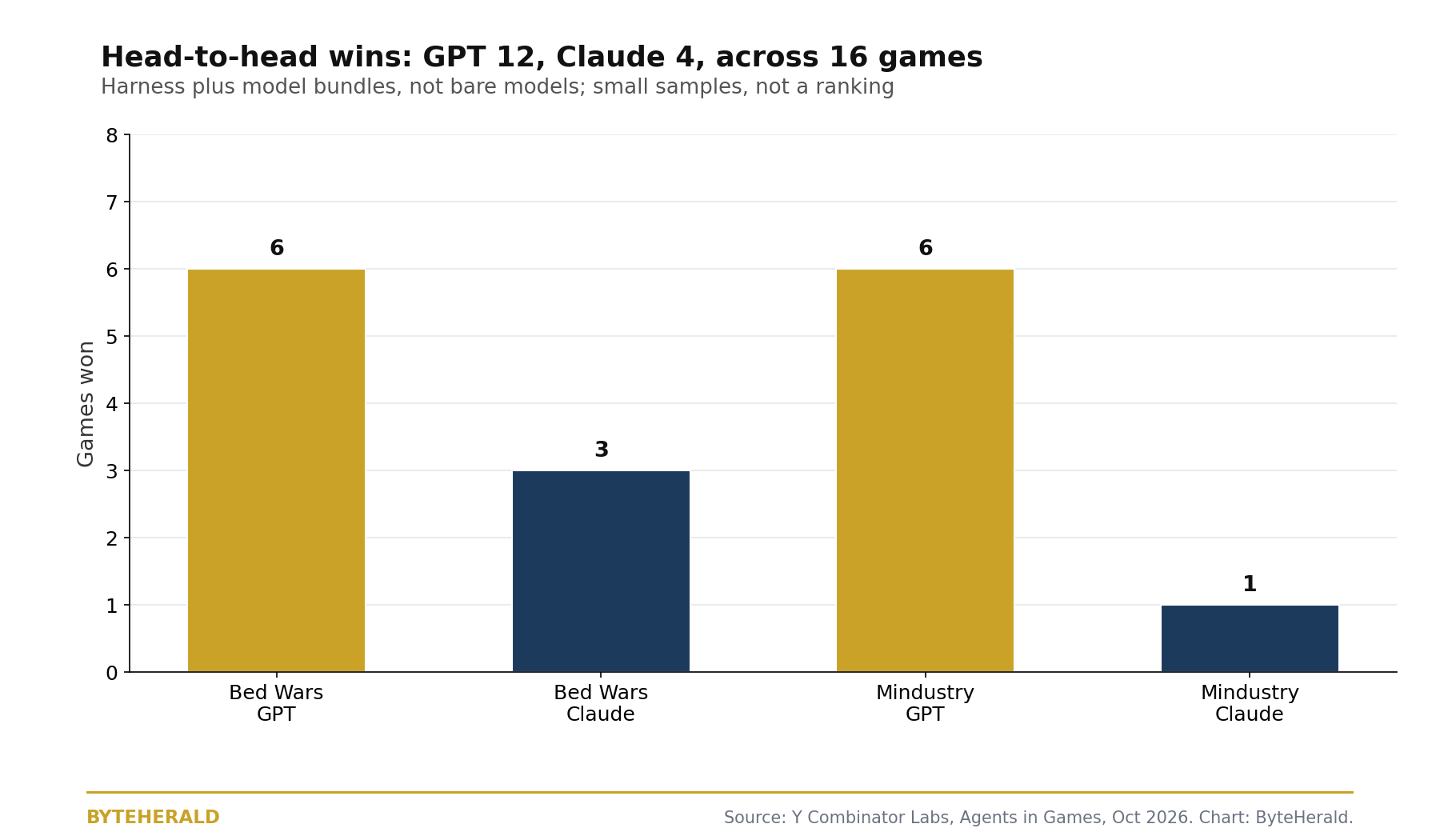
In Bed Wars, Claude's teams could win individual fights but struggled to turn fights into a match plan. In Mindustry, the gap widened, because the game punishes a team that cannot keep its supply lines running while also defending. GPT's teams built more coherent factories and kept them running under attack, while Claude's teams, according to YC Labs' write-up, produced more fragmented plans that broke down when the game state changed.
The lesson is coordination, not model quality
The most interesting finding is not who won. It is how the winning teams won. GPT's teams did not win because individual agents were faster or smarter in every encounter. They won because they stayed coordinated when the game changed. When a defence fell, or a supply line broke, GPT's teams re-planned as a group, reassigned roles, and kept a shared picture of what needed doing next. Claude's teams, by contrast, tended to keep following their original plan, or to fragment into small groups that each solved a local problem while the overall position collapsed.
That pattern shows up in real multi-agent systems too. A team of agents that cannot agree on who does what will duplicate work, overwrite each other's changes, and waste time on tasks that no longer matter. A team that can re-plan will look less impressive in a single step, because it spends time communicating, but it will finish the job. YC Labs' experiment makes that trade-off visible, because games punish coordination failure immediately, in a way that a normal benchmark, which tests one agent on one task, never does.
| Failure mode | What it looked like in the games | What it looks like in real agent teams |
|---|---|---|
| Fragmented planning | Small groups solved local problems while the overall position collapsed | Agents duplicate work or overwrite each other's changes |
| Stale plans | Teams kept following an original plan after the game state changed | Agents keep working on tasks that no longer matter |
| Weak re-planning | Teams did not reassign roles when a defence fell or a supply line broke | No shared picture of what needs doing next |
| Communication cost | Coordinated teams spent time communicating instead of acting | Teams that communicate look slower per step but finish the job |
What the experiment does not show
Games are not workplaces, and 16 games is a small sample. A team that wins at Bed Wars has not proved it can write software, run a factory, or manage a supply chain. The agents also played with tools, interfaces, and rules built for this experiment, so a different setup, with different prompts, different model versions, or different game settings, could change the result. The experiment also compares two model families at one point in time, so it does not settle which family is better in general, only which teams coordinated better in these games, on these days, under these rules.
That limit is also the point. If coordination is the deciding factor, then the right question for a multi-agent project is not which model scored highest on a single-agent benchmark. It is how the team shares information, how it resolves disagreements, and how it re-plans when the world changes. A project that tests only individual skill will miss the failure mode that actually breaks multi-agent systems in production.
An evergreen explainer: why multi-agent teams fail
Multi-agent systems fail in three predictable ways. First, they fail by fragmentation, when each agent optimises its own task and no one owns the whole. Second, they fail by staleness, when agents act on old information because no one told them the plan changed. Third, they fail by communication overload, when agents spend so much time updating each other that they never act. Good multi-agent design is a balance between those three failures, not a way to eliminate all of them at once. A hierarchy helps, because a leader can resolve disagreements, but a hierarchy also creates a bottleneck. A shared plan helps, because everyone works from the same picture, but a shared plan must be updated, or it becomes stale.
YC Labs' games make those trade-offs concrete. A 20-agent team cannot be run like a five-agent team, and a team that communicates well will look slower in the short term and stronger in the long term. That is a useful rule for anyone building agent teams, whether the team writes code, manages logistics, or plays a game.
ByteHerald's earlier scorecard compared five coding assistants on the same tasks, and the same lesson applies: a single-agent score does not predict team performance. ByteHerald also tracked DeepSeek's 400 million dollar robot bet, a reminder that the race to build capable agents is also a race to build teams of agents that can work together.
What to watch next
Three follow-ups will show whether this experiment becomes a useful benchmark or stays a one-off demonstration. First, whether YC Labs repeats the experiment with more games, more teams, and different model versions, so the result is not a single 16-game sample. Second, whether other labs publish their own multi-agent game results on the same games, with the same rules, so teams can be compared fairly. Third, whether the coordination techniques that won in games, such as shared plans and role reassignment, transfer to real tasks like software development, where the stakes are higher and the feedback is slower. Until then, the lesson to keep is the simple one. In a swarm, coordination is the product, and individual skill is only the starting point.
By ByteHerald Staff. YC Labs, an AI research project run by Y Combinator, reported in 2026 that it ran 50 agents in adversarial games, with 20 GPT agents facing 20 Claude agents in one rivalry and five GPT agents facing five Claude agents in the other, across nine Bed Wars games and seven Mindustry games. GPT teams won 12 games and Claude teams won four, with Bed Wars split six to three and Mindustry split six to one, and YC Labs' write-up attributed the difference to coordination and re-planning under changing game conditions, not to individual agent speed alone.
Comments
Post a Comment