Companies are using more AI than ever, and they are not spending more on it. That is the finding in a new report from Ramp, the expense-management firm that tracks corporate card spending, reported by TechCrunch on November 6, 2026. Token spending grew just 1.5 percent across August and September combined, after growing 42 percent in July alone. The stall arrives as Anthropic prepares for an initial public offering, and Bloomberg reported the same day that the company's potential valuation has fallen from about $2 trillion in early October to between $1.2 trillion and $1.3 trillion.
The stall, in numbers
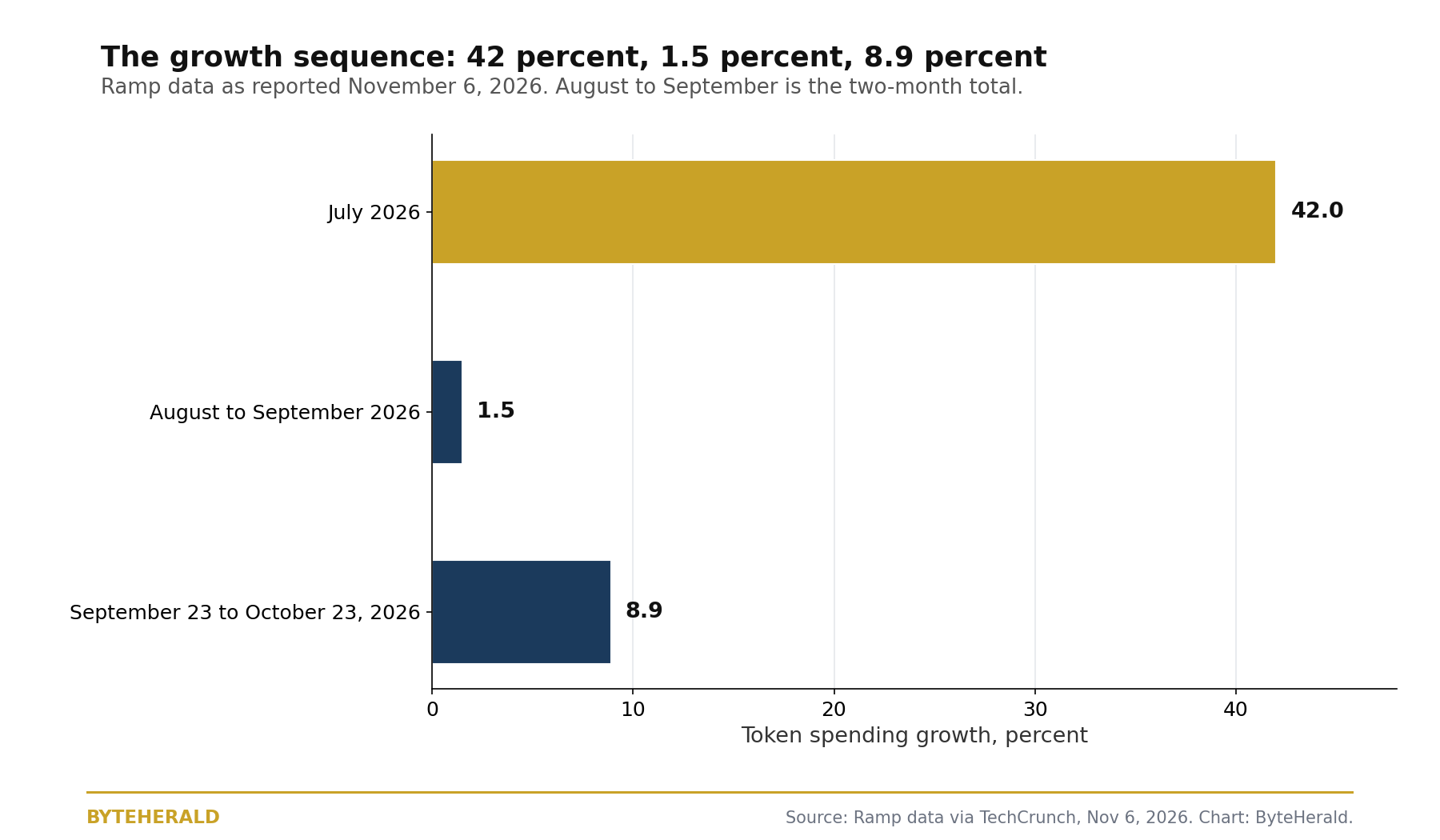
Ramp's data covers the spending its corporate customers put on cards, which makes it a window into real budgets rather than a survey of intentions. The sequence is the story. In July, token spending grew 42 percent from the previous month. Across August and September together, it grew 1.5 percent. The heaviest users stuttered first: the top 1 percent of firms, the most AI-committed companies Ramp tracks, spent just below the $10,000 per employee per month they had reached at their summer peaks. Ramp's lead economist, Ara Kharazian, told TechCrunch that a slowdown among that cohort alone is sufficient to slow revenue entirely, even while volumes keep rising, because the top 1 percent carries so much of the total.
The rest of the market did not make up the difference. Median firms spend $12 to $15 per employee per month on AI, and the top 10 percent spend $600 to $1,000. Both groups grew, but from bases too small to offset the top 1 percent. The gap between the tiers is the shape of the market: the top 1 percent spends about 667 to 833 times what the median firm spends per employee, by ByteHerald's arithmetic from Ramp's figures. Almost all AI spending comes from venture-backed, high-growth technology companies, Kharazian said, which concentrates the risk. If that cohort slows together, the slowdown arrives everywhere at once.
| Period | Token spending growth | What it means |
|---|---|---|
| July 2026 | Up 42 percent month on month | Hypergrowth pace |
| August to September 2026 | Up 1.5 percent across both months | Flat, after the July surge |
| September 23 to October 23, 2026 | Up 8.9 percent | Re-acceleration, but from a flat base |
Why spending stalled while usage rose
The stall is not a demand problem. Token volumes kept rising. The money stopped rising because the price of a token fell and buyers got better at spending less. OpenAI halved API prices for GPT-6 Sol and GPT-6 Luna in September. Anthropic cut prices for Fable 5.1 and Opus 5.5, and said in a recent filing that the cuts reduced its revenue growth by about $600 million. Both companies have also been offering enterprise discounts meant to lock in spending, which in practice cut into their own revenue targets. The result, in Kharazian's words, is a buyer's market.
Competition is doing the rest. Meta and Nvidia are introducing enterprise offerings built on cheap or open models, and open-model companies from China and the United States are pressing prices down from below. A lightweight routing tool called Jev, which picks between a few predetermined outputs for simple jobs, is now among the top performers on Ramp's platform, because many AI jobs only need a yes or no answer. Companies are also getting thrifty on their own: they set defaults that keep expensive models away from long-running tasks, impose budgets on employees, and route work from standard models to even cheaper light models. Notion co-founder Akshay Kothari posted internal data that matched Ramp's findings, summarizing the pattern as tokens rising while costs fall.
What the valuation cuts say
The market has already repriced the story. Anthropic's potential valuation fell from about $2 trillion in early October to $1.2 trillion to $1.3 trillion, a drop of 35 to 40 percent by ByteHerald's arithmetic, and the company is expected to receive a high junk credit rating, according to Bloomberg's reporting. OpenAI lowered its proposed valuation from $1.4 trillion to $1.25 trillion and cut its latest fundraising goal by about $10 billion, a cut we reported on October 31, 2026, when the target fell from $30 billion to $20 billion. The $600 million revenue-growth hit Anthropic disclosed is about 3.5 percent of one quarter's revenue, by ByteHerald's arithmetic from the $16.956 billion Anthropic reported for the third quarter of 2026 in the same filing we examined in detail. A 3.5 percent hit is not a collapse, but it arrives in the quarter when the company is asking public investors to price its future growth.
The test that could prove this wrong
October's numbers are the counter-signal, and they deserve more weight than a footnote. Token spending rose 8.9 percent from September 23 to October 23, which could be the start of a re-acceleration rather than a pause inside a stall. Kharazian's own view is that the headwinds on spending growth are strong, and that the era of hypergrowth may be over, but a single month does not settle it. The other caveat is the sample: Ramp's data reflects its own customers' card spending, a real but partial view of corporate AI budgets, not a census of the market. A reader judging this story should watch three numbers. First, whether November holds October's pace or falls back toward the August-September flatline. Second, whether the top 1 percent cohort returns to $10,000 per employee per month or stays below its peak. Third, whether Anthropic's IPO pricing, when it lands, reflects the $1.2 trillion to $1.3 trillion range or recovers toward $2 trillion. The hope among investors is that a new use case arrives, the way AI coding did about eighteen months ago, and restarts the growth. Kharazian is skeptical that personal agents will do it, calling them not as economically productive as coding. On what can be observed today, he said, AI spending has started to slow down. The data supports the narrower claim: usage is up, and the money has stopped following it.
By ByteHerald Staff. TechCrunch, November 6, 2026, reported Ramp data showing AI token spending grew 1.5 percent across August and September after growing 42 percent in July, with the top 1 percent of firms spending just below $10,000 per employee per month. Bloomberg, November 6, 2026, reported Anthropic's potential valuation fell from about $2 trillion in early October to between $1.2 trillion and $1.3 trillion. Anthropic's Form S-1/A filed November 2, 2026, reported third-quarter revenue of $16.956 billion and disclosed that pricing cuts reduced revenue growth by about $600 million.
Comments
Post a Comment