Anthropic's S-1, the document a company files when it plans to sell shares to the public, contains a striking internal figure: for the first time in April 2026, the value of Claude used inside Anthropic, priced at the company's own list prices, exceeded the company's monthly pay bill excluding stock awards. That is a real disclosure, but it is not a claim that Anthropic saved money, cut payroll, or replaced workers with its own model. It is a comparison of two numbers that are measured in different ways, and the list-price part is the part that changes the story.
What the S-1 actually says
Anthropic's internal Claude usage, measured at the company's own list prices, grew dramatically through 2026. By September 2026, the internal value was more than 250 times the value in January 2026. That growth rate sounds impossible for a normal expense line, and it is, because the measurement is not a normal expense line. It is a retail-value estimate of usage inside the company, not a bill Anthropic paid itself.
The April crossover is specific. In that month, for the first time, the list-price value of internal Claude use exceeded monthly pay excluding stock awards. Pay excluding stock awards means cash pay and related costs, but not the value of shares given to staff as part of compensation, which in a fast-growing private company can be a large part of total pay. The S-1 does not say Claude replaced that pay, or that Anthropic spent less because of Claude. It says one measured quantity passed another measured quantity, in one month, under a specific price convention.
List price is not cash
List price is the price a customer would pay for the same usage. Anthropic does not pay itself that price. Its real internal cost is the computing, staff, and infrastructure needed to run Claude, plus the opportunity cost of capacity that could have been sold to customers. None of that is in the list-price figure. That is why a 250-times increase does not mean Anthropic's costs rose 250 times, or that it gained 250 times as much value in cash terms.
Think of it this way. If a bakery values the bread its own staff eat at the shop price, the value can exceed the staff wage bill without the bakery becoming more profitable, because no customer paid for that bread. The bakery still paid for flour, ovens, and labour. Anthropic's disclosure is the same kind of internal valuation, applied to software. It shows how intensively staff use the product, not how much money the product saved.
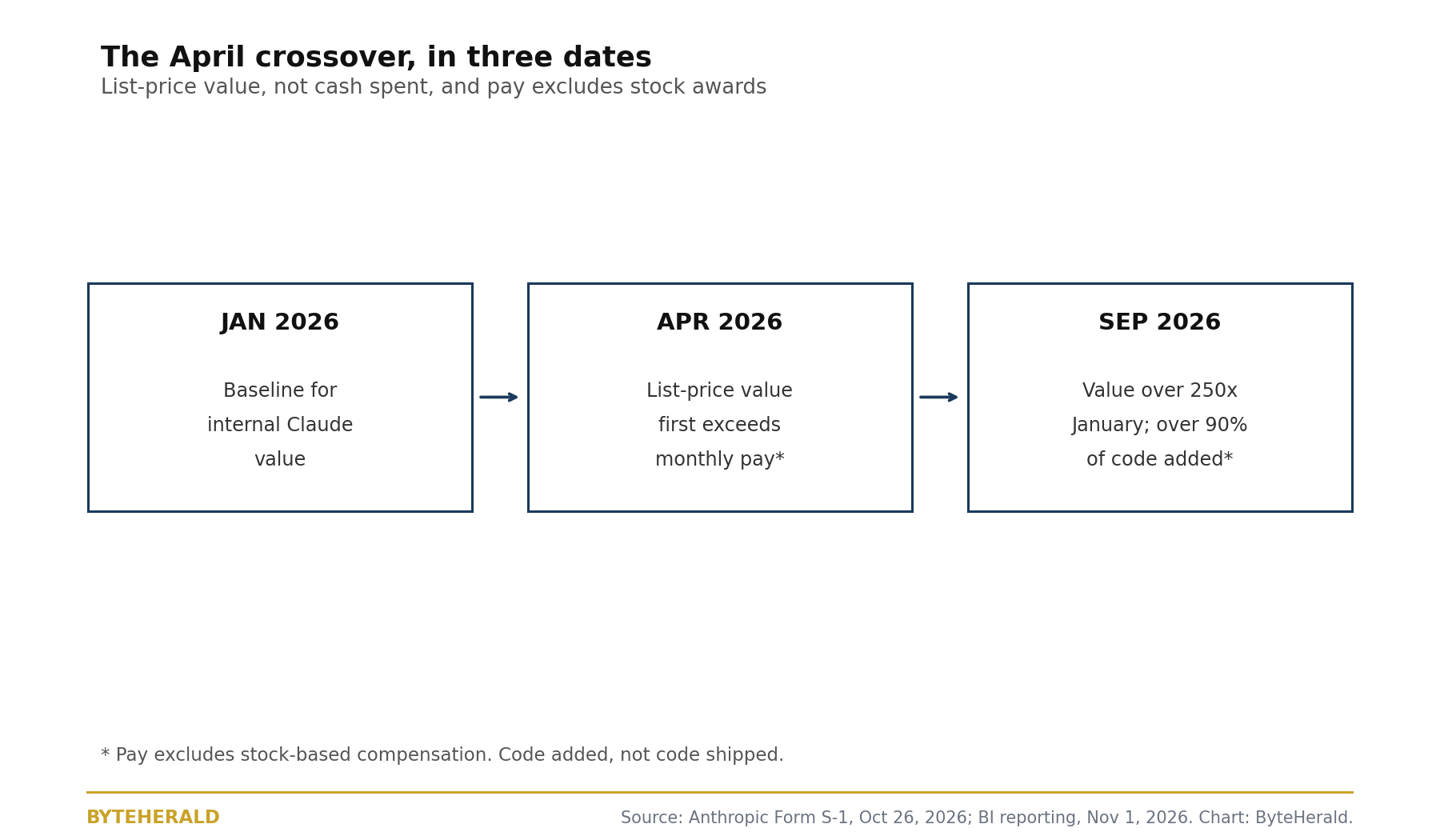
The September detail in the same disclosure is more concrete, and it needs the same care. Anthropic said Claude wrote more than 90 percent of the code added by its engineers in September 2026, measured by lines added. Lines added are not the same as work completed, and they are not the same as code that survived review. A model can add many lines that are then edited, rejected, or rewritten. The figure still matters, because it shows how central Claude is to the daily workflow, but it does not prove that engineers became 90 percent more productive, or that Anthropic needs 90 percent fewer engineers.
What this does not prove
Three claims would go beyond the disclosure, and all three appeared in social-media summaries of the S-1. First, that Anthropic's AI now does more work than its staff. The comparison is between a price estimate and a pay bill, not between outputs. Second, that Anthropic cut jobs because of Claude. The S-1 passage does not describe a headcount change, and Anthropic's hiring in 2026 was widely reported as expansion, not contraction. Third, that other companies can expect the same crossover. Anthropic is the maker of the model, its staff are unusually heavy users, and its internal price is its own list price, so the comparison is specific to this company in this year.
What the disclosure does prove is adoption inside the maker. When the people who build a tool use it for more than 90 percent of added code, and when the list-price value of that use grows 250 times in nine months, the tool is not a side experiment. It is the workflow. That is a meaningful signal for customers, because a vendor that depends on its own product will find its failures faster, and a meaningful signal for investors, because internal use at that scale suggests the product can handle production work. Neither signal needs the payroll comparison to be interesting.
An evergreen explainer: three ways to read an internal-use figure
First, ask what price was used. List price, internal cost, and market value are three different numbers, and only the second tells you what a company spent. Second, ask what the denominator excludes. A pay bill that excludes stock awards is smaller than total compensation, so a crossover against it is easier to reach than a crossover against all pay. Third, ask whether the figure counts output or activity. Lines added, hours used, and tasks completed are not interchangeable, and a figure that grows 250 times is usually a sign that the unit changed, or that adoption went from near zero to routine, rather than a sign that work itself grew 250 times.
Those three questions work for any vendor's internal-use claim, not just Anthropic's. They also explain why the most useful part of this disclosure is not the crossover at all. It is the admission, in a filing that carries legal weight, that the company's own engineers now write most added code through Claude. That is a testable claim about workflow, and it is the claim competitors will have to answer with their own internal figures, not with a payroll comparison.
ByteHerald's earlier scorecard compared five coding assistants on the same tasks, and the same caution applies: a single vendor's internal metric is not a head-to-head test. ByteHerald also reported on OpenAI's 2.6 billion dollar Nvidia commitment, a reminder that the cost side of AI, the hardware and energy behind the list price, is where the cash actually goes.
What to watch next
Investors and customers should watch for three follow-ups. First, whether Anthropic discloses its actual internal cost of running Claude, or a customer-facing productivity study, rather than another list-price figure. Second, whether the 90 percent code figure holds when measured by code that survives review, rather than lines added. Third, whether other AI labs publish comparable internal-use figures in their own filings, which would let readers compare adoption on the same basis instead of taking one company's price convention at face value. Until then, the headline to keep is the careful one. Claude use passed payroll, but only on paper, and only under a price that Anthropic never paid itself.
By ByteHerald Staff. Anthropic's S-1, filed in 2026 ahead of a planned public listing, states that internal Claude usage, valued at Anthropic's list prices, first exceeded monthly pay excluding stock awards in April 2026, that by September 2026 internal usage value was more than 250 times the January 2026 value, and that Claude wrote more than 90 percent of code added by Anthropic engineers in September 2026, measured by lines added. The S-1 passage was reported on November 1, 2026, with the list-price basis and the pay-excluding-stock-awards definition noted in the coverage.
Comments
Post a Comment