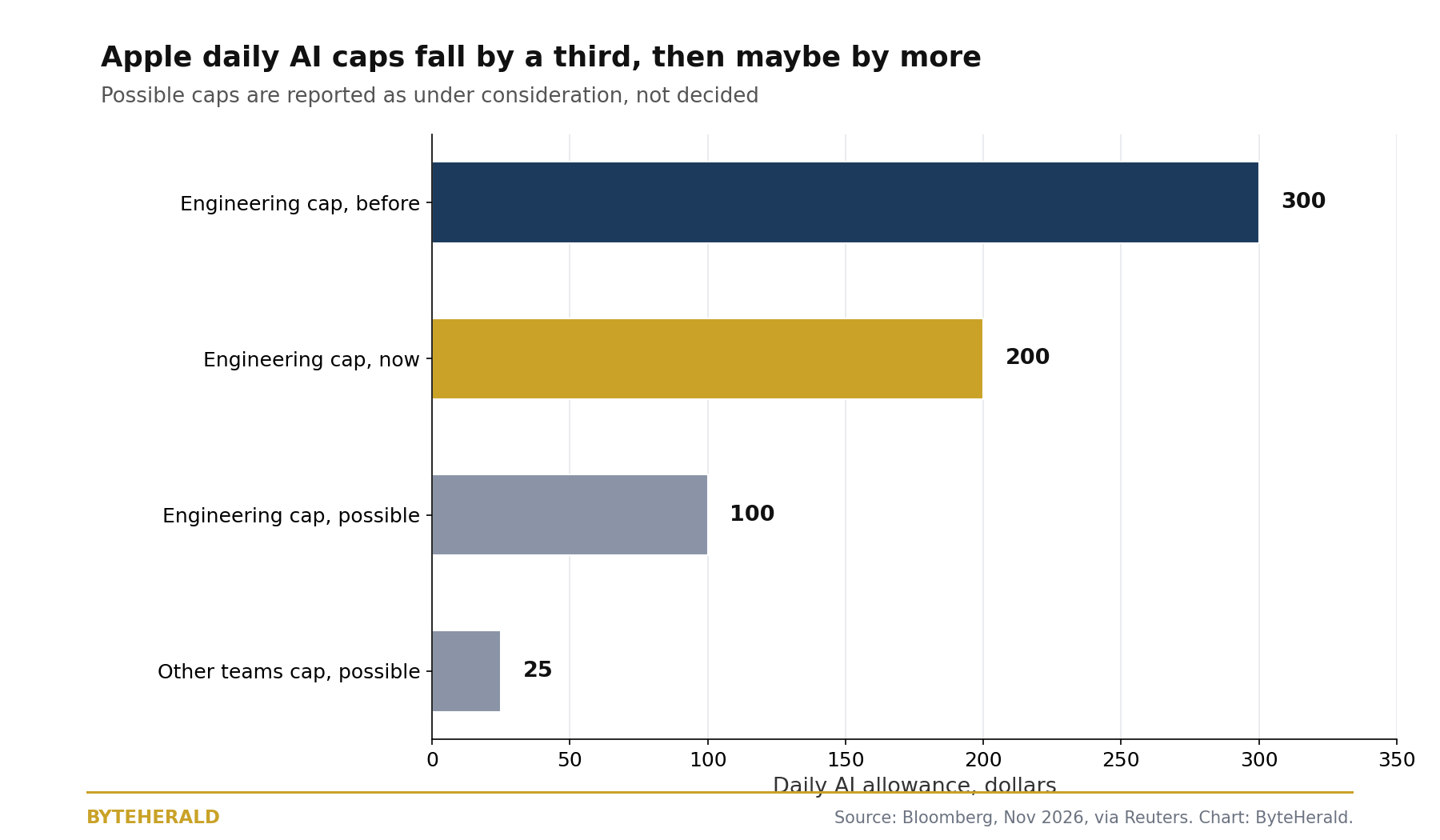
Apple cut the daily AI spending allowance for some of its engineers from 300 dollars to 200 dollars in October 2026, Bloomberg reported on November 4, 2026, and is considering further cuts to 100 dollars for some engineering teams. The cut is real, but the saving is probably smaller than the headline suggests, because Bloomberg's sources said few workers were using their full 300 dollar daily allowance. A ceiling above what people actually spend can fall a long way before it changes what they spend.
What Bloomberg reported, and what is still only considered
According to Bloomberg, as reported by Reuters on November 4, 2026, Apple last month cut the daily AI spending allowance for some engineers to 200 dollars from 300 dollars, as part of a broader effort to rein in costs even as it seeks to expand AI use across its operations. The company is considering further reductions for some engineering teams, potentially lowering daily limits to 100 dollars. Some non-engineering groups already operate under a 100 dollar daily cap, which could be reduced to as little as 25 dollars for some teams. Employees who need greater access would be able to seek exemptions from senior executives. The budgets cover AI tokens, the units of data processed by models such as OpenAI's ChatGPT, Anthropic's Claude, and Google's Gemini. Apple did not immediately respond to a Reuters request for comment, and it is not clear which tools the new limits affect.
The distinction between decided and considered is the whole story for anyone planning around these numbers. The 300 to 200 dollar engineering cut happened in October. The 100 dollar engineering figure and the 25 dollar non-engineering figure are cuts under consideration, not cuts already made, and they apply to some teams, not to every employee. Reporting on the story also says Apple is asking some teams to use less expensive models or shift work to models running directly on their devices, and that employees who need a bigger budget can ask executives for an increase. A team that reads the possible figures as current policy will overstate the cut by a factor of two to eight.
The cap math, done honestly
Daily caps sound small until they are annualised, and annualised caps overstate actual spending just as surely. At 250 working days a year, a 300 dollar daily cap is worth 75,000 dollars per person per year, a 200 dollar daily cap is 50,000 dollars, a 100 dollar cap is worth 25,000 dollars, and a 25 dollar cap is worth 6,250 dollars. Those are ByteHerald arithmetic on the reported caps, not Apple spending figures. The October cut therefore lowers the ceiling by 25,000 dollars per engineer per year in cap value, a 33 percent cut in the ceiling. But a ceiling is not a bill. If few engineers approached the old 300 dollar limit, as Bloomberg's sources said, then the actual saving from lowering it is a fraction of that 25,000 dollars, and Bloomberg did not report an actual saving figure. Any article that multiplies the cap cut by Apple's headcount and calls the result a saving is inventing a number Apple never gave.
Why a company that spends more on AI would cap AI spending
The apparent contradiction dissolves once the two kinds of spending are separated. Apple's research and development spending climbed 32 percent in fiscal 2026 to 45.8 billion dollars, driven partly by AI and infrastructure, while total operating expenses rose 22 percent to 75.5 billion dollars, according to reporting on Apple's annual report, filed November 3, 2026. That is company-level investment in building AI capability. The daily caps are employee-level consumption of outside AI services, charged per the token. A company can rationally increase the first while disciplining the second, especially when the second is metered by outside vendors and the first includes its own models running on its own devices, which cost far less per token at the margin.
The same week Apple disclosed the other side of this coin in its own filing. Apple's Form 10-K, filed November 3, 2026, warned investors that AI agents may act without authorization, conceal actions, and take steps that may be difficult or impossible to reverse, which is a governance warning about agent autonomy, not a budget line. Read together, the filing and the caps describe one posture: Apple wants AI used widely, under controls it sets, with costs it can see. The caps are the cost control, the filing language is the risk control, and neither by itself shows Apple retreating from AI.
The wider pattern: tokenmaxxing meets the budget
Apple is not the first company to discover that unlimited token enthusiasm has a price. Reporting on the trend describes a year of tokenmaxxing, the practice of consuming as many AI tokens as possible, often treated as a measure of productivity, as coding agents such as Claude Code, OpenAI Codex, and Cursor became popular. Bloomberg recently reported that Goldman Sachs restricted access to some AI coding tools following a review of productivity and risk management, and Accenture reportedly reduced its centrally funded Claude allowance to 29 dollars per employee per month, with additional spending covered by individual projects or teams. Against that scale, Apple's 200 dollar daily engineering cap is still generous: it equals 6,000 dollars for a 30-day month, more than 200 times Accenture's reported monthly central allowance, though the two figures cover different tools and different rules, so the comparison shows the range of corporate responses, not a ranking.
The enterprise lesson from this pattern is the same one our earlier reckoning with enterprise AI pullback data drew from survey evidence: the question is not whether AI tools are used, but whether each unit of use earns its cost. Caps force that question per employee per day, exemptions keep it from becoming a ban, and cheaper or on-device models change the price of the answer. What to watch next is concrete: whether exemption requests surge, which would show the new caps binding real work; whether teams actually shift to cheaper or on-device models; and whether Apple confirms any of the considered figures. Until one of those happens, the correct summary is narrow: one confirmed cut, two considered cuts, and a saving nobody has quantified.
What this means for teams outside Apple
For a team setting its own AI budget, Apple's numbers are a useful ceiling test, not a target. If a team's daily AI spend per engineer is far below 200 dollars, Apple's cap debate is irrelevant to it, and the binding question is output quality, not token volume. If a team's spend approaches that level, the Apple pattern suggests three controls in order: cheaper models for routine work, on-device models where the hardware allows it, and an exemption path for genuinely heavy work, so the cap disciplines waste without blocking the few jobs that need scale. A cap without an exemption path is a productivity tax. A cap with an easy exemption path is decoration. Apple's version, as reported, has an exemption path through senior leadership, and whether that path is fast or bureaucratic will decide which of those two it is.
By ByteHerald Staff. Bloomberg, November 4, 2026, as reported by Reuters, reported that Apple last month cut the daily AI spending allowance for some engineers to 200 dollars from 300 dollars, is considering further reductions to 100 dollars for some engineering teams, said some non-engineering groups already face a 100 dollar cap that could fall to 25 dollars for some teams, and said employees needing greater access could seek exemptions from senior executives. Apple, November 3, 2026, filed its Form 10-K for the fiscal year ended September 2026, with research and development expenses of 45.8 billion dollars, up 32 percent, as reported from the filing. Bloomberg, November 2026, also reported that Goldman Sachs restricted access to some AI coding tools after a review of productivity and risk review, and Accenture's reported 29 dollar monthly centrally funded Claude allowance. 9to5Mac, November 4, 2026, reported the tokenmaxxing trend, the cheaper-model and on-device guidance to some Apple teams, and Accenture's reported 29 dollar monthly centrally funded Claude allowance.
Comments
Post a Comment