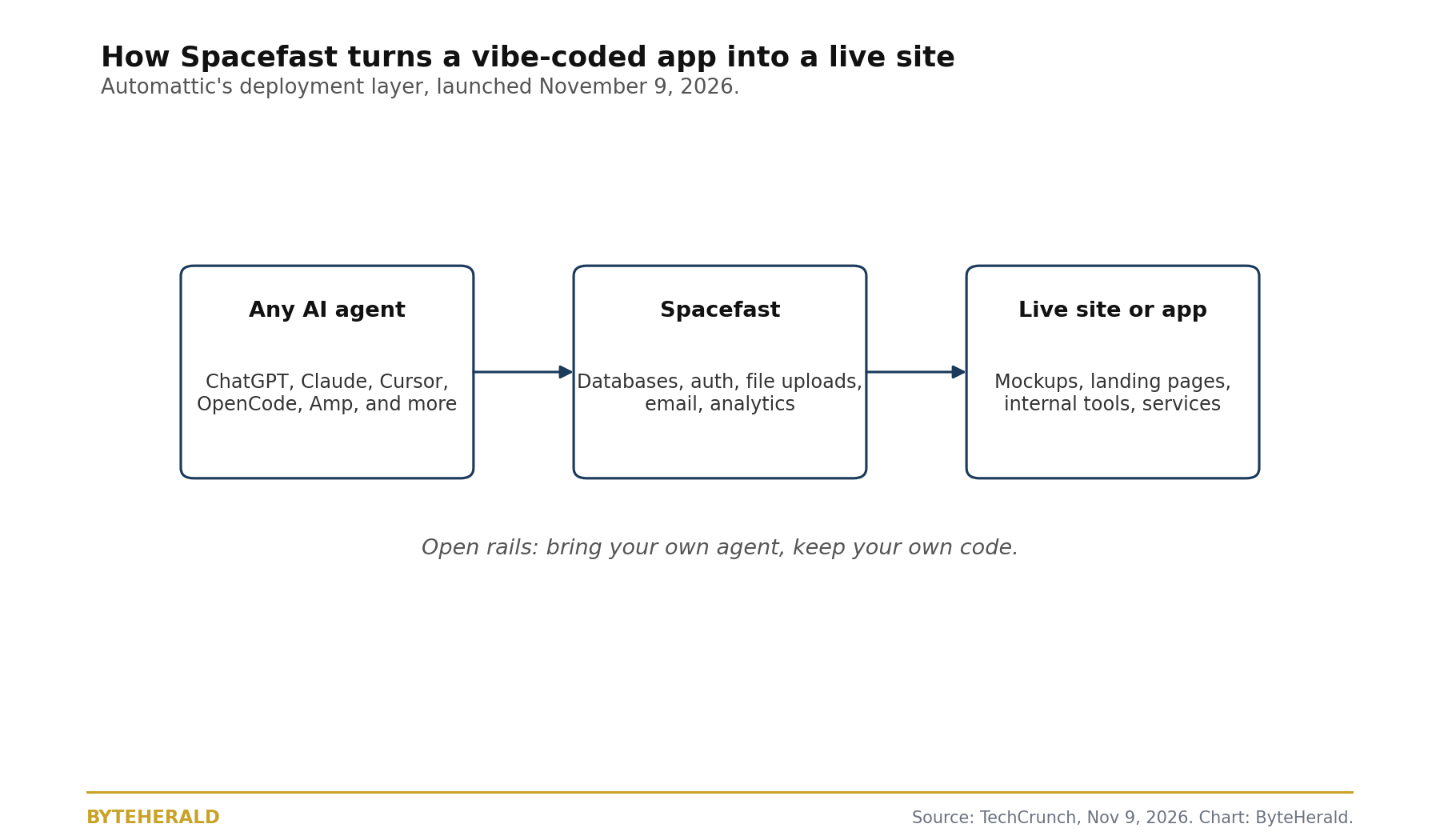
Automattic, the company behind WordPress.com, launched Spacefast on November 9, 2026, a service that deploys vibe-coded websites and apps, and it made an unusual bet for this market: it does not want to be the agent. Spacefast provides the infrastructure that turns AI-generated code into a working site, databases, authentication, file uploads, email, and analytics, and it works with any AI agent the user already likes, from ChatGPT and Claude to Cursor and OpenCode. The company that built the web's most popular content management system is now selling the rails for a web in which people build with agents instead.
Spacefast, launched November 9, 2026, by Automattic, is deployment infrastructure for vibe-coded apps: databases, authentication, file uploads, email, and analytics, usable with any AI coding agent or a Git repository, after a soft launch in September 2026.
Open rails against the all-in-one
Vibe coding means describing an app in plain language and having an AI agent write the code. The problem Spacefast solves is what happens next: a pile of generated code is not a website until it has a database, a login system, file storage, email, and analytics, and wiring those up is the part non-technical users cannot do. Spacefast provides them, and it does so without demanding the user adopt Automattic's agent. Users can connect Spacefast with ChatGPT, Claude, Hermes, OpenClaw, Grok Bot, Muse, Pi, Cursor, OpenCode, or Amp, or they can connect a Git repository to get started. The product is led by Batuhan Icoz, who built it during one of the company's hackathon sprints, after watching non-technical friends send him Vercel links from their vibe-coding experiments and concluding there had to be a better way to deploy them.
The competition is the all-in-one: Lovable and Emergent offer both the interface and the rails, so the user never chooses anything. Spacefast's argument is that choice is the advantage, and the counter-argument, which Icoz acknowledges, is that a certain kind of user would rather have everything figured out for them. Productivity and design software is moving into the same space from the other direction: Figma, Canva, and Notion have launched products that sit at the intersection of vibe coding, mockups, and presentations. Spacefast's answer is that it can add WordPress integration, web analytics, and e-commerce through WooCommerce more easily than a newcomer can, because those products already exist inside Automattic.
| Approach | Who builds the app | Who deploys it | The trade-off |
| Spacefast (Automattic) | Any agent the user picks, or a Git repo | Spacefast, with WordPress and WooCommerce nearby | Freedom to choose, but the user must choose |
| Lovable / Emergent | Their own built-in agent | The same platform, end to end | Nothing to choose, but locked to one agent |
| Figma / Canva / Notion | Their design tools, with AI features | Mockups and presentations first, apps second | Familiar tools, but deployment is not the core |
The enterprise pitch
The enterprise argument is about sprawl, not features. Marketing teams are churning out landing pages on services like Lovable, and IT departments want to consolidate that work with a company that understands enterprise needs. Automattic's pitch is that it already serves enterprise customers, and that Spacefast gives those teams one place to deploy what their marketers vibe-coded, with analytics and e-commerce attached. The early use cases are modest, internal mockups, slideshows, and offer-related websites, which is honest about where the product stands: it soft-launched in September to gather feedback, and the launch is the start of the retention test, not the end of it. Icoz is candid about that too, saying he expects people to churn, since they might not be interested in making apps at all, and that the product has to be so easy, and the results so much better with it, that people stay.
The admission that matters
The most revealing part of the launch is what Icoz says about WordPress itself. People are making websites with ChatGPT or Claude now, he told TechCrunch, and some sites will not need a content management system at all as the web expands. That is the owner of the web's dominant CMS saying, in public, that the CMS is optional for a growing class of sites. The context is a traffic squeeze: many websites and publishers are struggling with dwindling traffic as AI chatbots and summaries answer questions without sending visitors. Spacefast is Automattic's answer to that squeeze: if people will build with agents anyway, Automattic would rather own the deployment layer than watch the work happen on someone else's rails. We priced the building side of this shift last week, ranking 12 framework builds by their AI bill, from 2.67 dollars to 4.97 dollars for the same app; Spacefast is where those builds get deployed, and the deployment layer is the part of the bill nobody has priced yet.
The turbulence behind the launch
Spacefast arrives amid turbulent months at Automattic. The company's board forced chief executive Matt Mullenweg out, but he was back in control within days, the rebel board was eventually replaced, and the interim chief financial officer left within weeks of appointment. In October, TechCrunch reported that the company had begun layoffs across several properties, with more cuts expected. None of that is the product's fault, and none of it makes the product better, but it is the context in which a new platform has to earn trust: a company in transition, asking developers to build on infrastructure it has just launched. The open question is the same one facing every agent platform: who writes the rules for how agents work together, and Spacefast's bet is that the answer is no one vendor, which is why it works with any agent at all.
What to watch
First, whether open beats all-in-one: the users who want to choose their agent against the users who want everything decided for them. Second, retention past launch week, since Icoz himself expects churn and the product's survival depends on being meaningfully easier than deploying without it. Third, whether the WordPress integration and WooCommerce e-commerce features ship, since those are the advantages Automattic claims over Lovable and Emergent. And fourth, whether the enterprise consolidation pitch lands, because that is where the revenue is, and it is also where a new platform has the most to prove.
By ByteHerald Staff. TechCrunch reported on November 9, 2026, that Automattic, the owner of WordPress.com, launched Spacefast, a service to deploy vibe-coded websites and apps with databases, authentication, file uploads, emails, and analytics, that users can connect with agents including ChatGPT, Claude, Hermes, OpenClaw, Grok Bot, Muse, Pi, Cursor, OpenCode, and Amp, or with a Git repository, and that the product soft-launched in September 2026 after being built by Batuhan Icoz during a company hackathon sprint. TechCrunch also reported that the product competes with Lovable and Emergent, that Figma, Canva, and Notion have launched products at the intersection of vibe coding, mockups, and presentations, and that Automattic went through a board dispute that forced chief executive Matt Mullenweg out before he returned within days, followed by layoffs across several properties in October 2026.
Comments
Post a Comment