Citibank changed its terms of service this week to tell customers who hand their bank login to a third-party AI assistant that whatever the assistant does is their problem, even if the tool is hacked and criminals use their account. Citi is the sixth large US bank to rewrite the rules since October, and the third to move this week alone. The six banks that rewrote their terms are not blocking AI. They are deciding who pays when it goes wrong, and the answer, in every case so far, is you.
The liability matrix
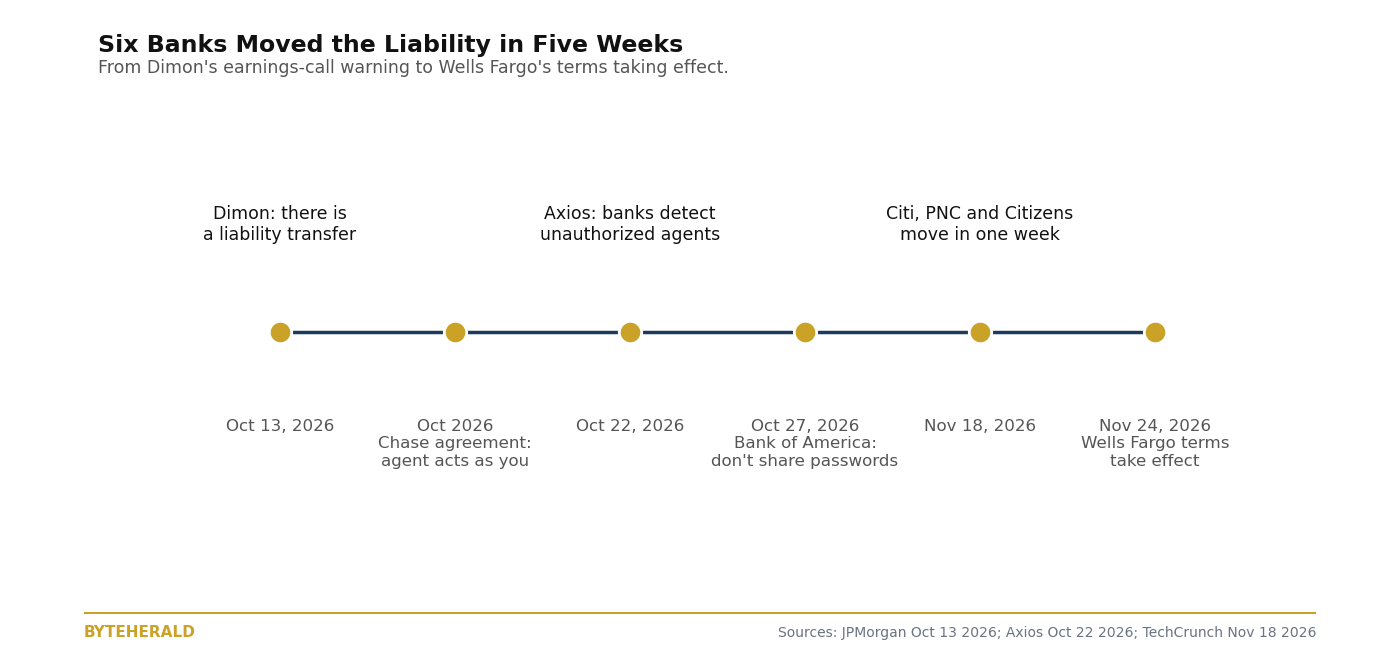
Six banks have now put the same position in writing, in two waves. JPMorgan Chase and Bank of America moved in October, and Citi, PNC, Citizens and Wells Fargo followed in November. Two more, Charles Schwab and Morgan Stanley, are blocking outside agents rather than pricing the risk. The matrix below is the first compiled record of who has moved, what each bank changed, and who pays.
| Bank | What changed | When | Who pays |
| JPMorgan Chase | Digital Services Agreement: the bank will rely on any instructions or actions taken by your agent as if they were taken by you personally, and you are responsible even if the agent performs unintended actions or exceeds the authority you gave it; outside agents blocked from direct account access | October 2026 | Customer |
| Bank of America | Announced a similar policy last month; customers take responsibility for what happens in the account | Late October 2026 | Customer |
| Citibank | Online User Agreement: customers who grant third-party AI tools account access are responsible for activities conducted through those agents, even if the tool leaks credentials or is hacked | Week of November 18, 2026 | Customer, even if hacked |
| PNC | Terms of service changed to address third-party AI tools | November 18, 2026 | Customer |
| Citizens Bank | Emailed customers warning they are on the hook for anything their AI assistant does | Week of November 18, 2026 | Customer |
| Wells Fargo | Online Access Agreement: transactions initiated by a customer's delegates, AI agents included, count as authorized by the customer | Effective November 24, 2026 | Customer |
| Charles Schwab | Blocks agents that use client logins or browser automation | October 2026 | Blocked, no access |
| Morgan Stanley | Began blocking third-party agents | October 2026 | Blocked, no access |
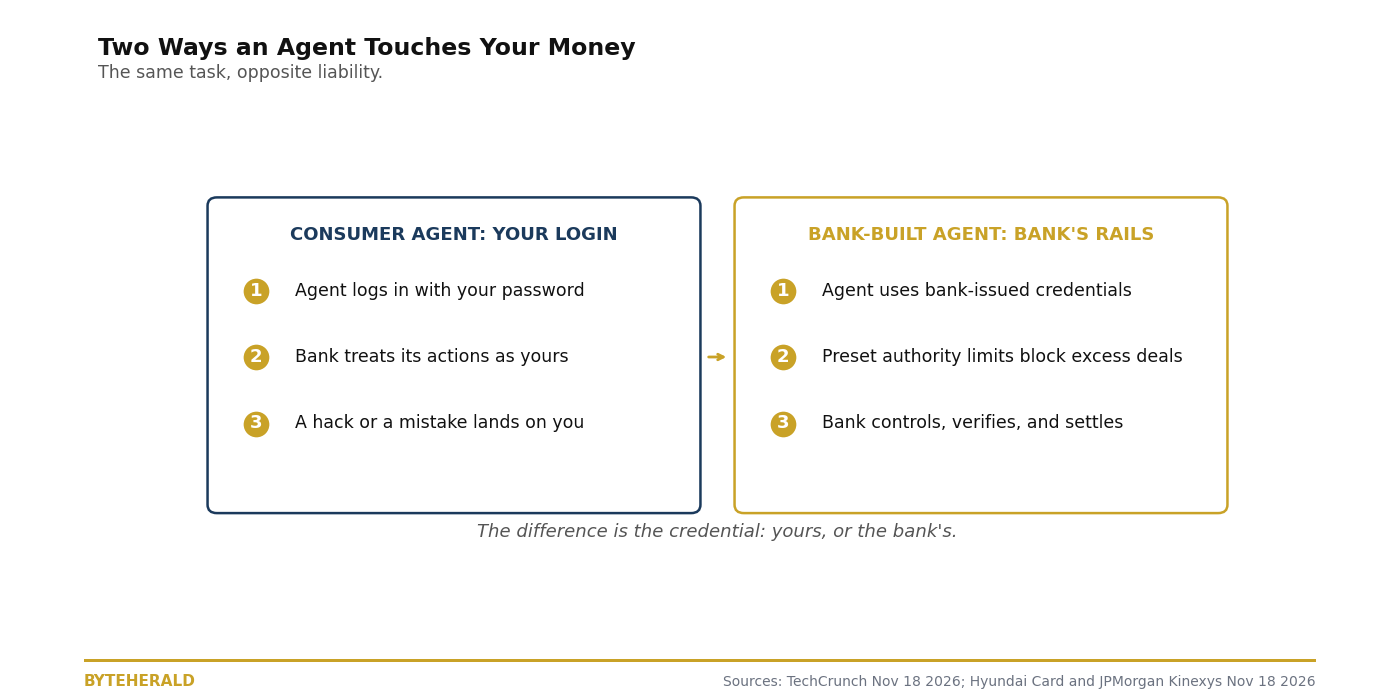
The sharpest detail is Citi's. Most banks tell customers not to share their login, which is advice. Citi's update goes further: if the AI tool leaks your credentials or is hacked, the customer is responsible for anything hackers do with the account. A Citi spokesperson told TechCrunch the bank updated its Online User Agreement to provide greater clarity about the risks and to reinforce that customers who choose to grant account access to third-party AI agents are responsible for activities conducted through those agents. There is also an asymmetry the banks do not hide: Citi's terms note that AI agents the bank itself provides can be used by customers without worrying about additional liability. The bank's own agents come without the extra risk. Everyone else's agents come with it.
The legal hinge: Regulation E
The banks can write what they like into their terms, but for personal accounts there is a federal floor, and the whole dispute turns on one word in it. Regulation E, the rule under the Electronic Fund Transfer Act, caps a consumer's loss at $50 or $500 for an unauthorized transfer, depending on how quickly it is reported. The catch is the definition: a transfer is not unauthorized if it was made by someone the consumer gave access to. The official interpretation is plainer still. If you give someone access and they exceed the authority you gave them, the consumer is fully liable for the transfers unless the consumer has notified the financial institution.
That is the hinge the banks are using. By defining everything an agent does as authorized by you, they take the transaction out of the unauthorized category before a dispute even starts, which means the $50 and $500 caps may not help. One exception cuts the other way: a transfer by someone who got your access through fraud or robbery can still count as unauthorized. Whether an agent that was itself hacked, or tricked into handing over credentials, falls on the fraud side or the authorized side is the question no court has tested yet, and no US agency has publicly weighed in on how Regulation E treats an agent's actions. Jamie Dimon put the banks' position in the shortest possible form on JPMorgan's October 13 earnings call: there is a liability transfer. His chief financial officer, Jeremy Barnum, said on the same call that if customers give up their credentials to the agent, and the agent does something they don't want, that's going to be on them.
The other side of the trade
The same week the banks told consumers they are on their own, JPMorgan showed the other way this can work. Hyundai Card and JPMorgan's Kinexys unit announced a proof of concept on November 18, 2026, in which AI agents compared foreign-exchange quotes and executed currency conversion and fund transfers between simulated overseas subsidiaries without direct human intervention, while deals exceeding preset authority were automatically blocked. The test ran in an environment connected to JPMorgan's backend systems, not with real funds, and Kinexys built both agents plus the identity verification, authorization, control and validation mechanisms around them. The next phase, targeted for the first half of 2027, will test multiple agents negotiating with each other. Wee Kee Toh, global head of Kinexys Insights, told CNBC that accountability, not technology, is the harder problem.
The contrast is the point. A consumer agent logs in with your password, which the bank cannot distinguish from you, so the bank treats its actions as yours. A bank-built agent uses bank-issued credentials inside a controlled environment with preset authority limits, identity checks and validation, so the bank can see exactly what it is and what it is allowed to do. The identity half of this problem, who verifies an agent and what credential it carries, is a separate stack we compared in October in AI Agents Need ID: The Agent Identity Stack, Compared. The blocking half, which institutions refuse agent access at all, is mapped in The Great Agent Lockout: Who Blocks AI Agents, and the Cost. What the banks are building now is the third piece: a controlled lane where agents may transact, under the bank's rules, while the uncontrolled lane, your login in someone else's agent, carries your liability.
The labs have noticed the same wall. Anthropic's personal finance tool, launched earlier this month, is explicitly read-only and can't move, manage, or invest your money, according to TechCrunch, which reads as a lab designing around the liability problem rather than through it. The infrastructure to solve it is now a funding category of its own: Disseqt AI raised $8 million to build a governance and assurance layer for enterprise AI agents, Vero Security raised an $11 million seed round to enforce policies across AI agents. The money is flowing to the companies that can prove an agent is who it says it is and stayed inside its authority, because that proof is what stands between a customer and the loss.
What to do instead
Five checks follow from the matrix, and none of them requires giving up on AI assistance. First, never share a banking password with a third-party agent; that single act is what moves the loss onto you under every policy in the table. Second, use read-only connectors, through Plaid or a bank-run server with fixed tools, instead of login sharing, so the agent can see balances without being able to move money. Third, use the bank's own AI tools where they exist, since those carry no additional liability under the banks' own terms. Fourth, read your bank's terms for the agent clause, because the wording differs: some banks block, some authorize, and the difference decides who pays. Fifth, report problems fast, because the Regulation E caps depend on how quickly an unauthorized transfer is reported. None of this is legal advice, and the terms are the contract: no court has tested whether these clauses survive a real dispute over a drained account, and that test, when it comes, will matter more than any terms update.
By ByteHerald Staff. TechCrunch reported on November 18, 2026, that Citibank, the third largest commercial bank in the United States, changed its Online User Agreement this week to say customers who grant third-party AI tools account access are responsible for activities conducted through those agents even if the tool leaks credentials or is hacked, that JPMorgan and Bank of America, the two largest banks, announced similar policies last month, that PNC, the eighth largest bank, changed its terms on November 18, 2026, and that Citizens Bank emailed customers this week with the same warning. AI Policy Desk reported in October 2026 that Axios found banks detecting unauthorized third-party AI agents in customer accounts on October 22, that JPMorgan's Digital Services Agreement of October 2026 says the bank will rely on any instructions or actions taken by a customer's agent as if they were taken by the customer personally, and that Jamie Dimon said on the October 13 earnings call that there is a liability transfer. CoinDesk and PYMNTS reported on November 18, 2026, that Hyundai Card and JPMorgan Kinexys completed a proof of concept in which AI agents executed foreign-exchange conversions and fund transfers between simulated overseas subsidiaries without direct human intervention, with deals over preset authority automatically blocked, and that the next phase is targeted for the first half of 2027. University College Dublin reported on November 18, 2026, that Disseqt AI raised $8 million to build a governance and assurance layer for enterprise AI agents, and Unite.AI reported the same day that Vero Security raised an $11 million seed round to enforce policies across AI agents.
Comments
Post a Comment