OpenAI put businesses inside ChatGPT on November 10, 2026, with a beta called Businesses in ChatGPT. Companies can claim a profile, manage what ChatGPT says about them, and, if they are an eligible ecommerce or online-service business in the United States, let a verified agent answer customers inside the chat. The audience is 1.2 billion people OpenAI says use ChatGPT each week.
Businesses in ChatGPT, launched in beta on November 10, 2026, lets eligible US ecommerce and online-service businesses claim a verified profile in Business Hub and answer customers through a labeled Business Agent, and businesses can pay to sponsor that agent as a destination for ChatGPT Ads.
What a business actually gets
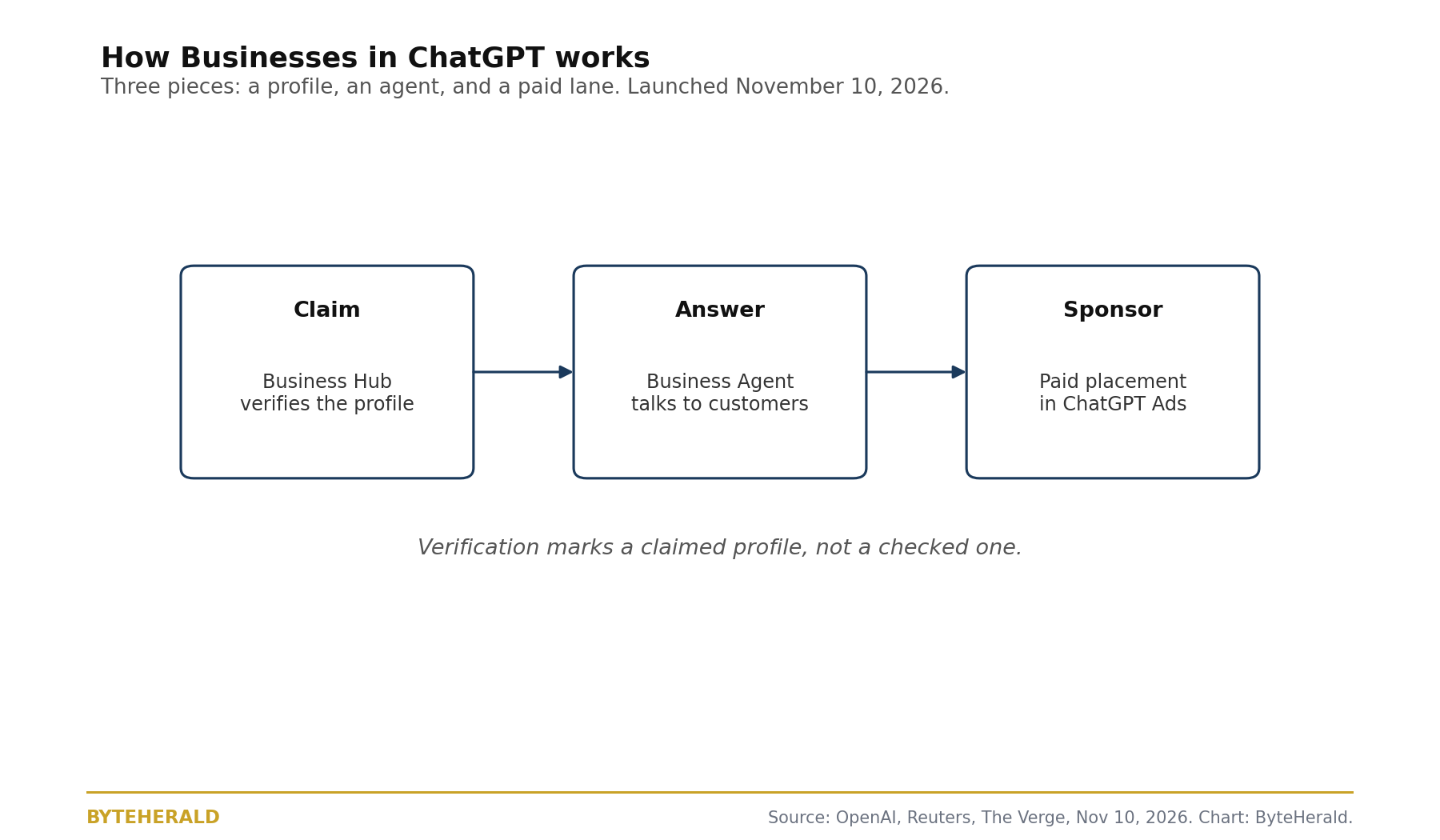
There are three pieces, and they do different jobs. The profile is the listing: a business claims its organization in Business Hub, gets it verified, and can then update key details and add product feeds with pricing and availability. The insights are the dashboard: aggregated mentions, views, and website clicks, showing how often ChatGPT talks about the business and what people click through to. The Business Agent is the salesperson: a verified agent that represents the brand inside ChatGPT, answers questions about its offerings, and handles follow-ups such as the differences between two products, with the business setting the agent's instructions and providing its business context. Chats with a Business Agent are clearly labeled and separate from the main ChatGPT conversation.
| Piece | What it does | Who gets it |
| Business Hub profile | Claim, verify, update details, add product feeds | Eligible businesses where ChatGPT is available |
| Insights | Aggregated mentions, views, website clicks | Verified businesses, above volume thresholds |
| Business Agent | Answers customers inside ChatGPT, labeled and separate | Eligible US ecommerce and online-service businesses |
The evergreen part is the listing itself. A claimed profile feeds verified facts into the answer, while an unclaimed business is described from whatever the web says about it. That is the same trade every business listing has made since Google Business Profiles: control the facts, or let the internet describe you. The difference is that ChatGPT's answer is a conversation, not a search result, so the profile does not just sit on a page. It shapes what the assistant says.
How a business gets in
A business claims its organization through a text or phone call to its main business number, or through DNS verification, and then manages it in Business Hub. Existing OpenAI Enterprise customers and advertisers work with their OpenAI representative to claim their business, while Shopify merchants can connect their stores through Business Hub or the Shopify admin. The launch is limited to eligible ecommerce and online-service businesses in the United States, and OpenAI has not stated what claiming a profile costs, or whether it costs anything at all. The price that is public is the one on the other side of the product: the sponsored agent.
The blue check is not a fact check
A claimed profile displays a blue check, but the check marks a claimed profile, not a checked one. OpenAI does not verify every business-supplied detail or resolve every factual dispute, and profiles may include information from other sources, according to the Businesses in ChatGPT profile policy. The company is not sharing specifics about its verification methods, saying only that there are different methods for different businesses, according to Benji Shomair, its vice president of monetization, in a press briefing. Verification alone does not guarantee agent eligibility either: OpenAI considers both the business category and the intended use before publication. The check tells a user that a business claimed this profile. It does not tell the user that everything in it is true, and the first businesses' tests that gap will be the first real test of the product.
What OpenAI does not share
The privacy line is the part users will care about most, and it is drawn clearly. OpenAI does not share users' conversations or Business Agent chats with businesses, and the insights a business sees are aggregated, available only when there are enough conversations or interactions about certain thresholds. A business learns how often it is mentioned and what people click. It never sees what any individual typed. OpenAI's line, that a business never sees your chats, lands the same week Google said human reviewers can see some Gemini files and emails. We reported that change last night. Google's September 2023 promise that Gemini files would not be seen by human reviewers was updated in October 2026 to allow human review in limited circumstances, and the contrast with OpenAI's rule here is the whole point. One company is opening its chatbot to businesses while keeping user chats away from them. The other is opening its users' files to human reviewers. Both moves happened in the same week.
Who gets paid
The money is in the agent, not the profile. Businesses can sponsor their Business Agent and use it as the destination for ChatGPT Ads, with sponsored placements labeled, which means OpenAI sells the ad placement, the business pays to be the destination, and the user gets the agent instead of a link. The shape is Google's: Google Business Profiles are free and universal, and Google makes its money on the ads around them. OpenAI is building the same shape inside a chatbot, starting narrower, with US ecommerce and online services first, and with the paid lane open on day one. The ad revenue at stake is the market we mapped last week: US retail media is projected at 74.4 billion dollars, with Amazon and Walmart holding 88 percent of it, and every shopping agent is now chasing a piece of that total. This is also the third layer of OpenAI's commerce stack, after Instant Checkout in September 2025 and Universal Cart in October 2026: first the checkout, then the cart, now the business itself, with an agent attached.
What to watch
First, the rollout: who gets eligibility next, and whether non-US businesses follow, or whether the product stays an American ecommerce feature. Second, the first impersonation test of the blue check, because a verification mark that does not verify details will be tested by someone. Third, pricing: OpenAI says running a Business Agent is free, so the open questions are the cost of claiming and the sponsored-agent rate, and the sponsored rate is the number that will tell the market how much this is worth. And fourth, whether sponsored agents change what ChatGPT recommends, because an agent that pays to be the destination and an assistant that is supposed to give the best answer are two roles that will eventually collide.
By ByteHerald Staff. Reuters reported on November 10, 2026, that OpenAI launched Businesses in ChatGPT, that Business Hub lets companies claim their business and, once verified, update key details and add product feeds with pricing and availability, that Business Agents will let people chat with an agent from a business in ChatGPT, that businesses can sponsor their Business Agent as the destination for ChatGPT Ads, with sponsored placements labeled. Search Engine Roundtable reported on November 10, 2026, that a business can claim its organization through a text or phone call to its main business number or through DNS verification, and quoted OpenAI's announcement that Businesses in ChatGPT is in beta and connects businesses with the 1.2 billion people who use ChatGPT each week. The Verge reported on November 10, 2026, that chats with Business Agents are clearly labeled and separate from the main ChatGPT conversation, and that OpenAI uses different verification methods for different businesses, according to Benji Shomair, vice president of monetization. Unite.ai reported on November 10, 2026, that a claimed profile displays a blue check but claiming does not guarantee higher placement or sales, and that OpenAI does not verify every business-supplied detail or resolve every factual dispute.
Comments
Post a Comment