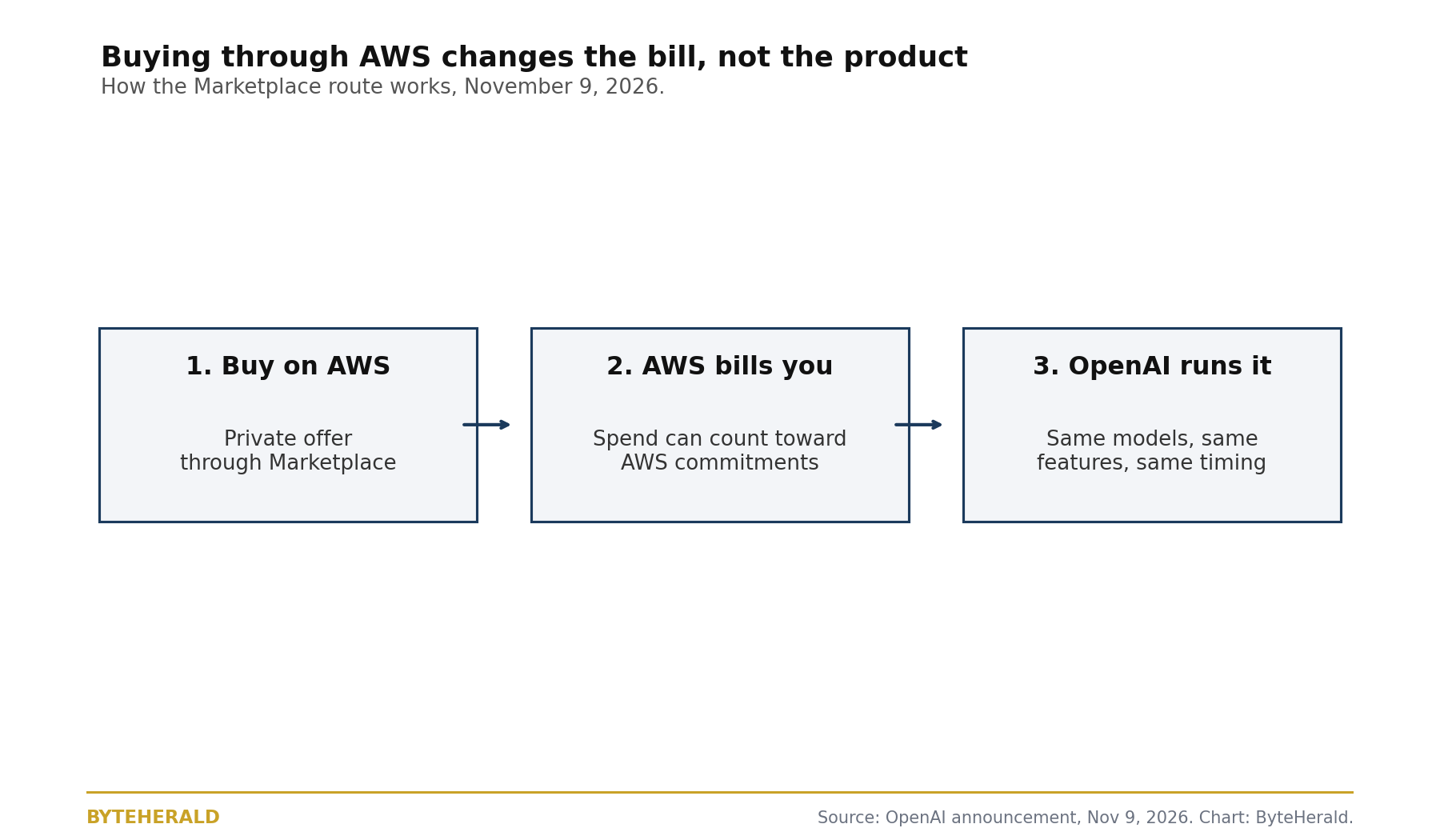
OpenAI made ChatGPT Enterprise available through AWS Marketplace on November 9, 2026, letting organizations buy the workplace AI service through the AWS purchasing and billing relationship they already have. Eligible spending can count toward AWS commitments. Nothing about the product itself changes: the same models, the same features, and new features released at the same time as for customers who buy directly from OpenAI.
The move is commercial, not technical, and that is the point. OpenAI is selling the same Enterprise bundle through a channel enterprises already use to buy software, and the buyer that benefits most is the one with an AWS commitment to burn down. The buyer that should pause is the one that assumes buying through AWS means its data stays on AWS. It does not, and the listing says so in plain language.
What changes, and what does not
| Through AWS Marketplace | Direct from OpenAI | |
| Where you buy | AWS Marketplace, through your existing AWS purchasing relationship | OpenAI sales, through a direct contract |
| Who bills you | AWS, alongside the rest of your software spend | OpenAI |
| Commitment drawdown | Eligible spending can count toward AWS Enterprise Discount Program or Private Pricing Agreement commitments, subject to your agreement | Does not apply |
| Price | Private offer, no public price; quote based on requirements and eligibility | Private offer, no public price |
| Models and features | Same as direct, new features at the same time | Same as Marketplace |
| Who runs the product | OpenAI; AWS handles purchasing and billing | OpenAI |
| Data training default | Business data is not used to train OpenAI models by default | Same |
The bundle is the full Enterprise suite: Chat for conversational work, ChatGPT Work for delegated research and multi-step projects that produce documents, presentations, spreadsheets, and reports, Codex as the coding agent, and dots, the always-on agents that track updates and keep documents and analyses current. Eligible customers can also access ChatGPT for Healthcare and ChatGPT for Financial Services through the Marketplace, with eligibility confirmed through an OpenAI or AWS account team.
The fine print buyers should read
Three details in the listing deserve a buyer's attention before signing. First, the price. There is no public price, and the commitment benefit is conditional: eligible spending can count toward an AWS commitment, but only as far as the customer's own AWS agreement allows, and customers should confirm eligibility with their OpenAI or AWS account team. A buyer that assumes the drawdown is automatic will be disappointed.
Second, residency. The listing distinguishes two kinds of residency that buyers often confuse. Data residency controls where supported customer content is stored at rest. Inference residency controls where model inference on that content runs. Published reporting on OpenAI's residency documentation says AWS Marketplace workspaces can select inference residency only in the United States. The options apply only when enabled, are not available in all regions, and do not cover all processing or systems data. A buyer outside the United States that needs inference to run in its own region should check this before committing, not after.
Third, the data-location guarantee that does not exist. The listing explicitly says that buying through AWS Marketplace does not guarantee that all customer data remains on AWS infrastructure or within the customer's AWS environment. OpenAI is the data processor for ChatGPT Enterprise and engages subprocessors, including AWS. The Marketplace label describes how the software is sold, not where the data lives. Business data is encrypted at rest and in transit, and administrators can manage user access, permissions, and connected tools, while users control what agents can access and which actions require approval, but none of that is a promise that data never leaves AWS.
Enterprise or Bedrock: which route is which
OpenAI positions the two AWS routes as complementary, not competing. ChatGPT Enterprise is the workplace product: teams across a business use it for their daily work. OpenAI models on Amazon Bedrock are for developers building applications and agents inside AWS environments. The distinction matters because the two routes have different buyers inside the same company, and buying one does not buy the other.
The Marketplace listing follows the April 28, 2026 expansion of the OpenAI and AWS partnership, in which OpenAI models on Amazon Bedrock, Codex on AWS, and Amazon Bedrock Managed Agents powered by OpenAI launched in limited preview. It also follows a multi-year, 38 billion dollar compute agreement the two companies signed in November 2025. The partnership has been moving in one direction for a year: OpenAI's products deeper into AWS's commercial plumbing, while OpenAI keeps running the products itself.
The spend behind that plumbing is large, which is why the procurement route matters at all. Enterprise buyers were spending on AI at an annualized run rate of 176.8 billion dollars as of September 2026, according to Menlo Ventures, and the buyers deciding between a direct contract and a Marketplace purchase are deciding how a slice of that spend flows through their own procurement. That figure is a run rate, not money already spent during 2026, and it is a Menlo estimate based on a survey of about 400 United States enterprise decision-makers conducted September 8 to 26 by Morning Consult. And buyers weighing the Enterprise bundle should know one more thing about the product they are buying: ChatGPT and Codex will share one usage limit from December, so the bundle's two most used tools draw on the same allowance.
How AWS Marketplace commitments work
The mechanism behind the headline is the AWS Enterprise Discount Program, or EDP, and the Private Pricing Agreement, or PPA. Large AWS customers commit in advance to a level of AWS spending over several years, in exchange for discounted rates. Spending that counts toward the commitment helps the customer meet a target it has already agreed to, which makes a Marketplace purchase effectively cheaper than the same purchase outside AWS, even at the same sticker price.
That is the real reason vendors list on the Marketplace, and the real reason buyers ask for it. The trade-off is that commitment spend is a target, not a discount on its own: a customer that buys through the Marketplace to hit a commitment it would otherwise miss is spending money to save money, and the saving only exists if the purchase was worth making in the first place. The Marketplace route is a better way to buy ChatGPT Enterprise if you were going to buy it anyway and you have AWS commitment to use. It is not a reason to buy it.
The judgment call
The Marketplace route wins for the buyer that is already an AWS shop, has commitment to burn, and wants procurement, billing, and governance in one place. Matt Yanchyshyn, vice president of AWS Marketplace and Partner Services, put it as buying "through their AWS account, govern it alongside the rest of their software spend, and move from evaluation to rollout faster." The direct route wins for the buyer that needs inference residency outside the United States, or wants OpenAI as the single contracting party, or finds the private offer no better than the direct quote. Either way, the product is the same, the bill is different, and the data-location question has to be answered separately from the purchasing question, because the listing answers them separately.
By ByteHerald Staff. OpenAI's announcement of November 9, 2026, said ChatGPT Enterprise is available through AWS Marketplace, with eligible spending counting toward AWS commitments and the same models, features and release timing as direct purchase. The AWS Marketplace listing, as reported on November 10, 2026, names OpenAI as the seller, requires a private offer with no public price, and states that buying through the Marketplace does not guarantee that all customer data remains on AWS infrastructure. Menlo Ventures' 2026 State of Enterprise AI, published November 3, 2026, estimated enterprise AI spending at an annualized run rate of 176.8 billion dollars as of September 2026, based on a survey of about 400 United States enterprise decision-makers conducted September 8 to 26 by Morning Consult. OpenAI and AWS announced the April 28, 2026 expansion of their partnership covering OpenAI models on Amazon Bedrock, Codex on AWS and Amazon Bedrock Managed Agents, and signed a multi-year 38 billion dollar compute agreement in November 2025.
Comments
Post a Comment