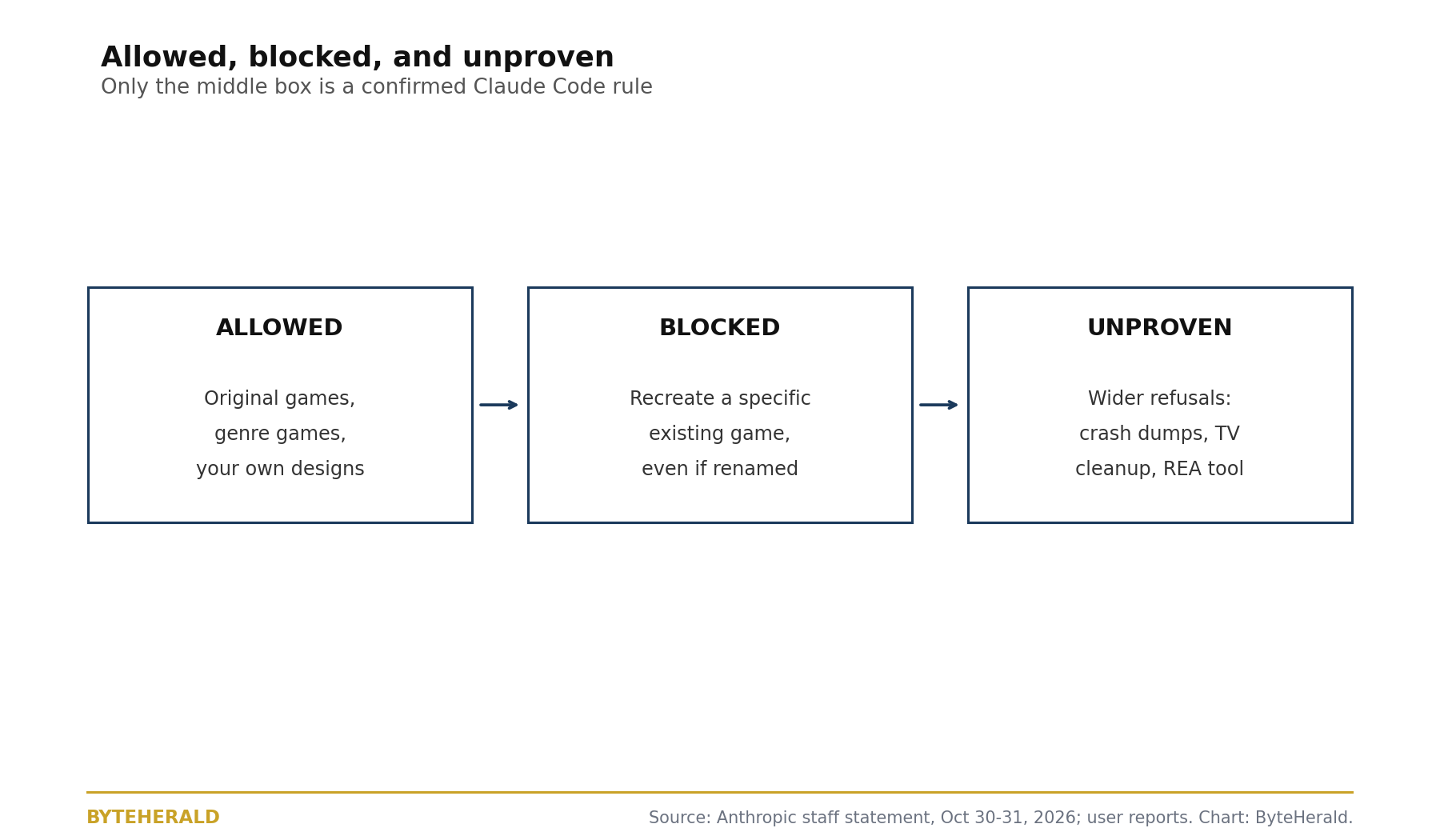
Anthropic has added a rule to Claude Code, its coding tool running on Opus 5.5, that steers it away from recreating a specific existing video game, even if the copy is renamed or described as original, according to a statement from Anthropic technical staff member Addy Osmani reported on October 30 and 31, 2026. Original games, games in a genre, and games built from a user's own designs and assets are meant to keep working. The rule is narrow on paper, and the argument around it is wider: developers also report refusals for ordinary reverse engineering work, and those wider refusals are not confirmed as a separate policy.
The confirmed rule, and how it surfaced
The change first surfaced around October 27, 2026, when a user posting as Chasm reported that Claude Code had picked up a server side instruction under an internal flag named tengu_heron_brook, with no user setting to switch it off. Reporting based on the Claude Code binary says the instruction appeared in version 2.1.314, and that a separate mechanism can apply it to Opus 5.5 on its own. Osmani then explained the reasoning in a reply on X: Anthropic added two sentences to Claude Code's prompt on Opus 5.5 to steer it away from recreating someone else's specific game, because using Claude to infringe intellectual property is against its usage policy, and Anthropic will continue to iterate to strike the right balance.
That sequence matters for how much weight to put on the rule. The existence of a game recreation instruction is now confirmed by Anthropic staff, not only by users. The exact internal flag and version are reported from the binary and from user observation, not from an Anthropic release note. The rule itself is a prompt level instruction, not a licensing system and not a hard filter. Prompt level rules guide a model; they do not guarantee that every rephrased request will be caught, and they do not define, in the reported wording, what counts as a recreation when a game shares a genre, a mechanic, or a look.
| Request | What the rule intends | Why it is hard in practice |
|---|---|---|
| Build an original game from your own design | Allowed | Originality is judged from the prompt, not from assets |
| Build a farming sim or a deck builder, as a genre | Allowed | Genre and specific game can blur in a detailed prompt |
| Rebuild a named commercial game, renamed | Blocked | Renaming does not change the underlying recreation |
| Rebuild a named game described as original | Blocked | The label in the prompt does not control the output |
| Work on your own licensed adaptation | Meant to work, but reports say some cases were refused | The model cannot verify a license from the prompt alone |
Why developers were asking for a line at all
The rule did not arrive in a vacuum. Opus 5.5 proved unusually good at reverse engineering code, with effects ranging from fast decompilation of old console games to jailbreaking a PS5, according to reporting on the change. Developers reported AI assisted clones piling up on Steam, and some studios changed their plans because of it. Digital Sun, the Valencia developer behind Moonlighter, cancelled a planned public Steam playtest for its upcoming title ReVamp, saying a large public build felt like too much risk if it could be reverse engineered, cloned, and released before the original.
That context explains the rule's target, and also its limit. Steam's clone problem is a distribution problem: what gets listed, and what Valve does about it. Valve has acknowledged an AI slop problem on Steam but has been reluctant to simply ban AI coding tools, according to the same reporting. A prompt rule in Claude Code changes what one tool will build. It does not change what Steam will list, what an open weight model will build, or what a determined user will build by rephrasing a request or switching tools. Players are unlikely to notice the change directly, because it affects what Claude builds rather than what Steam lists.
The wider refusals: reported, not confirmed
Separate from the game rule, Tom's Hardware reported a wave of complaints on Claude Code's GitHub page and on Reddit and other platforms. Developers said Claude refused standard game work halfway through development, refused to replicate a game mechanic, and refused to patch a tabletop style game. Other reports described refusals to analyze a simple Windows crash dump, to clear junk software from a Samsung TV, and to use the Reverse Engineer Anything tool at all. Purported game developers also said Claude blocked anti cheat development and security reviews for their own games, on the grounds that its safeguards were triggered.
Those reports deserve careful handling, because they mix three different things. First, a game mechanic is not a game. Replicating a mechanic, in the abstract, is not the same as recreating a specific title, and a refusal there would be overblocking if the mechanic is generic. Second, a crash dump or TV junkware cleanup is not a game at all, and a refusal there would point to a different safeguard, not to the game rule. Third, anti cheat and security review work for a developer's own game sits in the middle: it is legitimate work on a real product, but it involves exactly the kind of code inspection that a cloning safeguard might misread.
Anthropic's separate Cyber Verification Program, introduced on October 6, 2026, is the most obvious alternative explanation for some security related refusals, but it is not proven as the cause of these reports. Under that program, access to the advanced cybersecurity capabilities of Anthropic's frontier models is limited to organizations covered by Project Glasswing. The timing cuts against a simple link: the program took effect weeks before the refusal reports, which only appeared in about the last week before Tom's Hardware reported them. A reader should treat the program as context to investigate, not as an established cause.
One test reported by XDA Developers points the other way, toward a narrower rule. In that outlet's tests, Opus 5.5 refused to recreate Pokemon Diamond and cited its session instructions, yet the same model agreed to help with a Pokemon Diamond decompilation project, offering to turn disassembled functions into readable C, rebuild the ROM from the user's own copy, and write tooling, and it also agreed to help with a static recompilation that would run the game natively on Windows. If that test is accurate, the rule as implemented distinguishes building a clone from working with code the user already has, even for the same title. That distinction is exactly what developers need Anthropic to state clearly, because a prompt rule that cannot tell those cases apart will keep producing both clones and false refusals.
What developers should actually test
The practical question for a developer is not whether Anthropic has a rule, but whether their own work survives it. Four checks separate the confirmed rule from the noise. First, can Claude build a new game in a genre, with no named title in the prompt, from start to finish. Second, can it work on a project the developer owns, when the developer states that ownership and supplies their own assets, without the request being treated as a clone. Third, can it help with a non game reverse engineering task, such as reading a crash dump, that has no infringing output. Fourth, when it refuses, does it cite the game rule, a security safeguard, or neither, because the citation is the only clue about which system fired.
Osmani's reported offer to pass along cases where Claude rejects something that is genuinely the user's own work suggests Anthropic expects some collateral refusals while it tunes the wording. That is an admission worth holding onto. A rule that is meant to stop clones will, in its early form, also stop some legitimate work, and the fix is not a louder statement of intent but a testable distinction between a recreation, a genre game, and a developer's own project. Until Anthropic publishes that distinction, or a version of the rule that developers can read, the honest description is a confirmed game block with an unconfirmed wider spillover, and developers should report refusals with the prompt, the refusal text, and the model version attached, so the two can be separated.
The coding tool landscape is shifting under the same pressure. ByteHerald's coding assistant scorecard compared five AI coding assistants on the same tasks, and the Claude entry in that scorecard was measured before this game rule, so readers should not assume its refusal behavior in that test matches today's. The rule changes one assistant's behavior on one class of request. It does not settle whether coding assistants, in general, should be able to rebuild existing software, and it does not answer the harder question of who gets to decide when rebuilding is research, repair, or infringement.
By ByteHerald Staff. Anthropic technical staff member Addy Osmani stated on X, as reported on October 30 and 31, 2026, that Anthropic added two sentences to Claude Code's prompt on Opus 5.5 to steer it away from recreating someone else's specific game because using Claude to infringe intellectual property is against its usage policy, and that original games, genre games, and games from a user's own designs and assets are meant to keep working. Tom's Hardware reported on October 31, 2026, that users reported refusals for game work, crash dump analysis, Samsung TV junkware cleanup, and Reverse Engineer Anything tool use, and that Anthropic introduced its Cyber Verification Program on October 6, 2026, limiting advanced cybersecurity capabilities to organizations covered by Project Glasswing. XDA Developers reported testing in which Opus 5.5 refused to recreate Pokemon Diamond while agreeing to help with a decompilation project for the same title.
Comments
Post a Comment