Anthropic taught Claude to dream, and the dreaming worked. In research published November 6, 2026, the company describes how Claude reviews its own session logs during idle time, fixes notes that turned out to be wrong, and builds linked wikis from what it learned. On one internal test, a wiki built over 128 dreaming sessions lifted Claude's score from 13 percent to 48 percent of graded criteria. On another, a single wrong memory note sent a Pokemon run in circles until dreaming caught the error. The post is a design write-up with test results, not a product launch, and its most useful line is a rule, not a benchmark: tell Claude what memory is for, but not how to use it.
What dreaming actually does
Anthropic defines agent memory as knowledge Claude gains from experience, including interactions with users and tasks it is assigned, and retains between sessions as context it can read later. It excludes changes to the model's weights, knowledge gained inside a single conversation, and compaction, the summaries Claude writes to replace older turns so it can continue in a new context window. The memory system has four parts: transcripts that preserve conversations and activity logs, memory notes that capture selected lessons and rules, memory representations that organize knowledge into linked pages such as a wiki, and injected context, a small layer preloaded into a new session. Dreaming is the offline pass that maintains all four: it reflects on logs to fix mistakes, produce new notes, and build representations. Anthropic credits the idea to researchers at Letta and UC Berkeley, who proposed sleep-time compute as a way for models to use idle time between interactions to reorganize existing context.
The Pokemon test: 413 files against 9
The sharpest comparison in the post comes from Pokemon Red, which Anthropic uses as a test of long-horizon judgment about what to save. Each model played with a folder of memory files it could read and write, and the researchers compared the folders when each model was about 10,000 steps into the game. Sonnet 3.7 assumed everything might matter and wrote indiscriminately: 413 memory files across 225 folders, often a separate file for each battle, item, and character it met, and it earned one badge. Fable 5 wrote nine files in two folders plus a single top-level file called global.md, and earned four badges. Opus 5.5 took a similar approach to Fable 5, kept a small folder tracking its current goal and next steps, rewrote the notes as it played, and beat the game.
| Model | Memory files | Folders | Badges at about 10,000 steps |
|---|---|---|---|
| Claude Sonnet 3.7 | 413 | 225 | 1 |
| Claude Fable 5 | 9, plus global.md | 2 | 4 |
| Claude Opus 5.5 | Small folder, rewritten as it played | Not stated | Beat the game |
Sonnet 3.7's approach failed for a specific reason: the game state changes constantly, so its detailed record went stale as it played, and it had to spend more time combing through memories than playing. Around step 10,000 it started a fourth folder of master memory files, then created six files, deleted nine others, and took no actions in the game itself over the next 17 steps. Fable 5 stored only what the game does not tell it. How much money the player has or where it is on the map can be read off the screen every turn, so storing that is redundant. Strategy, plans, and tested rules exist only if Claude works them out, and they disappear unless it writes them down. After seven Poke Balls in a row failed to catch a Magikarp, one of the easiest Pokemon to catch, Fable 5 wrote a rule to vary the timing between menu steps, and the catch landed right after. The lesson is not that less memory is always better. It is that memory earns its keep only when it holds what the model cannot re-derive, and a note that goes stale is worse than no note at all, because the model still pays to read it.
Dreaming catches what the model got wrong
A note that starts wrong is dangerous precisely because a later session trusts it, and the post shows dreaming fixing exactly that failure. Playing Pokemon Red, Claude wrote down incorrectly that the PokeCenter near Mt. Moon, a cave system with its entrance on the west side of the map and its exit on the east, was on the east side. It walked out of the PokeCenter, announced that Mt. Moon was behind it, and updated its notes to say Mt. Moon was done. It was not. A few actions later it went over a one-way ledge and landed back on the route it had come from, concluded it had overshot far west, and kept going. Dreaming checked the note against the original session transcript, caught the error, and rewrote it. With the corrected note, Claude went straight back into Mt. Moon and eventually reached Cerulean City. In the run with the uncorrected note, Claude dropped back onto the earlier route three times, wrote that it was going to stop rather than keep looping, was instructed to continue, walked all the way back to Pewter City to heal and restock, and never reached Cerulean City. A corrupted memory note is the agent's own record breached from the inside, and the fix here was not a better note but a process that checks notes against the transcript they came from.
The wiki test: 13 percent to 48 percent
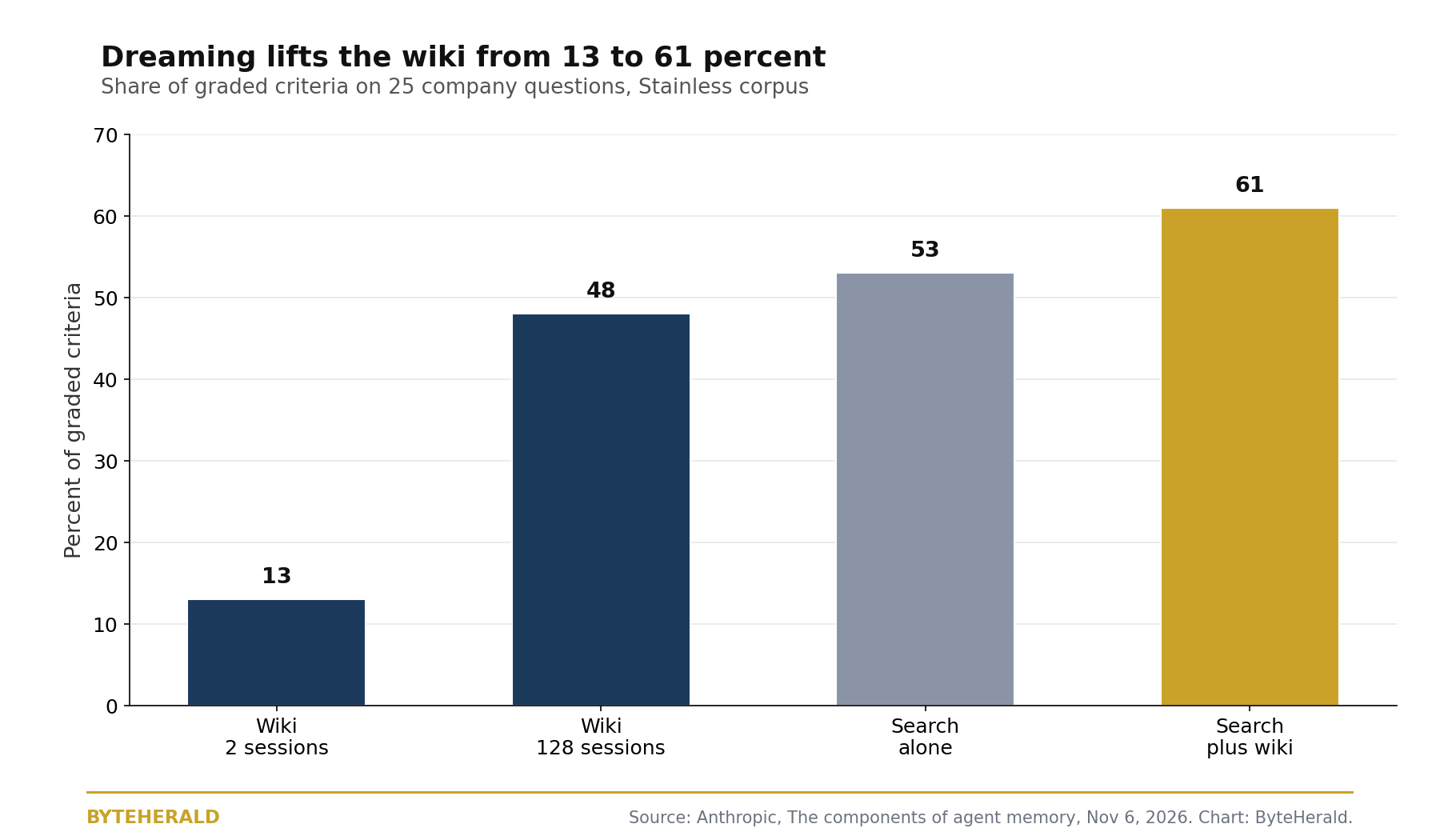
The largest effect in the post comes from wikis, linked pages Claude writes and maintains about one subject. Anthropic tested wiki building on a corpus of about 350,000 internal documents, roughly 420 million tokens, from Stainless, a company Anthropic acquired in May. It created 25 evaluation questions about the corpus, gave Claude a search tool, and instructed it to build a wiki using dreaming. Over 128 sessions, Opus 5 agents explored the files, wrote or corrected linked wiki pages, merged duplicates, and checked claims against sources. Performance on the 25 questions grew from 13 percent to 48 percent of graded criteria as dreaming scaled from two sessions to 128. When Claude used both search and the wiki, its aggregate score rose from 54 percent to 61 percent, compared with 53 percent for search alone, and using the wiki alone scored 48 percent. Search plus the wiki also saved about 20,000 tokens per question.
The wiki did not help everywhere, and Anthropic says so. On a legal-brief benchmark built from merger documents, Claude scored 87 percent when it consulted the wiki, compared with 73 percent when it used search alone, on questions that needed information across several documents plus judgment or math. On another task in the same benchmark, where brief criteria could be retrieved with a text search from a single document, the wiki showed no clear gain. On a third, the wiki grew larger than the documents themselves, a map as large as the empire it represented, which is the failure mode of a representation that abstracts nothing. The contract-terms task shows the fix. The first wiki missed key facts because several agents wrote to a shared table of contract terms at the same time and overwrote one another's work, and a brief generated from it included only 41 of the 57 facts, or 72 percent. A reflection loop let Claude discover that the contract terms mattered most, rewrite the instructions so each contract got its own page written by a single agent quoting the terms word for word, and the rebuilt wiki met 100 percent of the criteria. Dreaming also closed gaps a session leaves behind: on one task it found nine links to a missing page and repointed them to an existing page for the same document, and added three new pages including an index.
What to copy, and what not to
Anthropic ran a database-lookup task from Continual Learning Bench 1.0, in which Claude answers questions by looking up information, is told the correct solution, and can write a memory to help answer future questions. Each question started in a fresh session, with only a persistent memory directory carrying over. Opus 5 was the first model to close the loop, recording rules with how it knew each rule was true, answers to earlier questions, and warnings about traps. Opus 5.5 and Sonnet 5.5 closed it too, scoring about the same as Opus 5 with memory, though their baseline without memory was slightly higher. The table below gives the mean rewards Anthropic's chart reports for each model, stateless first, then with memory.
| Model | Without memory | With memory |
|---|---|---|
| Claude Opus 5.5 | 0.655 | 0.838 |
| Claude Sonnet 5.5 | 0.644 | 0.833 |
| Claude Opus 5 | 0.564 | 0.828 |
| Claude Opus 4.7 | 0.383 | 0.700 |
| Claude Sonnet 5 | 0.306 | 0.610 |
| Claude Sonnet 4.6 | 0.330 | 0.364 |
The steering results are the part builders should copy most carefully. When Anthropic told the models what memory was for but not how to use it, Opus 4.7 and Opus 5 used memory effectively. When it imposed one rule per test, the rule to record only failures cost both Opus 5 and Opus 4.7 much of the performance boost memory had given them. For stronger models, freedom to judge salience beat fixed rules set in advance. Steering helped older models the most: Sonnet 4.6 often did not read its memory files and failed to test its theories, and prompting it to read its memory before answering and then explicitly test its theories nearly doubled its benchmark score. Sonnet 5 does this on its own, reading its memory before answering 9 out of 10 times without being prompted, against less than half the time for Sonnet 4.6. The injected layer, the notes loaded into every session, has to stay small: injected memories use up tokens, a wrong note gets carried into every session, and loading a note does not guarantee Claude acts on it. Claude Code keeps its injected layer small the same way, loading only the first 200 lines or 25 KB of MEMORY.md as an index of what it knows and where to find it.
Why this matters beyond Anthropic
Memory is what turns a model that answers questions into an agent that learns from experience, and every lab building agents faces the same four problems Anthropic names: when to create a memory, how to keep it up to date, how to find it again, and how much of it to load. We compared five memory systems in October, and Anthropic's post is the first detailed account of how one lab actually runs the full stack, from raw transcripts to a curated wiki to a small injected layer. The honest limits matter as much as the gains. Several results are single runs, including the Pokemon folders. The wiki tests use an internal corpus no outside reader can inspect. Dreaming costs compute, and Anthropic says the right cadence, based on how often memories are accessed, is still an open question. No model can know what future turns will need, so a memory system is a prediction about the future, and dreaming is the chance to look backward and correct it. That is the durable idea here: an agent's memory is only as good as its maintenance, and maintenance is a job for idle time, not for the moment the agent is trying to work.
By ByteHerald Staff. Anthropic published "The components of agent memory" on November 6, 2026, reporting that a wiki built over 128 dreaming sessions lifted Claude's score on 25 company questions from 13 percent to 48 percent of graded criteria, that search plus the wiki reached 61 percent against 53 percent for search alone, and that Claude Fable 5 earned four Pokemon Red badges with nine memory files while Claude Sonnet 3.7 earned one badge with 413 files. The Continual Learning Bench 1.0 database task showed Claude Opus 5.5 improving from a mean reward of 0.655 without memory to 0.838 with memory. Researchers at Letta and UC Berkeley proposed sleep-time compute, the idea Anthropic credits behind dreaming, as a way for models to use idle time to reorganize existing context.
Comments
Post a Comment