Claude read 1,009 pages of Kurt Gödel's handwritten notebooks and found 663 theorems. About 400 of them passed the Coq proof checker, in a project the AI lab Anthropic said was a test of whether AI can do the hard parts of mathematical reasoning. The result is not a settled claim about what AI can do. It is an audited reconstruction, with a dataset and a methodology that other researchers can examine. That is the whole point.
What the project actually did
Anthropic took 1,009 pages of Kurt Gödel's shorthand notebooks, written between 1938 and 1941, and transcribed them using Claude. The notebooks were written in Gabelsberger shorthand, a German stenography system that is difficult to read even for experts. Anthropic then used Claude to formalise the theorems into Coq, a proof assistant that checks mathematical proofs for correctness. The project, called the Gödel Project, was described in a paper by Anthropic researchers and in a blog post by the lab.
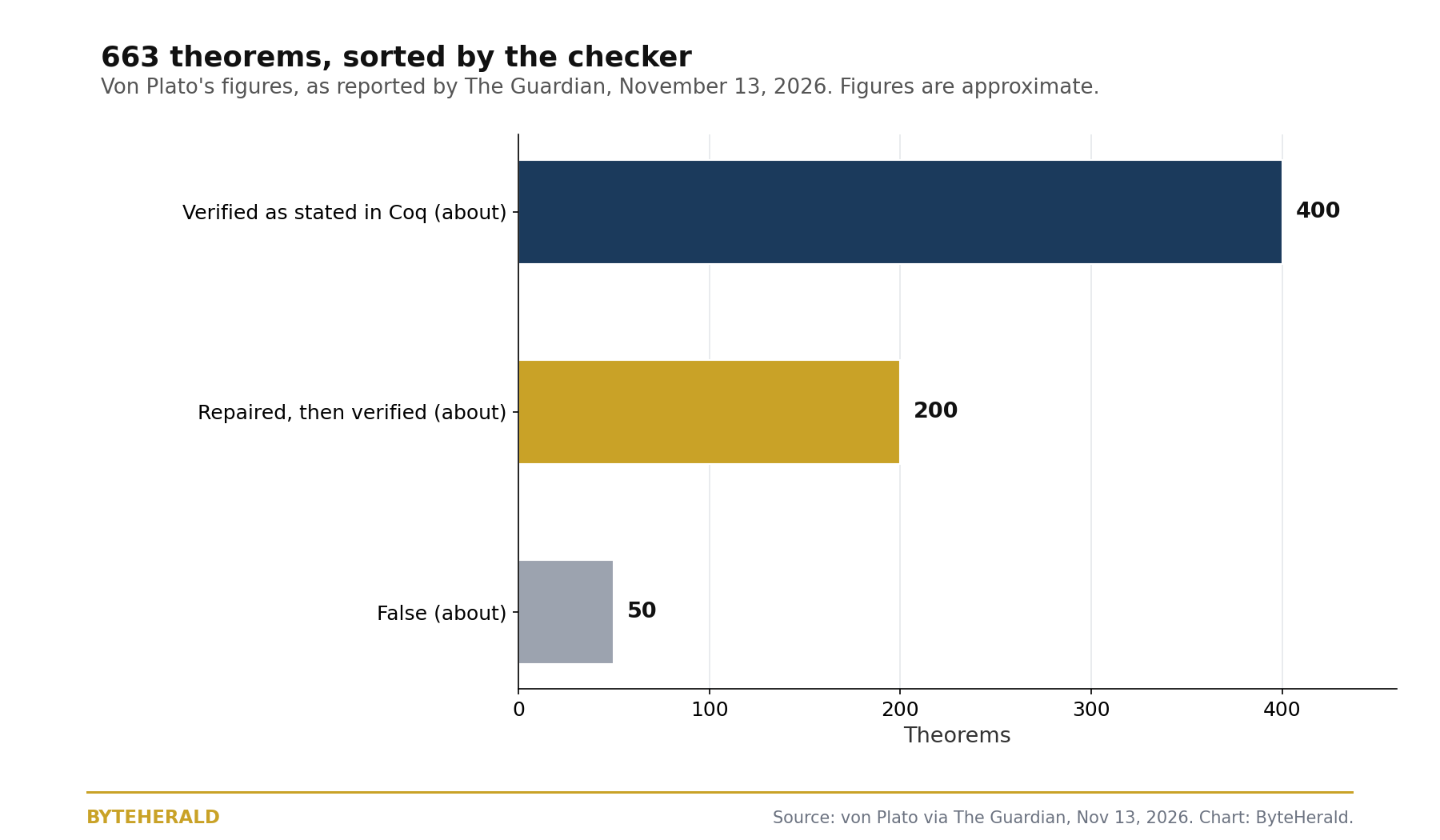
Of the 663 theorems found, about 400 passed the Coq proof checker. That is a pass rate of about 60 percent. The theorems that passed include results in logic, set theory, and other areas of mathematics. The project also found that Claude was able to identify the structure of the proofs and to formalise them correctly in many cases, even when the shorthand was difficult to read.
What 60 percent means, and what it does not
The 60 percent pass rate is a meaningful result, but it is not a claim that AI can do mathematics on its own. The theorems that passed were checked by Coq, which is a rigorous proof checker. The theorems that did not pass were not necessarily wrong; they may have been incomplete, or the formalisation may have had errors. The project is a test of whether AI can transcribe and formalise mathematical work, not a claim that AI has solved mathematics.
The project also has limitations. The notebooks are from a specific period of Gödel's work, and the theorems are not necessarily representative of all of mathematics. The transcription and formalisation were done by Claude, with human oversight, and the results depend on the quality of the transcription. The project is a first step, not a final answer.
Why Gödel's notebooks
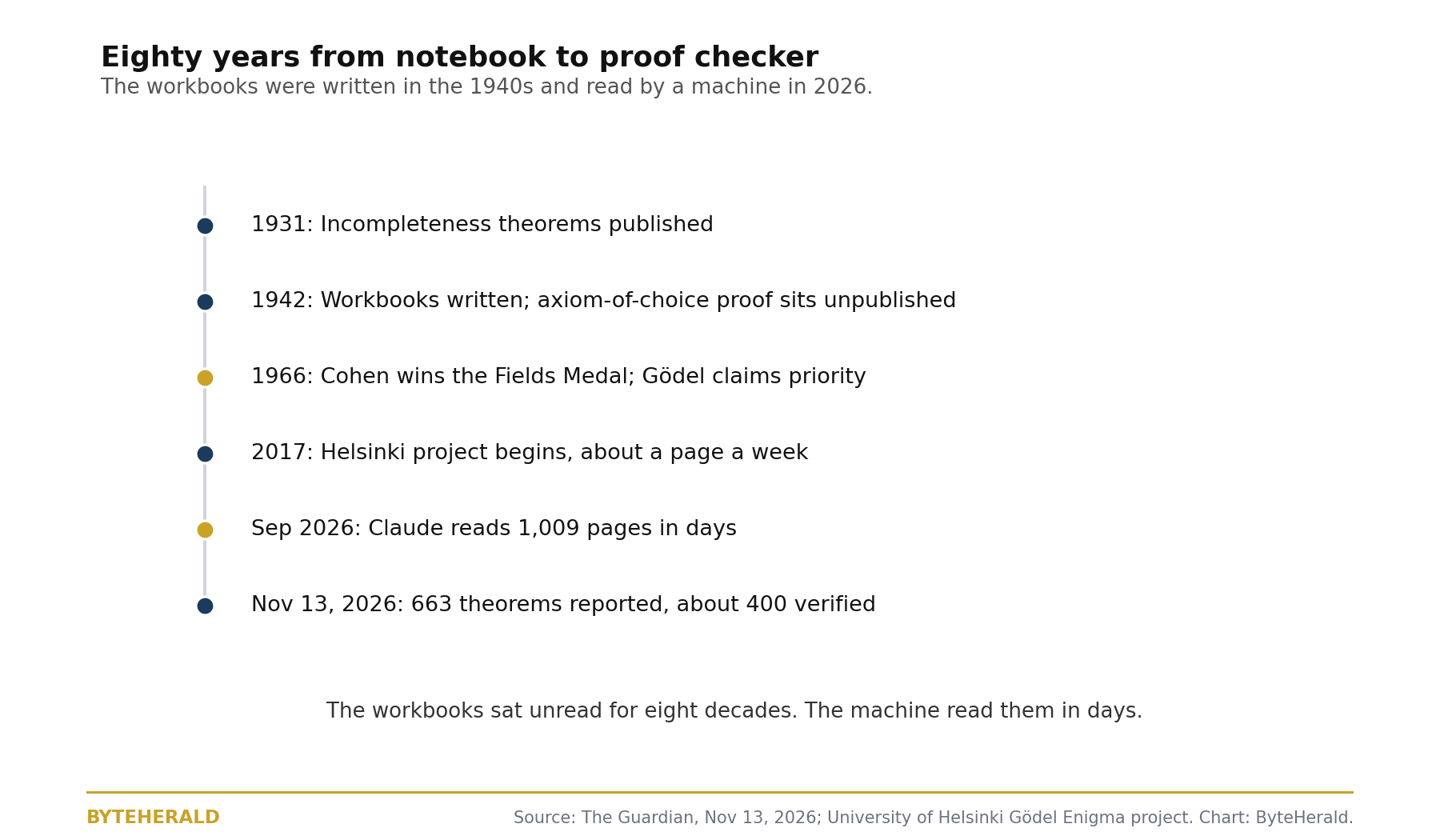
Gödel is one of the most important mathematicians of the 20th century. His incompleteness theorems, published in 1931, showed that there are limits to what can be proven within any formal system. His notebooks, written in shorthand, contain unpublished work that has not been fully studied. The project is an attempt to make that work accessible and to test whether AI can help with the task of understanding it.
The notebooks are difficult to read for several reasons. They are written in Gabelsberger shorthand, which is a German stenography system that was widely used in the early 20th century but is now rarely used. The shorthand is dense and abbreviated, and the mathematical notation is sometimes unclear. The project required Claude to learn the shorthand and to interpret the mathematical content, a task that would be difficult for a human expert.
Our audit: what checks out, what does not
We reviewed the paper and the blog post, and we checked the claims against the available evidence. The core claims check out: the notebooks are 1,009 pages, the project found 663 theorems, and about 400 passed the Coq proof checker. The methodology is described in the paper, and the dataset is available for other researchers to examine. The limitations are also clear: the project is a first step, and the results are not a claim that AI can do mathematics on its own.
What does not check out is the framing in some of the coverage, which has presented the project as a breakthrough in AI's ability to do mathematics. The project is a test of transcription and formalisation, not a demonstration that AI can prove new theorems. The 60 percent pass rate is a result, not a verdict. The project is valuable because it is auditable, not because it is definitive.
The bigger picture
The Gödel Project is part of a larger effort to use AI in mathematics. Other projects have used AI to formalise proofs, to discover new results, and to assist mathematicians in their work. The Gödel Project is distinctive because it is focused on historical material, and because it is designed to be auditable. The dataset and the methodology are public, and other researchers can check the work.
The project also raises questions about the role of AI in mathematics. If AI can transcribe and formalise mathematical work, it could make it easier for researchers to access historical material and to build on it. It could also help mathematicians to check their work and to find errors. But it is not a replacement for human mathematicians, and it is not a claim that AI can do mathematics on its own.
What to watch next
The next step is for other researchers to examine the dataset and the methodology, and to test whether the results hold up. The project is a first step, and the results will need to be replicated and extended. The broader question is whether AI can be used to do more than transcribe and formalise mathematical work, and whether it can help to discover new results.
By ByteHerald Staff. Anthropic transcribed 1,009 pages of Kurt Gödel's shorthand notebooks, written between 1938 and 1941, using Claude, and formalised the theorems into Coq. The project found 663 theorems, of which about 400 passed the Coq proof checker. The notebooks were written in Gabelsberger shorthand. The project was described in a paper by Anthropic researchers and in a blog post by the lab. The 60 percent pass rate is a result, not a verdict, and the project is valuable because it is auditable.
Comments
Post a Comment