Claude Fable 5.2 has solved two open problems in the physics of black holes, Anthropic reported on November 17, 2026. One is a calculation physicists set out in 2003 and never finished. The other is the exact limit of a method physicists have used since 2009 to test theories of quantum gravity. Neither result describes our own universe directly, and neither has a practical application. What they show is narrower and more interesting: an AI system doing original theoretical research, with its work checked the way physics demands.
The first problem: a calculation left unfinished since 2003
The problem starts with a simple question: what happens when you heat up a model universe? At low temperatures, the universe fills with a gas of particles. Above a certain temperature, a black hole forms instead. In 1983, Stephen Hawking and Don Page showed that the switch is abrupt, a phase transition similar to how water suddenly boils at 100 degrees Celsius. That calculation works where the universe is vast and spacetime has a definite shape, the way general relativity describes it.
But physicists also study the opposite end, where the model universe is small and spacetime loses any definite shape, becoming blurry. In 1999, physicists found that a phase transition happens in that regime as well. What nobody knew was whether it was abrupt, like Hawking and Page's, or smooth. In 2003, a group of physicists set out the calculation that would settle the question. It involved many thousands of terms, known as diagrams, far too many to work through by hand, and naive addition of the parts gives an infinite answer that has to be tamed carefully. The calculation was never completed.
Claude did it by running a small research group of copies of itself, in which it worked out almost every piece of the calculation independently and checked its math against known results. The answer is that the transition is abrupt. The same sudden switch appears at both extremes, in the smooth universe of relativity and in the blurry one, which suggests that black hole formation is built into the underlying quantum theory, not just a feature of relativity. The result carries a second check: weeks after one of the agents reached a solution, a physicist who had independently used Claude to tackle the same problem shared his result, and a colleague realized the two solutions matched, reached by different methods.
The second problem: the exact ceiling
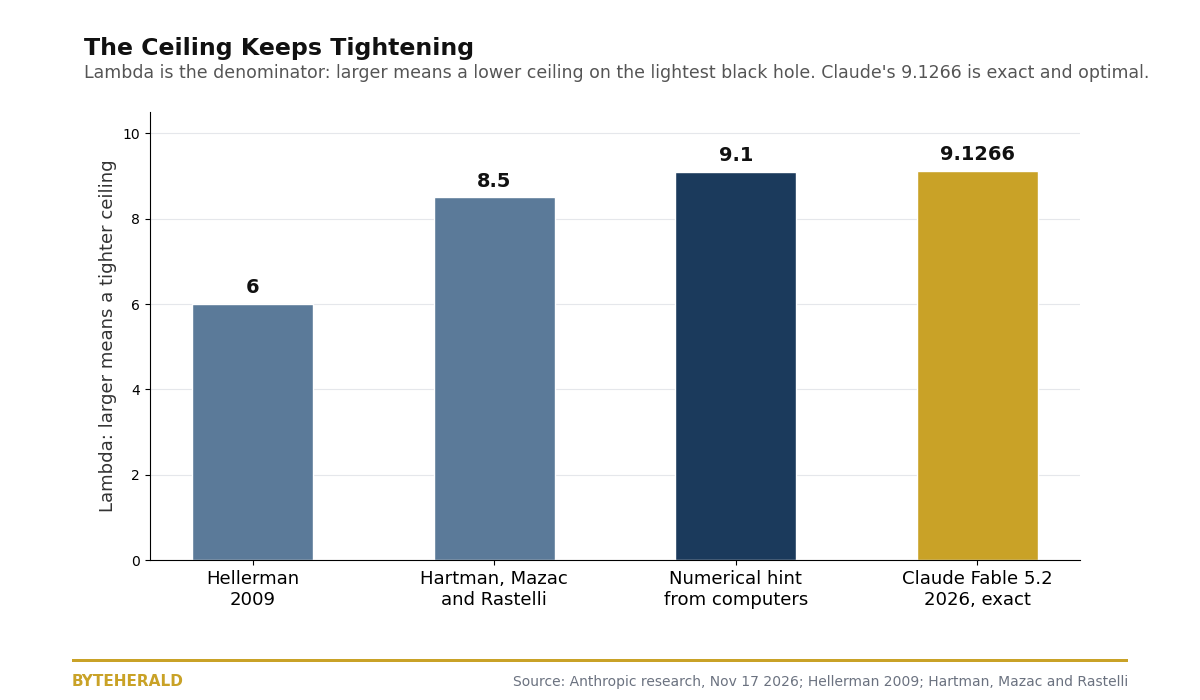
The second problem lives in a simpler model universe, with two dimensions of space instead of three, which physicists call 3D gravity because it describes gravity in three spacetime dimensions. Nobody knows how to write down a full theory of quantum gravity for it, so physicists work backwards: they try to rule out wrong theories by showing they contradict themselves. That method is called bootstrapping. Since 2009, physicists have used a version of it, the modular bootstrap, to set a ceiling on how heavy the lightest black hole in such a universe could be. Any theory that breaks the ceiling is ruled out, and each lowering of the ceiling narrows the search.
Physicists write the ceiling as M1 no larger than c over Lambda, where c roughly counts how many microscopic building blocks the universe is made of. In 2009, Simeon Hellerman proved the ceiling was c over 6. Tom Hartman, Dalimil Mazáč and Leonardo Rastelli later proved c over 8.5. Numerical calculations hinted the ceiling could go to about c over 9.1, but they could not prove it, and the best proven ceiling was well short of what the numbers suggested. Claude noticed a pattern in the numerical results that physicists had missed, borrowed a mathematical tool called a spectral curve from elsewhere in math and physics, and proved the ceiling is c over 9.1266, and proved that it cannot be lowered. It also showed that this version of the method cannot, on its own, push the ceiling down to c over 12, the mass at which black holes first appear. That will take other ingredients.
The route to the answer shows how the work actually happened. An earlier Claude agent had tried the same problem and failed in 61 parallel attempts. The winning approach came from a different agent, one working on a mathematically related problem about how tightly spheres can be packed into a high-dimensional space, which turned the pattern into a method. That method first reproduced a sphere-packing result recently proved by an OpenAI model, then applied the same idea to the bootstrap problem. Two other agents independently arrived at the same answer. In September, the results were formally verified in Lean, a computerized proof checker.
How the work was done
In August 2026, Anthropic researcher Hongbin Chen was testing Claude's capabilities as a side project. He asked Claude to draw up a list of interesting open problems in theoretical physics, specifically focusing on black holes and the bootstrap method. Claude came back hours later with 22 candidates, and Chen set up separate agents to work on each one. The agents could read each other's progress posts and collaborate when working on related problems, and they ran in the background, with no special setup, for about six weeks. The two problems in this post are the ones those agents solved. Claude wrote the papers with minimal guidance, and a physicist checked every main result. Both results are published as preprints. Fable 5.2 is the model Anthropic launched on November 9, 2026, the same model we covered in Claude Fable 5.2 Built an OS in 8 Days. It Costs 20% Less.
What this does and does not prove
The honest frame starts with what these universes are. Physicists study them through holographic duality: a theoretical universe with gravity can also be described as a quantum theory with no gravity at all, written on the universe's outer boundary, the way a flat hologram encodes a three-dimensional image. The two problems live in those model universes. They do not describe our own universe directly, and Anthropic says so plainly.
What the results do prove is specific. The Hawking-Page transition stays abrupt even where spacetime has no definite shape, which means the sudden switch is a property of the quantum theory underneath, not only of relativity's smooth description. The modular bootstrap, in its simplest form, cannot go below c over 9.1266, which tells physicists exactly where that tool stops and what other ingredients the search for quantum gravity will need. What they do not prove is the theory of quantum gravity itself. Neither result identifies the correct theory, settles whether spacetime emerges from something deeper, or comes close to doing so.
That distinction is also the reason the verification matters more than the headline. Anthropic's claims about its models are under unusual scrutiny this week: on November 18, 91 experts signed a statement saying the company is not a safe AI company, as we reported in 91 Experts: Anthropic Is Not a Safe AI Company, on IPO Eve. The research claims carry a verification chain the safety claims do not: a calculation done twice by independent agents, an independent physicist reaching the same answer by a different method, and a formal proof check in Lean. The value of this result is not that Claude said something, but that the proofs can be checked.
By ByteHerald Staff. Anthropic reported on November 17, 2026, in a research post updated November 18, that Claude Fable 5.2 completed the Hawking-Page phase transition calculation set out in 2003 and proved the modular bootstrap ceiling is c over 9.1266, that the work came from agents running for about six weeks after researcher Hongbin Chen asked Claude for 22 candidate problems in August, and that the bootstrap result was formally verified in Lean in September. The two preprints, "The Hawking-Page Transition at Weak Coupling" and "The Spinless Modular Bootstrap at Large Central Charge", are published on hexagonmath.org. ByteHerald reported on November 9, 2026, that Anthropic launched Claude Fable 5.2, the model behind both results.
Comments
Post a Comment